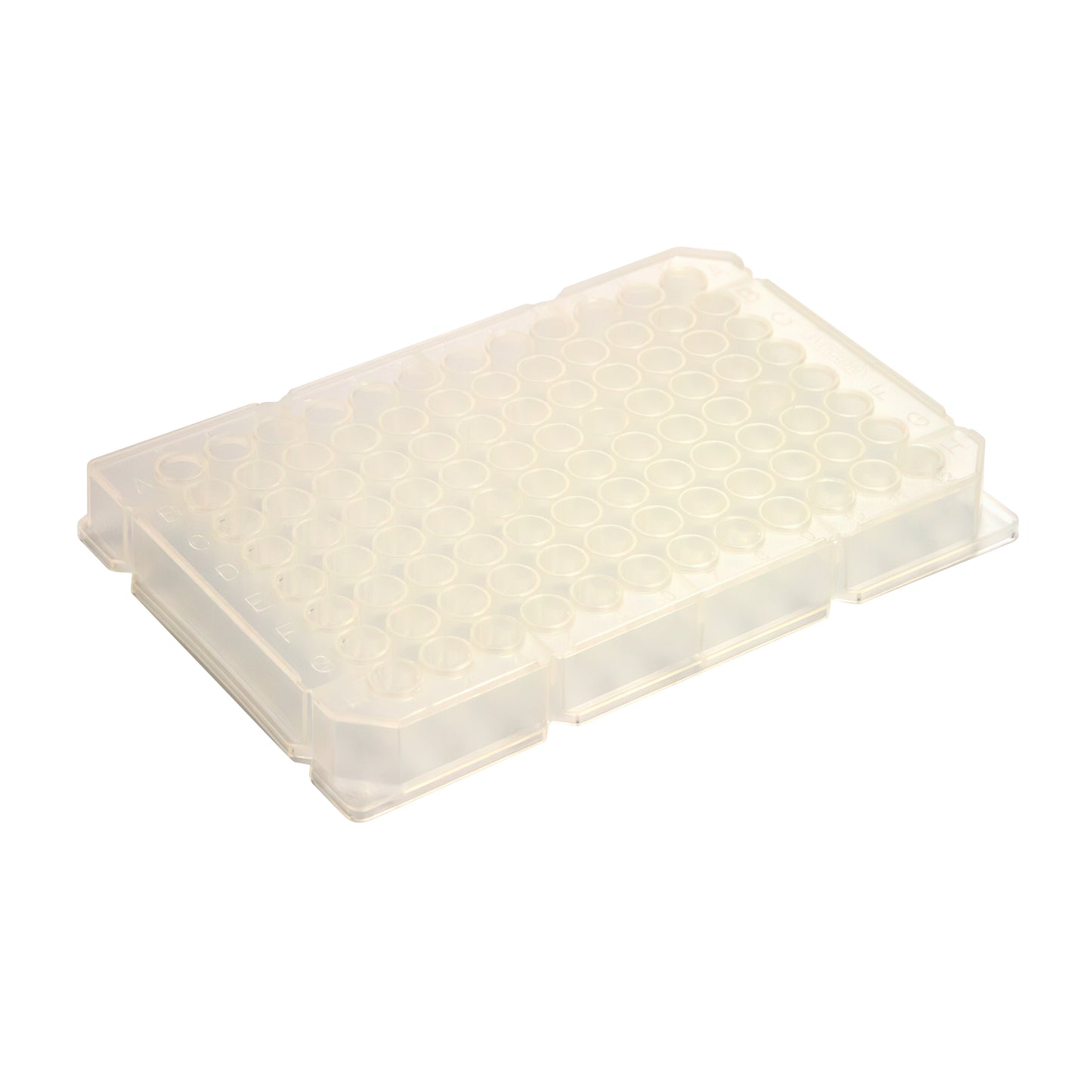

96-Well Round (U-Bottom) Microplates, 0.32 mL, Polypropylene — DMSO-Compatible & Autoclavable (290-8353-03R)
These 96-well polypropylene U-bottom microplates offer a 0.32 mL per-well capacity in the SBS/ANSI footprint, supplied 10 plates per box (100 plates per case) in natural (translucent) color. The round-bottom geometry allows suspension cells, beads, and particles to settle uniformly by gravity, enabling consistent supernatant aspiration and re-suspension across all 96 wells. Manufactured from polypropylene, these plates deliver full DMSO compatibility at all concentrations and autoclave tolerance at 121°C — capabilities that polystyrene U-bottom plates cannot match.
Technical Specifications
| Specification | Value |
|---|---|
| Part Number (MPN) | 290-8353-03R |
| Well Format | 96-Well, SBS/ANSI Footprint |
| Bottom Style | Round (U-Bottom) |
| Well Volume | 0.32 mL |
| Material | Polypropylene (PP) |
| Color | Natural (Translucent) |
| DMSO Compatibility | All concentrations |
| Autoclave Compatible | Yes — 121°C / 15 psi |
| BPA / Phthalates | BPA-free; no phthalate plasticizers |
| Pack Size | 10/Box (100/Case) |
| Country of Origin | USA (California) |
Applications
- Suspension cell culture with DMSO compounds: Lymphocytes, PBMCs, and other suspension lines treated with DMSO-formulated compound libraries benefit from PP's solvent tolerance and the U-bottom's uniform cell settling.
- Hybridoma culture: Plates can be autoclaved at 121°C prior to use, providing a sterile vessel for hybridoma and other suspension culture workflows without purchasing pre-sterilized supply.
- HAI and agglutination assays: Buffer formulations containing organic co-solvents, preservatives, or high-concentration detergents are safe in PP U-bottom wells, where such media can stress-crack polystyrene.
- Compound-treated suspension cell assays (drug discovery): Round-bottom geometry pellets cells consistently for supernatant removal between compound treatment steps.
- Bead-based assays in DMSO matrices: Magnetic bead assays and cytokine bead arrays run in DMSO-containing buffers are reliably accommodated by the PP construction.
- Serial dilutions with organic-solvent diluents: Dilution series prepared in DMSO, alcoholic buffers, or mixed organic/aqueous diluents remain compatible throughout the plate lifetime.
- Immunoprecipitation with DMSO-containing lysis buffer: PP's broad solvent resistance extends utility to IP bead workflows where DMSO is present in the lysis or wash buffer.
Compatibility
These plates serve as the DMSO-tolerant and autoclave-compatible upgrade to the Caplugs® Evergreen PS U-bottom microplate (290-8117-01R). When workflows are limited to standard aqueous samples with no solvent exposure and sterility is not required, the polystyrene variant is an economical choice. However, any protocol that includes DMSO compound delivery, high-concentration organic co-solvents, or pre-sterilization by autoclaving should specify the polypropylene plate offered here. The SBS/ANSI-compliant footprint ensures compatibility with standard liquid-handling workstations, plate readers, and robotic systems designed for the universal 96-well format.
Chemical Resistance
| Reagent / Condition | Compatibility |
|---|---|
| DMSO — all concentrations | Excellent |
| Aqueous buffers / saline / PBS | Excellent |
| Dilute acids and bases | Excellent |
| Ethanol / isopropanol | Good — short-term contact |
| Detergents (Tween, Triton, NP-40) | Good |
| Autoclave (121°C / 15 psi) | Compatible |
| Chlorinated solvents (chloroform, DCM) | Not recommended |
| Aromatic solvents (toluene, xylene) | Not recommended |
Quality & Procurement
Made in USA (California), these Caplugs® Evergreen microplates are produced from BPA-free, phthalate-free polypropylene resin under ISO 9001 quality management. LabSupplies.com is an authorized dealer of Caplugs® Evergreen laboratory consumables and ships from USA inventory.
Frequently Asked Questions
Can I autoclave these plates before use for sterile cell culture?
Yes. The polypropylene construction is autoclave-compatible at 121°C / 15 psi, making pre-sterilization straightforward for suspension cell culture workflows that require a sterile plate supply.
Why choose this PP U-bottom plate over the polystyrene U-bottom (290-8117-01R)?
Polystyrene U-bottom plates are well suited to standard aqueous assays but can stress-crack when exposed to high concentrations of DMSO or aggressive organic co-solvents, and they cannot be autoclaved. When your protocol involves DMSO compound delivery, solvent-containing buffers, or autoclave pre-sterilization, the polypropylene plate offered here is the appropriate choice.
Are these microplates compatible with standard plate readers and liquid-handling robots?
Yes. The plates conform to the SBS/ANSI 96-well footprint, which is the universal standard accepted by plate readers, automated washers, and liquid-handling workstations from all major instrument manufacturers.
Do these plates come sterile, and are they available by the case?
The plates are supplied non-sterile, 10 per box, and are available in case quantities of 100 plates. Sterility can be achieved by autoclaving prior to use. Contact LabSupplies.com for case pricing and institutional volume programs.