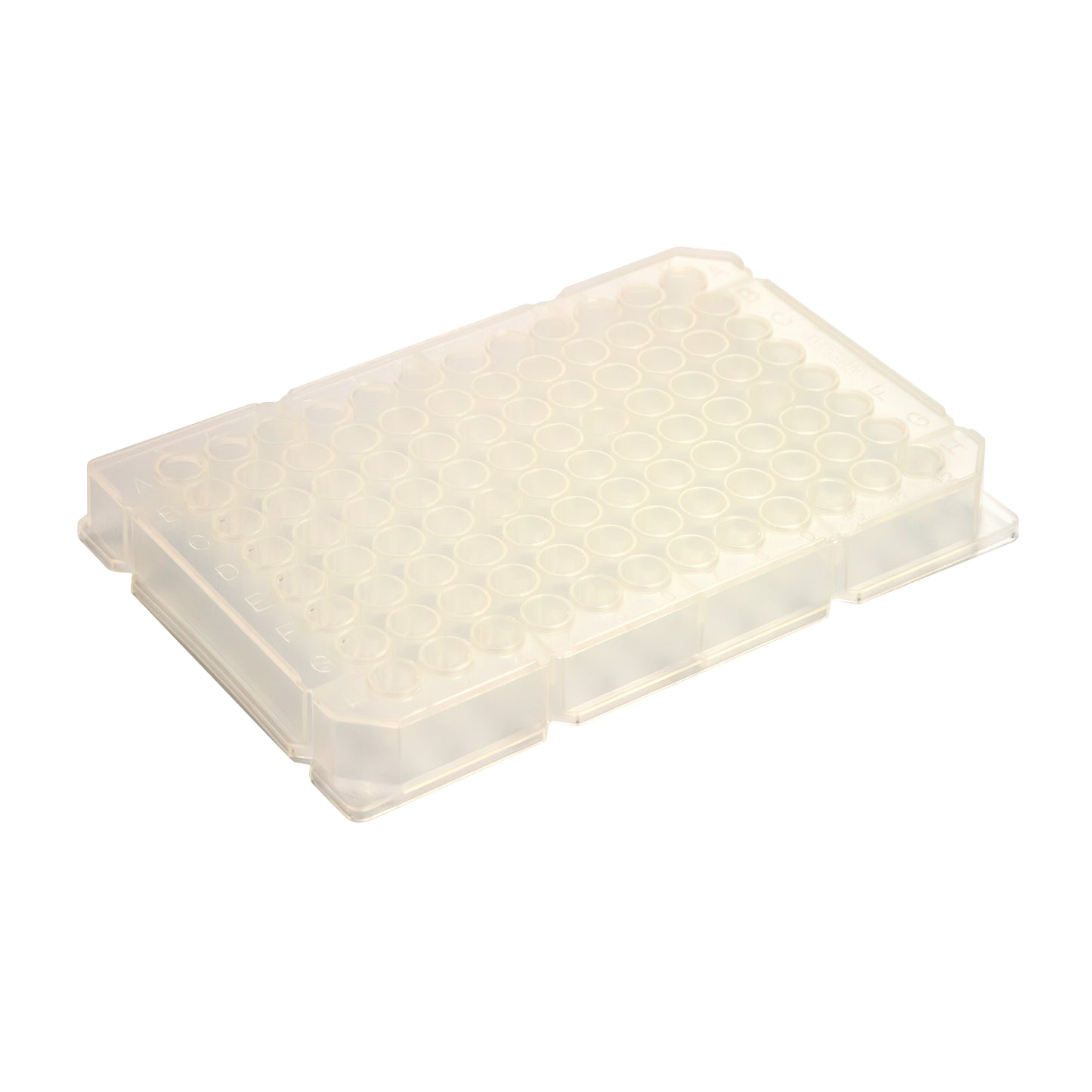

96-Well Flat-Bottom Microplates, 0.37 mL, Polypropylene — DMSO-Tolerant & Autoclavable (290-8350-03F)
These 96-well flat-bottom polypropylene microplates offer a 0.37 mL per-well capacity in the SBS/ANSI standard footprint, combining full DMSO compatibility and autoclave sterilization capability in a format that is otherwise geometry-identical to conventional PS 96-well plates. Supplied non-sterile in boxes of 10 (100 plates per case), they are the preferred choice whenever compound library management, organic solvent exposure, or pre-sterilization requirements exceed what polystyrene can reliably deliver. The natural translucent finish supports absorbance reads from 405–750 nm, visual cell assessment, and fluorescence intensity detection.
Technical Specifications
| Specification | Value |
|---|---|
| Part Number (MPN) | 290-8350-03F |
| Well Format | 96-Well, SBS/ANSI Standard Footprint |
| Bottom Style | Flat Bottom |
| Well Volume | 0.37 mL |
| Material | Polypropylene (PP) |
| Color | Natural (Translucent) |
| DMSO Compatibility | All Concentrations |
| Autoclave Compatible | Yes — 121°C / 15 psi |
| Sterility | Non-Sterile |
| Pack Size | 10/Box (100/Case) |
| BPA / Phthalates | BPA-Free; No Phthalate Plasticizers |
| Country of Origin | USA |
Applications
- DMSO compound library source plates: Stores and delivers compounds as 10 mM or higher DMSO stocks through repeated dispensing cycles and freeze-thaw events without the stress-cracking or plasticizer leaching that can affect PS plates.
- Acoustic dispensing programs: The SBS/ANSI footprint is compatible with standard liquid-handling automation, and PP's solvent resistance ensures plate integrity over the full compound management lifecycle.
- Autoclave-sterilized cell culture: Plates can be autoclaved at 121°C prior to use, providing sterile supply without gamma irradiation for cell-based assays and culture workflows.
- Solvent extraction and lysis assays: PP resists chloroform, hexane, isopropanol, and similar organic solvents used in lipid extraction and cellular lysis protocols.
- Acid/base-intensive assays: Suitable for workflows involving concentrated acids, alkalis, or detergents at pH extremes where PS plates are not appropriate.
- Absorbance and fluorescence detection: The natural translucent finish supports colorimetric reads at 405–750 nm and fluorescence intensity measurements; not recommended for UV absorbance at 260–280 nm.
Compatibility
These plates conform to the SBS/ANSI standard 96-well footprint and are compatible with Beckman® liquid-handling platforms as well as all standard 96-well automation, readers, and sealers that accept the SBS/ANSI format. The flat-bottom, 0.37 mL geometry is dimensionally equivalent to the standard PS 96-well flat-bottom format, meaning validated assay protocols transfer directly to PP without geometry-driven method revalidation. Laboratories currently running PS 96-well flat-bottom plates can substitute these polypropylene plates wherever DMSO resistance, broader chemical compatibility, or autoclave sterilization are required, with no adjustment to dispensing volumes or detection settings for the 405–750 nm absorbance and fluorescence intensity range.
Chemical Resistance
| Reagent / Condition | Compatibility |
|---|---|
| DMSO — all concentrations | Excellent |
| Aqueous buffers / saline | Excellent |
| Dilute and concentrated acids | Excellent |
| Dilute and concentrated alkalis | Excellent |
| Detergents / surfactants | Excellent |
| Ethanol / isopropanol | Good |
| Chloroform / hexane | Good — short-term contact |
| Acetone / aromatic solvents | Limited — verify for extended exposure |
| Autoclave (121°C / 15 psi) | Compatible |
| UV absorbance (260–280 nm) | Not recommended — use acrylic plate for UV reads |
Quality & Procurement
Made in USA, these Caplugs® Evergreen microplates are manufactured from BPA-free, phthalate-free polypropylene resin under ISO 9001 quality management. Case quantities of 100 plates are available for labs with ongoing DMSO compound management or high-throughput extraction workflows.
Frequently Asked Questions
Can these plates be autoclaved before use in sterile cell culture?
Yes. The polypropylene construction is autoclave-compatible at 121°C / 15 psi, allowing pre-sterilization for cell culture applications where a sterile plate is required but gamma-irradiated supply is not available or preferred.
How do these PP plates compare to standard PS 96-well flat-bottom plates?
The geometry — flat bottom, 0.37 mL wells, SBS/ANSI footprint — is identical to the standard PS 96-well format, so validated protocols transfer directly. The key advantages of PP over PS are full DMSO compatibility at all concentrations, broader organic solvent and chemical resistance, and autoclave capability. The trade-off is that PP's natural translucent finish provides slightly less optical clarity than PS, making it less ideal for UV absorbance reads at 260–280 nm.
Are these microplates sterile as supplied?
No — they are supplied non-sterile. For applications requiring sterility, the plates can be autoclaved by the end user at 121°C / 15 psi prior to use.
What detection modes are compatible with the natural PP finish?
The natural translucent finish is suitable for absorbance reads from approximately 405–750 nm, visual cell assessment, and fluorescence intensity detection. It is not recommended for UV absorbance measurements at 260–280 nm; an acrylic-format plate provides superior UV transmission for those applications.