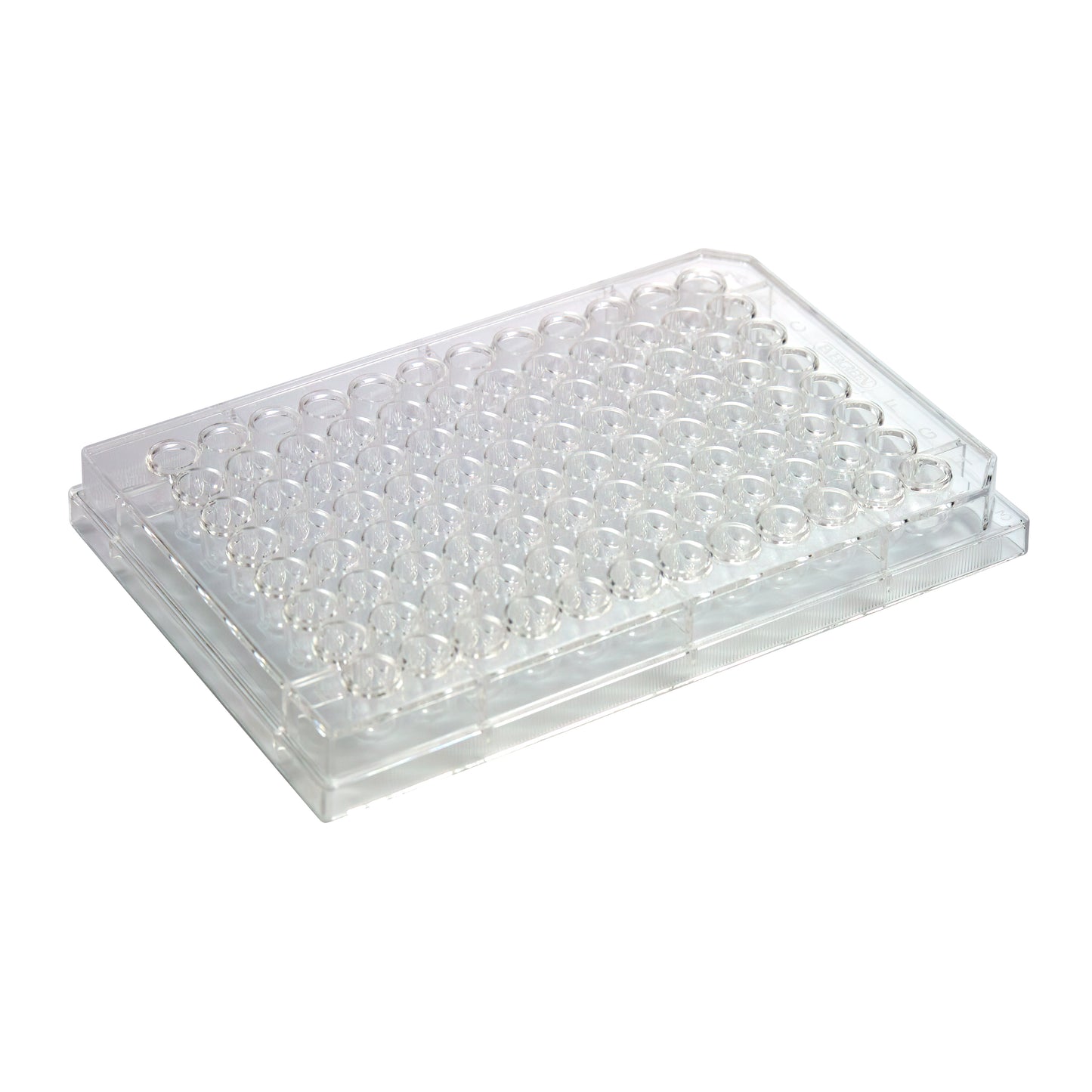

96-Well Round (U-Bottom) Microplates, 0.32 mL — Polystyrene, Natural, 10/Box (290-8117-01R)
These 96-well round (U-bottom) microplates feature a 0.32 mL well volume in natural polystyrene, purpose-built for suspension cell culture, cell-based aggregation assays, and wash-based immunoassays that rely on gravity pelleting. The U-bottom geometry guides cells and particles into a uniform central pellet, enabling consistent supernatant aspiration and re-suspension with minimal cell loss — a critical advantage over flat- or V-bottom formats in these workflows. Supplied non-sterile in a convenient 10/Box (100/Case) format, these plates conform to the SBS/ANSI standard footprint for seamless integration with automated platforms.
Technical Specifications
| Specification | Value |
|---|---|
| Part Number (MPN) | 290-8117-01R |
| Well Format | 96-well, SBS/ANSI Standard Footprint |
| Bottom Geometry | Round (U-Bottom) |
| Well Volume | 0.32 mL |
| Material | Polystyrene (PS) |
| Color | Natural (Clear) |
| Sterility | Non-Sterile |
| Pack Size | 10/Box (100/Case) |
| BPA / Phthalates | BPA-free; no phthalate plasticizers |
| Country of Origin | USA (California) |
Applications
- Suspension cell culture — lymphocytes, PBMCs, hybridomas, and bacteria settle into a uniform single-cell pellet at the well center, reducing cell loss during aspiration and re-suspension.
- PBMC isolation and culture — the U-bottom geometry concentrates primary blood mononuclear cells efficiently for downstream assays and medium exchanges.
- Hemagglutination inhibition (HAI/HI) assays — the round bottom distributes red blood cells evenly across the well floor, making this the standard plate format for viral titer and hemagglutination reads.
- Hybridoma screening — supports hybridoma growth and simplifies supernatant harvest from antibody-producing clones.
- Immunoprecipitation preparation — enables complete antibody-bead complex pelleting at low g-force with clear visual confirmation.
- Minimum inhibitory concentration (MIC) / broth microdilution assays — round-bottom wells provide clear turbidity and growth pattern reads in antimicrobial susceptibility testing.
Compatibility
Because these plates conform to the SBS/ANSI standard footprint (127.76 × 85.47 mm), they integrate directly with the full range of standard laboratory automation and detection equipment. Compatible plate readers include the Molecular Devices SpectraMax, BMG LABTECH PHERAstar, BioTek Synergy, TECAN Infinite, and PerkinElmer EnVision series. Automated liquid handlers from Hamilton and Tecan, as well as standard plate washers and robotic gripper arm systems, accept this footprint without adapter modification. Laboratories already running SBS-format workflows can adopt 290-8117-01R as a direct format-compatible consumable without any instrument reconfiguration.
Chemical Resistance
| Reagent / Condition | Compatibility |
|---|---|
| Aqueous buffers (PBS, HBSS, HEPES, etc.) | Excellent |
| Standard cell culture media (DMEM, RPMI, etc.) | Excellent |
| Dilute acids and bases | Good — short-term contact |
| Ethanol (<70%) | Limited — brief surface contact only |
| Acetone | Not recommended |
| Chlorinated / aromatic solvents | Not recommended |
| Autoclave / dry heat sterilization | Not suitable — PS is not autoclavable |
Quality & Procurement
Made in USA at Caplugs® Evergreen's California manufacturing facility, these microplates are produced from BPA-free, phthalate-free polystyrene resin under ISO quality management standards. LabSupplies.com is an authorized Caplugs® Evergreen dealer stocking inventory domestically for fast fulfillment. Both per-box and full-case orders are supported to match the procurement cadence of research, clinical, and biotech laboratory environments.
Frequently Asked Questions
Are these microplates sterile?
No — they are supplied non-sterile. For suspension cell culture workflows requiring sterility, pre-sterilize by UV exposure or use in a biological safety cabinet with standard aseptic technique. Contact us if a sterile format is required for your application.
Why choose a U-bottom over a V-bottom plate for suspension cell culture?
The U-bottom (round bottom) allows cells to settle by gravity into a soft, spread pellet at the well center, which is easier to re-suspend without shear damage than the tightly compacted pellet formed in V-bottom wells. V-bottom geometry is better suited for applications requiring complete, rapid pelleting — such as bead-based separations — while U-bottom is the preferred format for live cell suspension culture and gentle pelleting workflows.
Will these plates fit my plate reader and liquid handler?
Yes — the SBS/ANSI standard footprint (127.76 × 85.47 mm) is universally accepted by plate readers, automated liquid handlers, plate washers, and robotic gripper systems from all major manufacturers, including Molecular Devices, BMG LABTECH, BioTek, TECAN, Hamilton, and PerkinElmer platforms.
What is the recommended working volume per well?
The maximum well volume is 0.32 mL; working volume is typically 50–80% of that maximum, or approximately 160–256 µL per well, depending on the assay format and the need to avoid cross-contamination from splashing during plate handling or centrifugation.