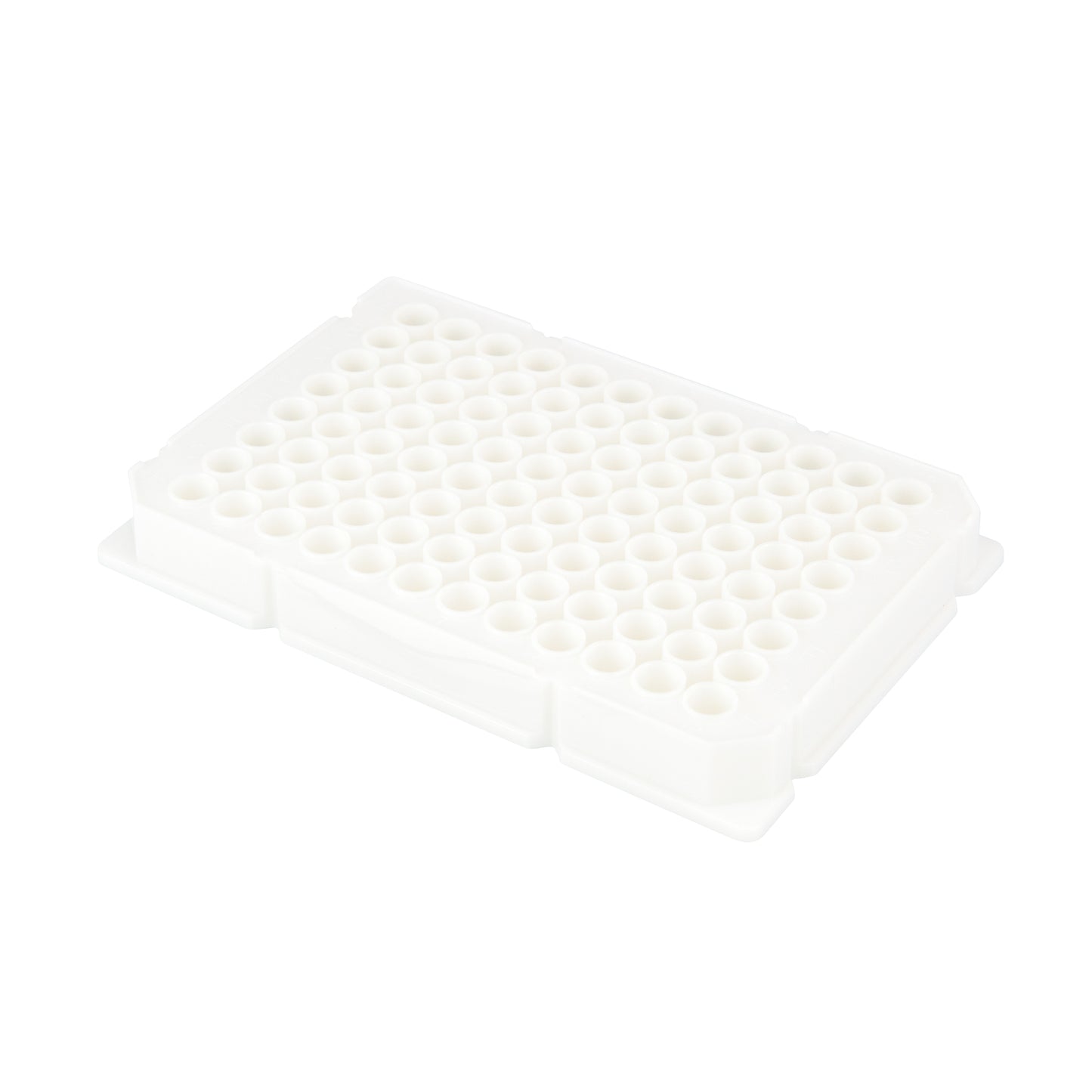

96-Well Round Bottom Microplates, 0.32 mL — Polystyrene, White, 9/Box (290-8029-W1R)
These 96-well round bottom polystyrene microplates offer a purposefully paired combination of geometry and surface color: the round bottom well promotes uniform suspension of cells and particles, while the white reflective PS walls maximize luminescence signal output from luciferase, ATP bioluminescence, and related reporter systems. Supplied non-sterile in 9/Box (90/Case) format, they conform to the SBS/ANSI standard footprint and slot directly into automated plate-processing workflows. Part number 290-8029-W1R is the specification of choice for labs running suspension cell-based luminescence assays and agglutination assays that demand both round-bottom behavior and enhanced optical signal in a single plate format.
Technical Specifications
| Specification | Value |
|---|---|
| Part Number (MPN) | 290-8029-W1R |
| Well Format | 96-well, SBS/ANSI standard footprint |
| Bottom Geometry | Round Bottom |
| Well Volume | 0.32 mL |
| Material | Polystyrene (PS) |
| Color | White |
| Sterility | Non-Sterile |
| Pack Size | 9/Box (90/Case) |
| BPA / Phthalates | BPA-free; no phthalate plasticizers |
| Country of Origin | USA (California) |
Applications
- Suspension cell viability (luminescence): CellTiter-Glo, CTG 2.0, ATPlite, and similar ATP-based assays where white walls maximize photon capture from suspension cell pellets
- Suspension cell reporter assays: Luciferase reporter constructs in suspension cell lines benefit from both the round-bottom geometry for culture and the white surface for enhanced luminescence signal
- Hemagglutination inhibition (HAI) and virus neutralization assays: Round-bottom geometry promotes uniform RBC and particle distribution; white walls support optical endpoint reading
- Hybridoma luminescence screening: High-throughput screening of luminescent reporter hybridoma clones at 96-well scale
- Agglutination assays: Any assay requiring consistent round-bottom well geometry for cell or particle settling patterns
Compatibility
The SBS/ANSI standard footprint (127.76 × 85.47 mm) ensures these plates seat correctly in all major plate readers — including SpectraMax, PHERAstar, Synergy, Infinite, and EnVision — as well as automated liquid handlers such as Hamilton and Tecan Bravo, standard plate washers, and robotic gripper arm systems. Luminescence-optimized plate readers in particular will realize the full benefit of the white reflective walls, which redirect emitted photons toward the detector rather than absorbing them.
Chemical Resistance
| Reagent / Condition | Compatibility |
|---|---|
| Aqueous buffers, PBS, saline | Excellent |
| Standard cell culture media | Excellent |
| Dilute acids and bases | Good — short-term contact |
| Ethanol (>70%) / isopropanol | Not recommended |
| Acetone / chloroform / aromatic solvents | Not recommended |
| Autoclave / dry heat sterilization | Not compatible (PS is not autoclavable) |
Quality & Procurement
Made in USA (California), these Caplugs® Evergreen microplates are manufactured from BPA-free, phthalate-free polystyrene under rigorous quality management standards. The 9/Box and 90/Case pack formats support both low-volume per-box ordering and high-throughput case-quantity purchasing for programs running dozens to hundreds of plates per week. LabSupplies.com is an authorized Caplugs® Evergreen dealer stocking 290-8029-W1R in USA inventory.
Frequently Asked Questions
Why choose a white plate over a clear plate for luminescence assays?
White polystyrene walls reflect emitted photons back toward the plate reader detector, significantly increasing the luminescence signal captured per well compared with clear or black plates. For luciferase reporter and ATP bioluminescence assays, this reflective property translates directly into higher signal-to-noise and improved assay sensitivity — particularly important when working with low cell numbers or dim reporters.
Are these plates sterile?
No — they are supplied non-sterile. For suspension cell culture applications, labs typically add cells and detection reagent in a single step (as in CellTiter-Glo protocols) without requiring pre-sterilized plates, but if your workflow requires sterile microplates, please contact us for alternative configurations.
Will these plates fit our automated liquid handler and plate reader?
Yes — the SBS/ANSI standard footprint is the universal plate format recognized by Hamilton, Tecan Bravo, SpectraMax, PHERAstar, Synergy, Infinite, EnVision, and virtually all modern plate-handling instrumentation. No custom adapters or programming changes are needed when substituting from other SBS-compliant 96-well plates.
Can I use these plates for adherent cell culture assays?
Round bottom geometry is designed for suspension cells and particle-based assays; adherent cells do not attach uniformly to round-bottom surfaces. For adherent cell culture assays, a flat-bottom PS plate with surface treatment is the appropriate choice. These plates are optimized specifically for suspension cell luminescence and agglutination workflows.