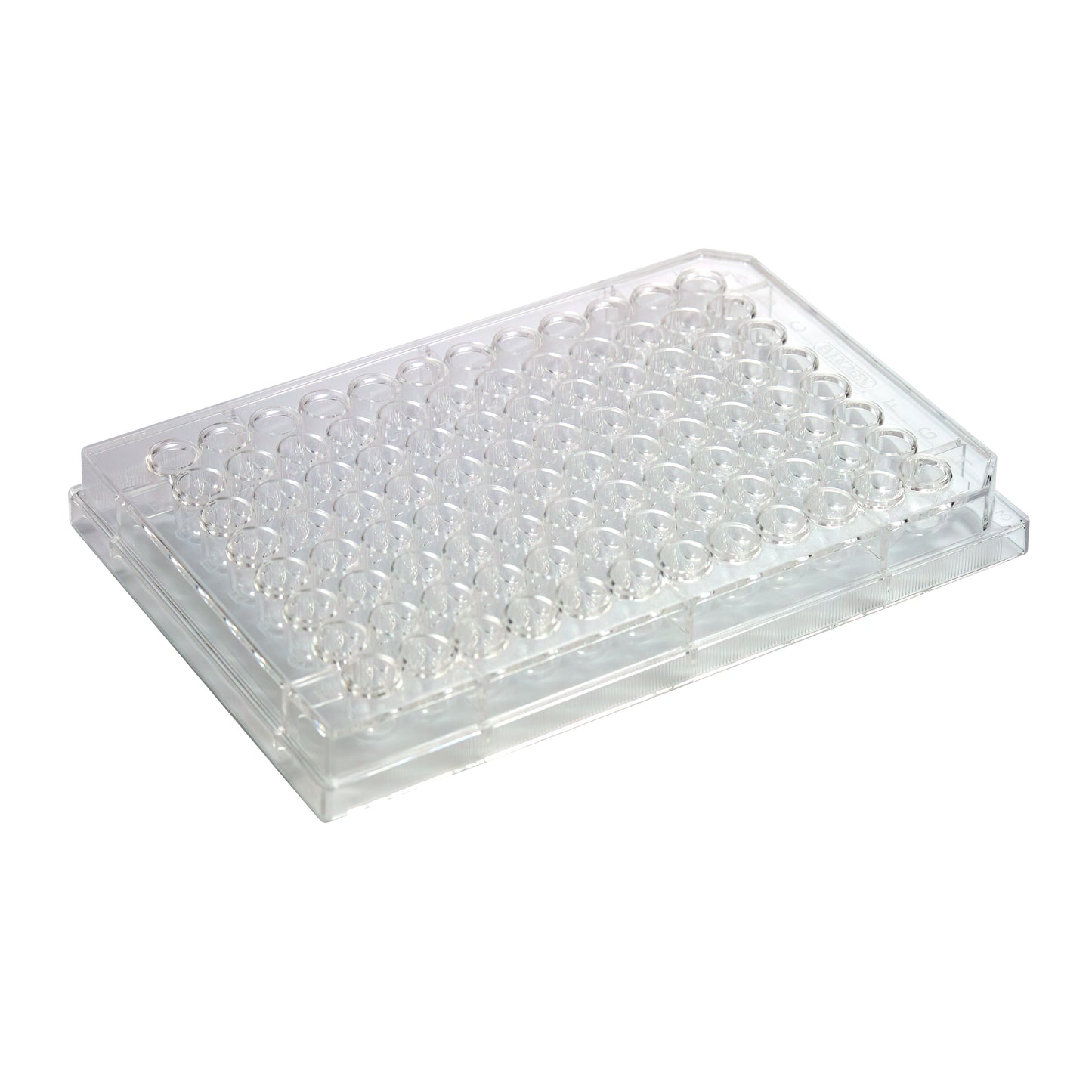

0.37 mL 96-Well Flat-Bottom Microplates, Polystyrene, Natural/Clear, Sterile — No Lid, 10/Box
These sterile 96-well flat-bottom microplates deliver a uniform optical surface across all 96 wells, making them the workhorse choice for ELISA, colorimetric assays, and fluorescence-based applications where consistent absorbance path length is critical. Constructed from optically clear polystyrene, each plate holds 0.37 mL per well and ships without a lid in a convenient 10/Box bulk format sized for high-throughput screening and daily assay processing. The standard SBS footprint ensures seamless compatibility with multichannel pipettes, automated liquid handling systems, microplate readers, washers, and incubators already in your lab.
Technical Specifications
| Specification | Value |
|---|---|
| Part Number (MPN) | 222-8050-F1K |
| Well Format | 96-Well |
| Well Volume | 0.37 mL |
| Bottom Style | Flat Bottom |
| Lid | Not Included |
| Material | Polystyrene (PS) |
| Color | Natural (Clear) |
| Sterility | Sterile |
| Pack Size | 10/Box |
| BPA / Phthalate Free | Yes |
| Country of Origin | USA |
Applications
- ELISA — flat-bottom geometry provides a uniform absorbance path length for accurate optical density readings across all 96 wells
- Colorimetric and fluorescence assays requiring consistent optical surface quality and PS clarity
- High-throughput screening and drug discovery workflows where bulk sterile plate supply is essential
- Cell-based assays and immunoassays in standard 96-well SBS-footprint formats
- Automated liquid handling workflows compatible with standard multichannel pipettes, microplate washers, and incubators
Chemical Resistance
| Reagent / Condition | Compatibility |
|---|---|
| Aqueous buffers / saline | Excellent |
| Dilute acids | Excellent |
| Dilute bases | Excellent |
| Methanol | Good — short-term contact |
| Acetonitrile | Limited — use with caution |
| Ethyl acetate | Not recommended |
| Aromatic / chlorinated solvents | Not recommended |
| Acetone / alcohols >70% | Not recommended |
| Autoclave | Not autoclavable |
Quality & Procurement
Made in USA, these Caplugs® Evergreen microplates are manufactured at ISO-certified facilities from BPA-free, phthalate-free polystyrene resin. LabSupplies.com is an authorized Caplugs® Evergreen dealer shipping from USA inventory.
Frequently Asked Questions
Are these microplates sterile?
Yes — each plate in the 10/Box package is individually sterile, making them suitable for cell-based assays, immunoassays, and other workflows where contamination control is required from the outset.
Do these plates include a lid?
No — these plates are supplied without lids, which is a common preference for high-throughput workflows using automated liquid handling systems and plate readers where lids are removed before processing.
Will these plates fit standard microplate readers and washers?
Yes — the standard SBS footprint and 96-well spacing are compatible with the vast majority of microplate readers, washers, incubators, and automated liquid handling platforms currently in use in clinical and research laboratories.
Are polystyrene microplates suitable for fluorescence assays?
Polystyrene provides good optical clarity for standard absorbance and fluorescence assay formats using common assay reagents and dyes. However, PS exhibits autofluorescence at certain excitation wavelengths, so for low-signal fluorescence applications you should evaluate the plate performance under your specific instrument and detection conditions before committing to large-volume use.