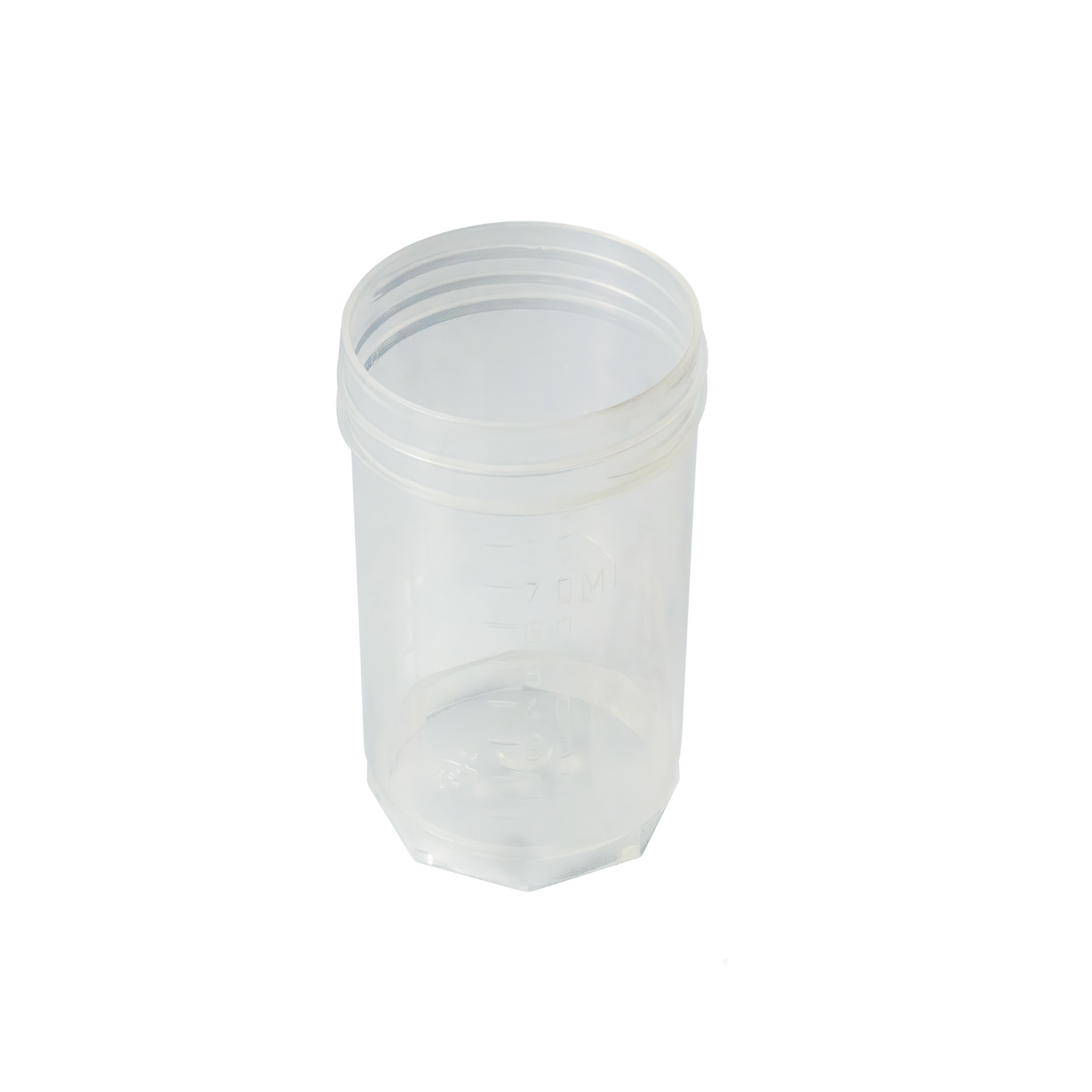

90 mL Flat-Bottom Threaded Specimen Containers — Wide-Mouth, PPC, Natural (220-5603-08K)
These 90 mL wide-mouth threaded specimen containers are molded from Polypropylene Copolymer (PPC) for enhanced flexibility and impact resistance compared with standard PP homopolymer — reducing cracking and leak risk during transport, centrifugation, and routine clinical handling. The threaded closure delivers a secure, leak-resistant seal, and the flat-bottom design ensures stable upright storage on benchtops and in refrigerated racks. Supplied non-sterile in sealed 100/Bag packaging, part number 220-5603-08K is well-suited for high-volume specimen collection workflows across clinical, anatomical pathology, and research settings.
Technical Specifications
| Specification | Value |
|---|---|
| Part Number (MPN) | 220-5603-08K |
| Volume | 90 mL |
| Container Type | Threaded Specimen Container |
| Bottom Style | Flat Bottom |
| Opening | Wide Mouth |
| Cap Style | Threaded — leak-resistant |
| Material | Polypropylene Copolymer (PPC) |
| Color | Natural |
| Sterility | Non-Sterile |
| BPA / Phthalate Free | Yes |
| Pack Size | 100/Bag |
| Country of Origin | USA |
Applications
- Urine specimen collection — 90 mL capacity and wide-mouth opening accommodate standard clinical urine volumes
- Tissue and biopsy collection — wide-mouth format allows direct specimen placement without instrument interference
- Sputum and stool specimen collection — threaded closure prevents leakage during transport and laboratory receipt
- Wound and environmental swab submission — wide opening accommodates swab insertion and retrieval
- Anatomical pathology and histology — flat bottom provides stable storage in refrigerators and on processing benches
- Centrifugation steps in specimen processing — PPC construction resists cracking under routine centrifugal force
Chemical Resistance
| Reagent / Condition | Compatibility |
|---|---|
| Aqueous buffers / saline | Excellent |
| Dilute acids | Excellent |
| Dilute bases | Excellent |
| Methanol | Good |
| Isopropanol | Good |
| Acetonitrile | Good |
| Aromatic solvents (e.g., toluene, xylene) | Limited — not recommended for prolonged contact |
| Chlorinated solvents (e.g., chloroform) | Not recommended |
Quality & Procurement
Made in USA, these Caplugs® Evergreen specimen containers are produced at ISO-certified manufacturing facilities using virgin-grade, FDA-registered PPC resin that is BPA-free and phthalate-free.
Frequently Asked Questions
Are these specimen containers sterile?
No — they are supplied non-sterile. For workflows that require sterile containers, please contact LabSupplies.com to confirm whether a sterile equivalent is available in the Caplugs® Evergreen line.
What is the advantage of PPC over standard polypropylene homopolymer for specimen containers?
Polypropylene Copolymer (PPC) incorporates a co-monomer that increases chain flexibility, making the container walls more impact-resistant and less prone to stress-cracking compared with standard PP homopolymer. This matters during specimen transport and centrifugation, where containers are subjected to mechanical stress and temperature changes.
Does the threaded cap ship with the container?
The source documentation describes a threaded closure design; however, cap inclusion is not explicitly confirmed in the available product data. Please contact LabSupplies.com before ordering to verify whether caps are included or sold separately.