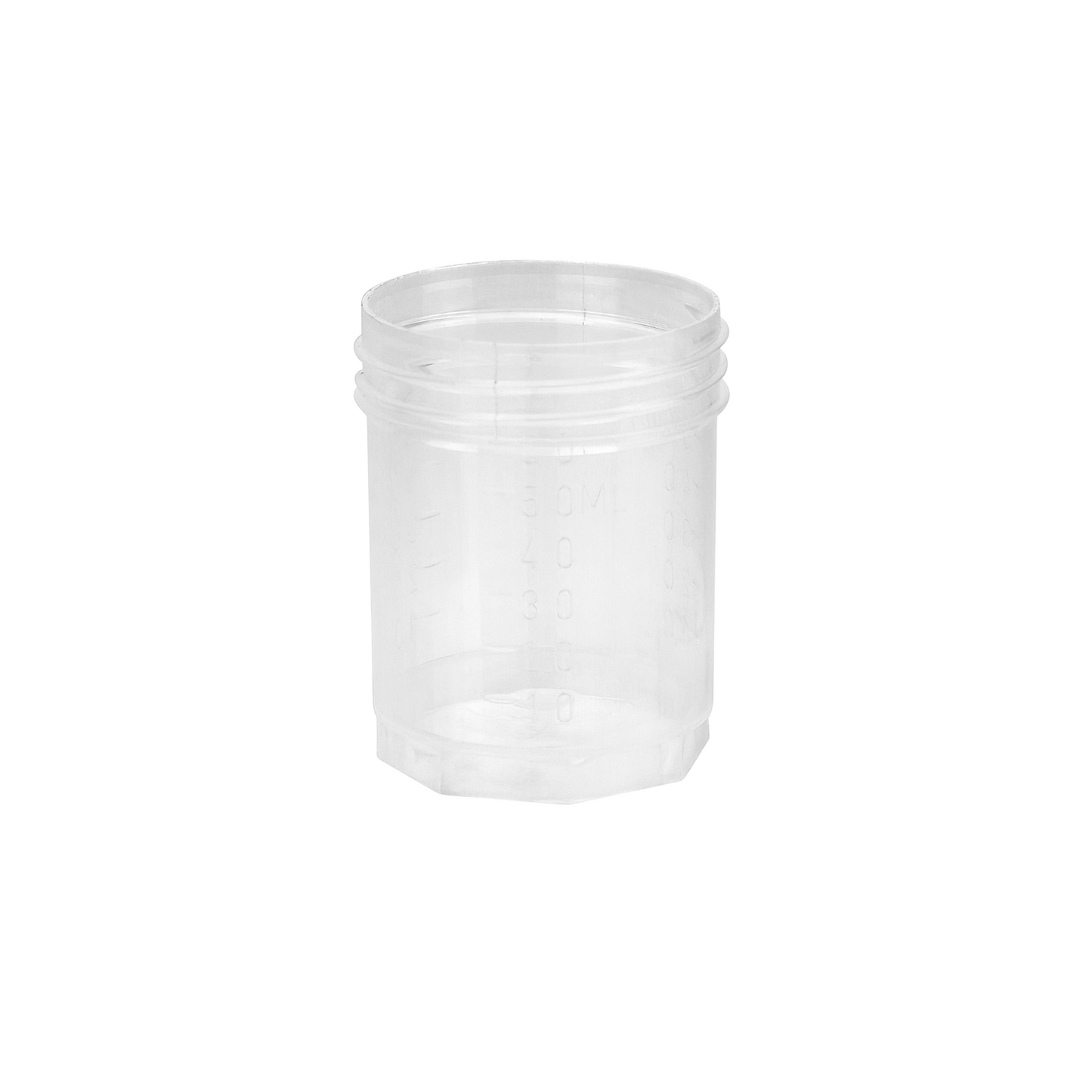

60 mL Flat-Bottom Threaded Specimen Containers — Wide-Mouth, PPC, Natural (220-5601-08K) | 500/Bag
These 60 mL wide-mouth threaded specimen containers are constructed from Polypropylene Copolymer (PPC), a material that offers enhanced flexibility and impact resistance compared with standard PP homopolymer — reducing cracking and leak risk during transport, centrifugation, and repeated handling in busy clinical environments. The flat bottom provides stable upright storage on any benchtop or rack, while the threaded closure delivers a secure, leak-resistant seal essential for specimen containment during transit and processing. Supplied non-sterile in sealed 500/Bag packaging, part number 220-5601-08K is well suited for high-volume clinical, anatomical pathology, and research laboratory workflows.
Technical Specifications
| Specification | Value |
|---|---|
| Part Number (MPN) | 220-5601-08K |
| Volume | 60 mL |
| Container Type | Threaded Specimen Container |
| Bottom Style | Flat Bottom |
| Opening Style | Wide Mouth |
| Cap Style | Threaded — leak-resistant |
| Material | Polypropylene Copolymer (PPC) |
| Color | Natural |
| Sterility | Non-Sterile |
| BPA / Phthalate Free | Yes |
| Pack Size | 500/Bag |
| Country of Origin | USA |
Applications
- Urine specimen collection — the 60 mL wide-mouth format accommodates standard collection volumes with easy patient access
- Tissue and biopsy collection — wide-mouth opening allows direct specimen placement and pipette access during processing
- Sputum and stool specimen containment — threaded closure provides secure, odor-resistant sealing for transport
- Wound and environmental swab transport — wide opening accepts swabs and collection devices without contamination risk
- Anatomical pathology and fixation workflows — flat bottom provides stable benchtop storage during tissue fixation steps
Chemical Resistance
| Reagent / Condition | Compatibility |
|---|---|
| Aqueous buffers / saline | Excellent |
| Dilute acids | Excellent |
| Dilute bases | Excellent |
| Methanol | Good |
| Isopropanol | Good |
| Acetonitrile | Good |
| Aromatic / chlorinated solvents | Limited — not recommended for prolonged contact |
Quality & Procurement
Made in USA, these Caplugs® Evergreen specimen containers are produced at ISO-certified facilities from virgin-grade, FDA-registered PPC resin that is BPA-free and phthalate-free. LabSupplies.com is an authorized Caplugs® Evergreen dealer shipping from USA inventory.
Frequently Asked Questions
Are these specimen containers sterile?
No — they are supplied non-sterile. For applications requiring sterile containers, a sterile-grade product should be selected. Non-sterile containers are appropriate for most urine, tissue, environmental, and transport specimen workflows where downstream processing or preservative addition is standard practice.
What makes PPC different from standard polypropylene for specimen containers?
Polypropylene Copolymer (PPC) incorporates a comonomer that increases chain flexibility, giving the container greater impact resistance and reduced brittleness compared with standard PP homopolymer. This is especially beneficial in high-throughput clinical labs where containers are handled repeatedly, stacked, or transported in coolers at low temperatures.
Does the threaded cap come included with each container?
The source data describes a threaded-closure design; please confirm cap inclusion with our customer service team or your LabSupplies.com account representative before placing a large institutional order.
Are these containers suitable for centrifugation?
The flat-bottom, PPC construction is designed to withstand the handling stresses common in clinical specimen workflows. Verify the maximum rated centrifugation speed with your specific protocol requirements and confirm compatibility with your centrifuge rotor before use at high g-forces.