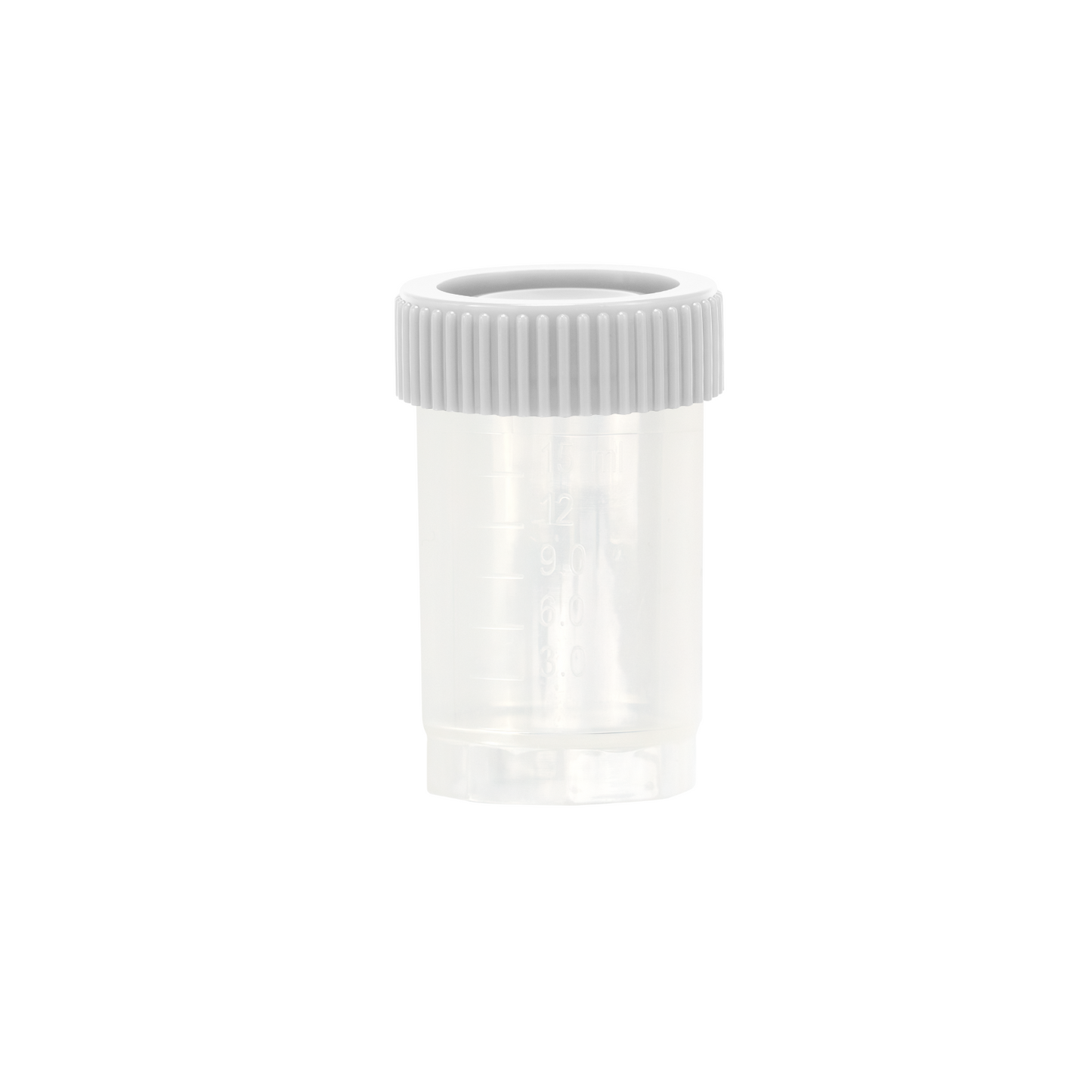

20 mL Freestanding Vials with White Caps — Polypropylene Copolymer, Non-Sterile, 1000/Bag (240-3519-W80)
These 20 mL polypropylene copolymer freestanding vials from Caplugs® Evergreen feature a stable flat-bottom base that stands upright on the bench without a rack, white caps for color-coded specimen identification, and are supplied non-sterile and unassembled in a 1000/Bag format. Part number 240-3519-W80 is well suited for high-volume clinical, environmental, and research workflows — including urine culture, swab transport, molecular specimen banking, and multi-analyte archival storage — wherever a large-capacity, self-supporting vial is needed. The label-compatible exterior surface supports direct-to-vial labeling and LIMS barcode scanning.
Technical Specifications
| Specification | Value |
|---|---|
| Part Number (MPN) | 240-3519-W80 |
| Product Type | Freestanding Vial |
| Volume | 20 mL |
| Material | Polypropylene Copolymer (PPC) |
| Cap Color | White |
| Vial Body Color | Natural |
| Base Style | Freestanding Flat Bottom |
| Sterility | Non-Sterile |
| Pack Size | 1000/Bag |
| Format | Unassembled |
| BPA / Phthalate Free | Yes |
| Country of Origin | USA |
Applications
- Urine culture and urinalysis collection requiring a large-volume, self-supporting vessel
- Swab transport medium elution and environmental specimen collection
- Molecular specimen banking — DNA, RNA, and nucleic acid archival storage
- Large-volume reagent and sample aliquoting in research and clinical labs
- Secondary aliquot tubes and multi-analyte archival storage where smaller vials create specimen insufficiency
- Color-coded specimen management systems using white caps to denote specimen type, batch, department, or processing priority
- LIMS-integrated workflows requiring direct-to-vial labeling and barcode scanning
Chemical Resistance
| Reagent / Condition | Compatibility |
|---|---|
| Aqueous buffers and saline | Excellent |
| Dilute acids and bases | Excellent |
| Biological specimens (urine, serum, swabs) | Excellent |
| Alcohols (short-term contact, <70%) | Good |
| Chlorinated solvents (chloroform, DCM) | Not recommended |
| Aromatic solvents (toluene, xylene) | Not recommended |
| Autoclaving | Compatible (polypropylene copolymer) |
Quality & Procurement
Made in USA, these Caplugs® Evergreen vials are manufactured from BPA-free, phthalate-free polypropylene copolymer resin under ISO 9001 quality management. The unassembled 1000/Bag format minimizes shipping footprint and storage space without sacrificing throughput. LabSupplies.com is an authorized Caplugs® Evergreen dealer shipping from USA inventory.
Frequently Asked Questions
Are these vials sterile?
No — they are supplied non-sterile. For applications that require sterile vials, a separately sourced sterile format should be selected. For general specimen collection, aliquoting, and storage workflows where sterility is not a requirement, these non-sterile vials are fully appropriate.
Do the vials need a rack or tube holder to stand upright?
No. The flat-bottom freestanding base allows the vials to stand independently on any bench surface, eliminating the need for external racks during collection, processing, capping, labeling, and storage steps.
How does the white cap support specimen management workflows?
White is a distinct, high-visibility cap color that integrates into multi-cap-color vial coding systems. Labs commonly assign cap colors to specimen type, assay batch, processing priority, or storage condition, and white provides a clean neutral option with excellent label contrast for printed or handwritten identification.
Are these vials compatible with LIMS barcode scanning?
Yes — the natural vial body provides a smooth, label-compatible exterior surface that accepts printed barcode labels for direct LIMS integration, enabling full lot.