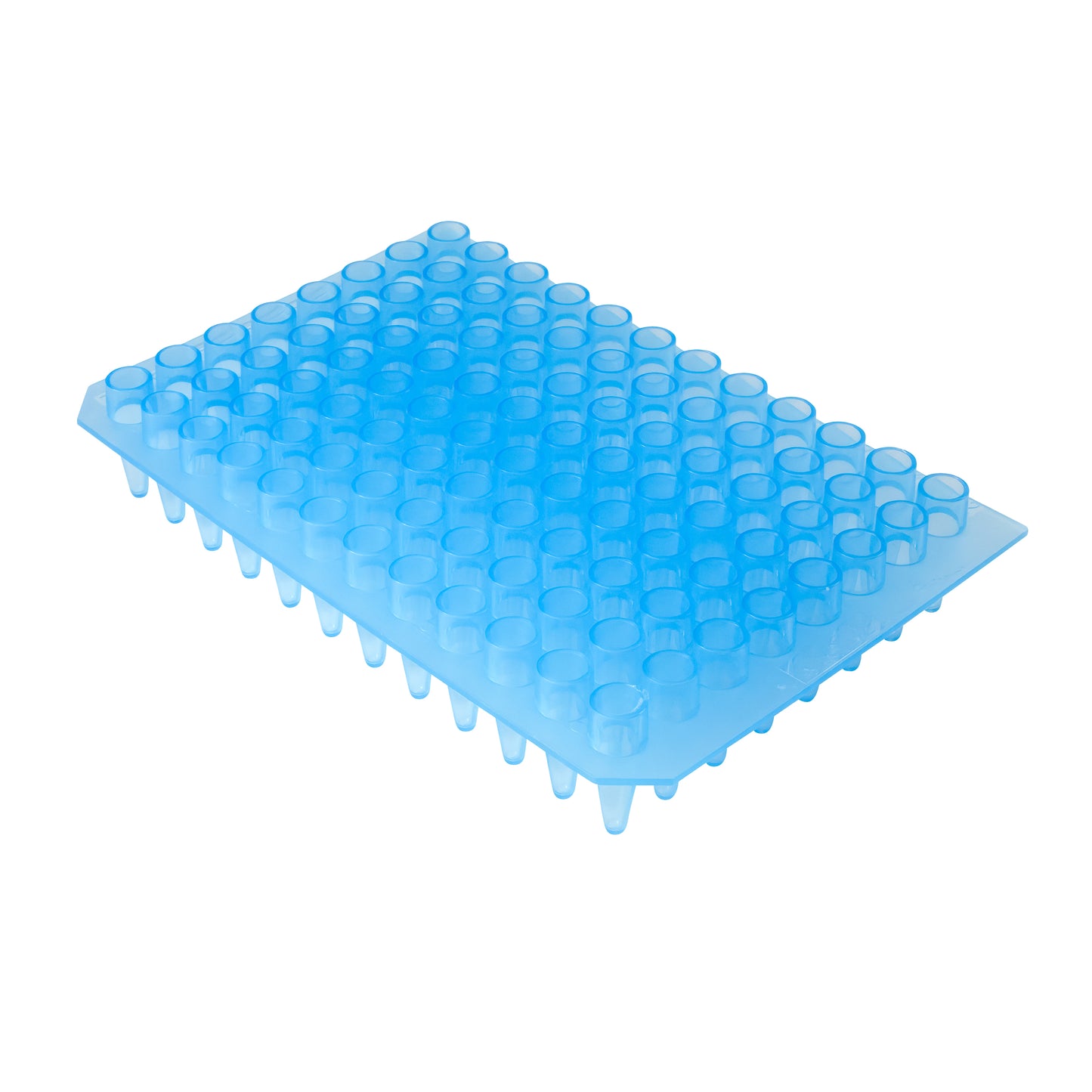

0.2 mL 96-Well PCR Reaction Plates — PPC, Blue, 10/Box (214-3496-B80)
These 0.2 mL polypropylene copolymer (PPC) 96-well reaction plates are designed for PCR, qPCR, and reverse transcription workflows in standard 96-well thermocycler blocks. Supplied non-sterile in sealed 10/Box packaging, part number 214-3496-B80 is manufactured with lot-to-lot dimensional consistency that ensures reliable fit in thermocycler block positions and uniform sealing film adhesion across all 96 wells. The blue color enables rapid visual identification and sample batch differentiation during multi-plate processing runs.
Technical Specifications
| Specification | Value |
|---|---|
| Part Number (MPN) | 214-3496-B80 |
| Volume per Well | 0.2 mL |
| Format | 96-Well Reaction Plate |
| Material | Polypropylene Copolymer (PPC) |
| Color | Blue |
| Sterility | Non-Sterile |
| Pack Size | 10/Box |
| Thermocycler Block | Standard 96-Well, 0.2 mL |
| Sealing Film Compatible | Yes — standard PCR plate sealing films and foils |
| BPA / Phthalate-Free | Yes |
| Country of Origin | USA |
Applications
- PCR and endpoint PCR amplification in standard 96-well thermocycler blocks
- Quantitative PCR (qPCR) and real-time gene expression analysis
- Reverse transcription PCR (RT-PCR) for RNA-based workflows
- High-throughput screening requiring the standard 96-well automated plate format
- Multi-plate processing runs where color-coded batch identification reduces handling errors
Chemical Resistance
| Reagent / Condition | Compatibility |
|---|---|
| Aqueous buffers / PCR mastermix | Excellent |
| Dilute acids | Excellent |
| Dilute bases | Excellent |
| Methanol | Compatible |
| Isopropanol | Compatible |
| Acetonitrile | Compatible |
| Aromatic solvents (toluene, xylene) | Not recommended — use with caution |
Quality & Procurement
Made in USA at ISO-certified Caplugs® Evergreen manufacturing facilities, these plates are produced from virgin-grade, FDA-registered polypropylene copolymer (PPC) resin that is BPA-free and phthalate-free. PPC construction provides enhanced flexibility compared to standard homopolymer polypropylene, reducing the risk of well-to-well cracking during high-speed thermocycler runs while maintaining consistent wall uniformity and skirt fit across all plates in a box. LabSupplies.com is an authorized Caplugs® Evergreen dealer stocking 214-3496-B80 and shipping from USA inventory.
Frequently Asked Questions
Are these PCR plates sterile?
No — they are supplied non-sterile. For the vast majority of PCR and qPCR applications, non-sterile plates are appropriate because the thermocycling process itself controls contamination. If your protocol requires sterile consumables, please contact us for guidance.
What makes PPC different from standard polypropylene for PCR plates?
Polypropylene copolymer (PPC) incorporates a comonomer that increases chain flexibility relative to standard homopolymer PP. In practice, this reduces the risk of well cracking during rapid thermal cycling and helps sealing films adhere more uniformly across all 96 wells — both important factors in high-throughput qPCR workflows.
Will these plates fit my thermocycler?
These plates are designed for standard 96-well, 0.2 mL thermocycler block formats and are compatible with standard PCR plate sealing films and foils. If your instrument uses a non-standard or proprietary block geometry, verify plate skirt dimensions with your instrument manual before switching from OEM consumables.
How does the blue color help in the lab?
The blue plate color allows technicians to distinguish plate batches at a glance during multi-plate thermocycler runs, reducing the risk of sample mix-up without requiring additional labeling steps. It also supports color-coded inventory systems common in high-throughput molecular diagnostic labs.