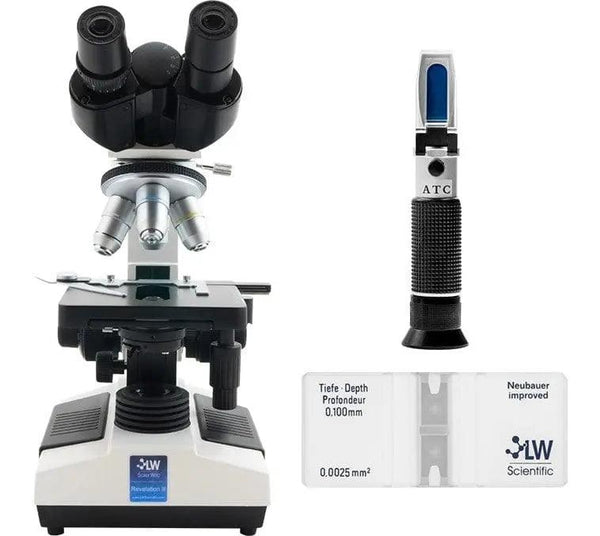

Assembled by LW Scientific for craft brewery quality control, the brewery lab kit includes the three instruments needed to monitor yeast health, manage fermentation, and track wort gravity. Contained in the kit: a Revelation III Binocular Microscope for detailed examination of yeast cells and contamination detection, a Neubauer-grid hemacytometer for accurate manual cell counting to support pitch rate calculations, and an automatic-temperature-compensating refractometer for rapid Brix and specific gravity measurement from just a drop of wort. LW Scientific is an ISO 13485 certified manufacturer based in Lawrenceville, Georgia.
Specifications
| Specification | Detail |
|---|---|
| Microscope | Revelation III compound microscope |
| Cell counter | Neubauer hemacytometer counting chamber |
| Refractometer | Handheld, for specific gravity / Brix |
| Application | Brewery QC — yeast cell counts, viability, gravity |
Frequently Asked Questions
What is included in the LW Scientific Brewery Lab Kit?
Three instruments make up the kit: the Revelation III Binocular Microscope for yeast and microorganism examination, a hemacytometer for accurate manual cell counting, and a refractometer for gravity and Brix measurement. The Revelation III provides detailed examination of yeast morphology and contamination. For cell counting, the dual-chamber Neubauer hemacytometer supports pitch rate calculations and fermentation management. Offering measurements from just a drop or two of liquid, the refractometer with ATC monitors fermentation progress and supports ABV calculation without drawing large sample volumes.
How does a hemacytometer support yeast management in brewing?
A hemacytometer is a precision counting chamber with an etched Neubauer grid that allows counting individual yeast cells within a defined volume under the microscope. Knowing cells per milliliter allows the brewer to calculate total cell count and determine the correct pitch rate. Accurate pitching is one of the most controllable variables in fermentation consistency — underpitching stresses yeast and produces off-flavors, while overpitching can result in underattenuated beer. Cell counting also enables early contamination detection when unexpectedly high or unusual cell populations appear.
When should a refractometer be used versus a hydrometer in brewing?
A refractometer requires only a drop or two of liquid and gives an immediate gravity or Brix reading — ideal for checking wort during the mash or boil when drawing a large hydrometer sample would waste hot wort. Refractometers are less accurate when alcohol is present because alcohol changes the refractive index independently of sugar, requiring a correction factor for post-fermentation readings. Both instruments together cover the full process: refractometer for in-process checks, hydrometer for final gravity confirmation.
What microscope objectives are needed for yeast examination in the Revelation III?
Yeast examination typically requires a 40x objective for initial scanning and morphology assessment, and a 100x oil-immersion objective for detailed cellular work. For hemacytometer cell counting, a 10x or 40x objective provides the field of view needed to count cells within the Neubauer grid squares accurately. The Revelation III supports DIN standard objectives, making it compatible with additionally purchased objectives for expanded magnification as the QC program grows.