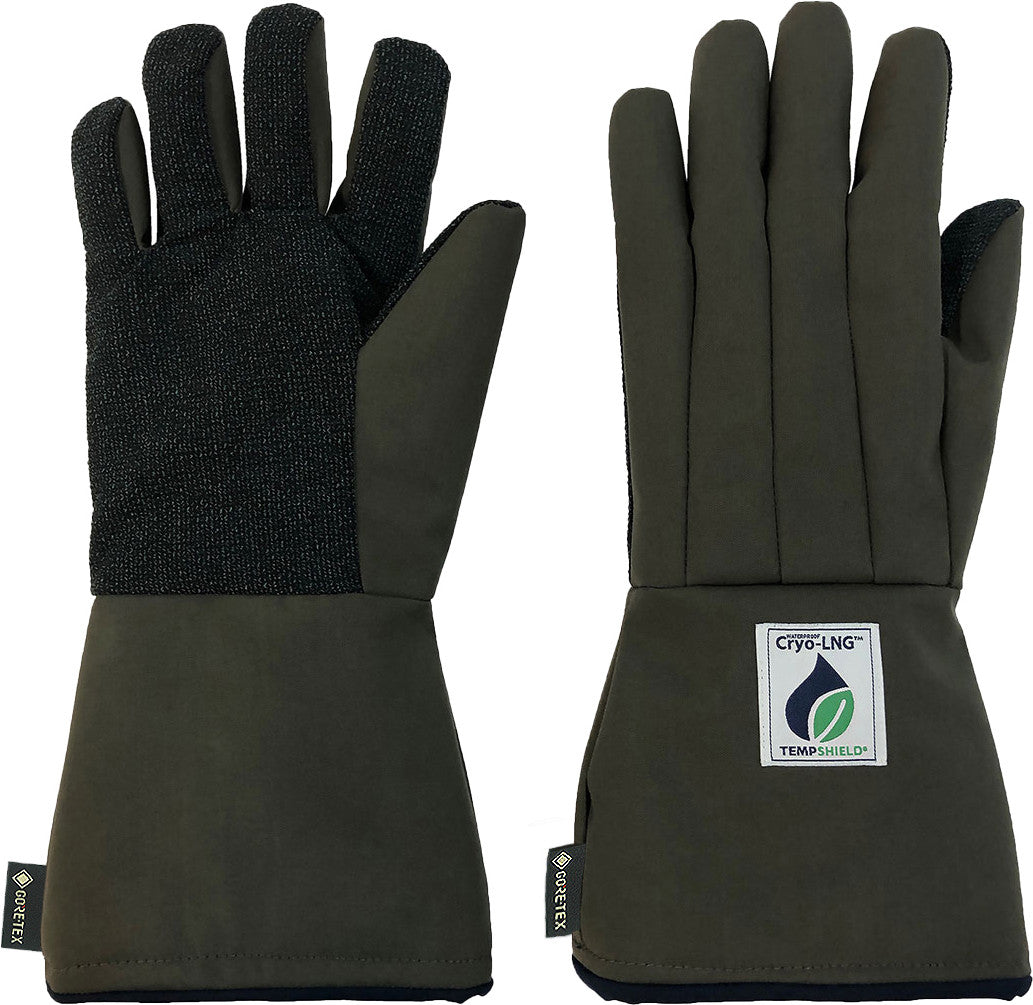


CRYO-LNG™ Mid-Arm Cryogenic Gloves — GORE-TEX® Waterproof Protection for Daily LNG and LN₂ Operations
The CRYO-LNG™ Mid-Arm Cryogenic Gloves from TempShield are engineered for laboratory and industrial personnel who handle liquefied natural gas (LNG) and liquid nitrogen (LN₂) as part of routine daily operations. A seamless, 100% waterproof GORE-TEX® inner liner provides the core protection against cryogenic fluid penetration, while the mid-arm length cuff extends coverage to the mid-forearm — the appropriate protection zone for the dispensing, decanting, and small dewar operations that define the majority of laboratory LN₂ work. CE and UKCA certified, these gloves protect researchers, biorepository staff, and industrial gas operators from the freeze injury risk of everyday cryogenic liquid contact.
Features & Benefits
- Seamless 100% waterproof GORE-TEX® liner: The seamless GORE-TEX® construction provides continuous waterproof protection from fingertip to cuff without the seam vulnerabilities of conventional bonded or stitched waterproof liners — preventing cryogenic fluid penetration to the skin in the event of a splash or direct contact incident.
- Breathable membrane technology: GORE-TEX® allows moisture vapor from the hand to escape through the liner, preventing the hand perspiration accumulation that causes skin discomfort and reduced dexterity during extended glove wear in active laboratory operations.
- Abrasion-resistant palm fabric: The outer hand surface uses a reinforced abrasion-resistant material that resists wear from repeated contact with dewar vessel necks, frozen storage rack components, and cryogenic fittings — the surfaces that most rapidly degrade conventional cryogenic glove materials.
- Mid-arm cuff length: Provides wrist and lower forearm coverage appropriate for the dispensing, transfer, and small-vessel handling operations that represent the typical daily LN₂ workload in research and clinical laboratories.
- CE and UKCA dual certification: Meets the personal protective equipment requirements for laboratory and industrial use in both EU and UK regulatory jurisdictions, facilitating standardized PPE procurement for international organizations.
- Full size range Medium through XXL: Proper glove fit is a safety requirement in cryogenic applications — the complete size range ensures that every operator can select a glove that provides secure coverage without excess material that can catch on equipment or reduce the tactile feedback needed for precise cryogenic operations.
Specifications
| Brand | TempShield |
| Glove Length | Mid-arm (mid-forearm coverage) |
| Inner Liner | Seamless 100% waterproof GORE-TEX® |
| Palm Material | Abrasion-resistant outer fabric |
| Application | LNG, Liquid Nitrogen, Cryogenic Fluids |
| Certifications | CE, UKCA |
| Sizes Available | Medium, Large, XL, XXL |
| Colors Available | Brown |
| Sold As | 1 Pair |
Applications
CRYO-LNG™ Mid-Arm Gloves are the standard selection for routine laboratory LN₂ operations where the primary exposure zone is the hand and lower forearm. In academic and industrial research laboratories, these gloves protect scientists adding liquid nitrogen to open containers, replenishing LN₂ in cryogenic tissue processors and MRI cooling systems, and transferring cryogenic samples between storage dewars. Biorepository and biobank technicians performing sample aliquoting from LN₂ storage tanks use mid-arm gloves during the repetitive transfer operations that define their daily workflow, where the controlled dispensing environment limits splash trajectory to the wrist and lower forearm. Laboratory instrument service engineers who work on cryogenically cooled analytical equipment — superconducting magnets, cryogenic traps, cold stage electron microscopes — use these gloves for coolant handling during maintenance procedures. Industrial LNG operations personnel performing routine meter checks, sample collection, and equipment inspection on LNG distribution pipelines specify mid-arm gloves for low-to-moderate splash exposure tasks, reserving elbow-length gloves for hose connections and filling operations.
Part Numbers
| Option | Manufacturer Part No. | Pack |
|---|---|---|
| Medium / Brown | CLMMWP | 1 Pair |
| Large / Brown | CLMLWP | 1 Pair |
| XL / Brown | CLMXWP | 1 Pair |
| XXL / Brown | CLMXXWP | 1 Pair |
Frequently Asked Questions
When should I choose mid-arm gloves versus elbow-length gloves for LN₂ work?
Choose mid-arm gloves for operations where the splash zone is limited to the hand and lower forearm: dispensing LN₂ from a small dewar into a controlled opening, handling cryogenic vials and straws, replenishing LN₂ in tissue processors or cryo-storage units, and performing maintenance on cryogenic-cooled instruments. Choose elbow-length gloves when the forearm enters the splash trajectory — overhead pouring, deep dewar retrieval with full arm extension, and LNG hose connection operations. When in doubt about the splash trajectory of a specific task, err toward the longer elbow-length glove.
Are these gloves chemical-resistant to LNG components beyond methane?
GORE-TEX® membrane and the outer fabric construction provide protection against the primary cryogenic fluid contact hazard — thermal freeze injury from LNG and LN₂. Chemical permeation resistance to the trace hydrocarbon components of LNG (ethane, propane, butane) through the GORE-TEX® liner has not been independently rated for extended contact scenarios. These gloves are designed for splash and brief contact protection in cryogenic operations, not for prolonged chemical immersion. For extended hydrocarbon immersion scenarios, consult TempShield's detailed chemical resistance data for the specific fluid composition.
How do I care for and inspect CRYO-LNG™ Mid-Arm Gloves?
Before each use, inspect the outer fabric for cuts, abrasions, or areas of wear that could compromise the underlying GORE-TEX® liner. Inspect the cuff seam and hand-cuff transition zone — areas subject to stress during repeated flexing. If the outer fabric is damaged, the glove should be replaced even if the GORE-TEX® liner appears intact, as the outer layer protects the liner from mechanical damage during use. Clean by hand washing with mild soap and warm water; do not machine wash, use bleach, or use fabric softeners, which can degrade the GORE-TEX® membrane. Store flat, away from sharp objects and chemical vapors.
USA Based Shipping
As an authorized Heathrow Scientific dealer, we ship directly from USA inventory.