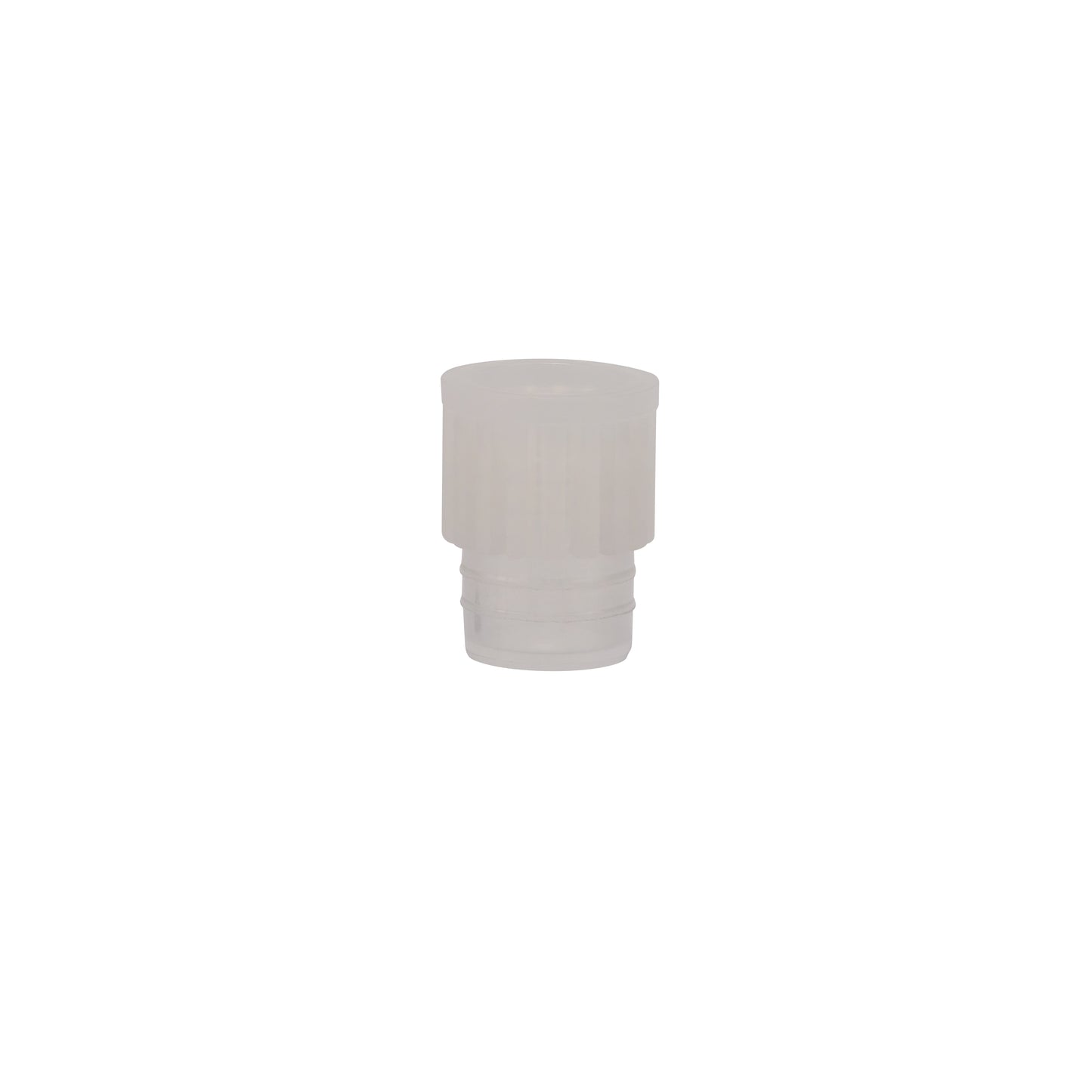

11 mm Test Tube Stoppers — LDPE, Natural, Plug-In Friction Fit (300-2911-020), 1000/Bag
These natural LDPE stopper caps provide a reliable plug-in friction-fit closure for 11 mm OD glass test tubes and culture tubes used in hematology, microbiology, clinical sample preparation, and research workflows. Supplied non-sterile in 1000/Bag, part number 300-2911-020 is manufactured from low-density polyethylene, which flexes on insertion and springs back against the tube wall to maintain a secure, retained seal through repeated insertion and removal cycles. The natural (clear) color works with any labeling method — barcode, sticker, or marker — making these stoppers a universal default for high-volume tube programs.
Technical Specifications
| Specification | Value |
|---|---|
| Part Number (MPN) | 300-2911-020 |
| Tube OD | 11 mm |
| Cap Style | Stopper — plug-in friction fit |
| Material | Low-Density Polyethylene (LDPE) |
| Color | Natural |
| Compatible Tube Types | 11 mm OD glass culture tubes |
| Temperature Range | -20°C to +60°C |
| Sterility | Non-Sterile |
| Pack Size | 1000/Bag |
| BPA / Phthalates | BPA-free; no phthalate plasticizers |
| Country of Origin | USA |
Applications
- Microbiology culture tube capping — LDPE flexibility maintains seal at 37°C incubation through full culture cycles in TSB, BHI, LB broth, and similar media
- Refrigerated and frozen specimen archiving — prevents evaporation from serum, plasma, and urine tubes stored at -20°C through cold-chain workflows
- Clinical chemistry sample tube closure — LDPE is inert to serum and plasma matrices, making these stoppers suitable for pre-analysis tube sealing without leaching
- Cell culture and virus propagation tubes — stopper provides contamination control while the flexible fit accommodates repeat access during serial passage workflows
- Pneumatic tube transport — LDPE flex retention maintains stopper engagement through the acceleration forces typical of hospital tube transport systems
- Research reagent and buffer tube closure — reusable glass tube caps for stock solutions, dilution series, and reagent staging benches
Chemical Resistance
| Reagent / Condition | Compatibility |
|---|---|
| Aqueous buffers / saline | Excellent |
| Urine / serum / plasma | Excellent |
| Broth media (TSB, BHI, LB) | Excellent |
| Dilute acids and bases | Good |
| Ethanol and alcohols | Good — short-term contact |
| Chlorinated solvents (chloroform, DCM) | Not recommended |
| Aromatic solvents (toluene, xylene) | Not recommended |
Quality & Procurement
Made in USA, these Caplugs® Evergreen stoppers are produced from BPA-free, phthalate-free LDPE resin under ISO 9001 quality management. The material is validated for the -20°C to +60°C working range, ensuring consistent friction-fit retention from frozen archive through incubation temperatures without hardening or losing engagement. LabSupplies.com is an authorized Caplugs® Evergreen dealer shipping from USA inventory.
Frequently Asked Questions
Will these stoppers work on plastic tubes as well as glass?
These stoppers are designed for 11 mm OD glass culture tubes. Compatibility with plastic tubes depends on whether the plastic tube's inner diameter and wall thickness match the LDPE plug dimensions — verify your tube's actual inner diameter against the stopper's plug geometry before substituting.
Can these stoppers be used at -80°C ultra-low freezer temperatures?
The validated temperature range for these stoppers is -20°C to +60°C. Performance below -20°C has not been specified; a different closure rated for ultra-low storage should be used for -80°C applications.
Are these stoppers autoclavable?
LDPE is not recommended for autoclaving. The material's upper working limit is +60°C, and standard autoclave cycles (121°C) will deform or damage the stopper. For sterile applications, downstream sterilization of capped tubes by autoclaving is not advised with these closures.
Why choose natural color instead of a colored stopper?
Natural (clear) stoppers are compatible with any labeling method — barcodes, printed labels, or marker — and do not impose a color-routing convention on the workflow. They are ideal for programs where specimen type or priority is tracked by secondary identification rather than cap color.