Caplugs® Evergreen
1–3 mL Microplates, Flat Bottom, PP, Natural — 290-8324-03F | 10/Bag | Caplugs® Evergreen
Couldn't load pickup availability
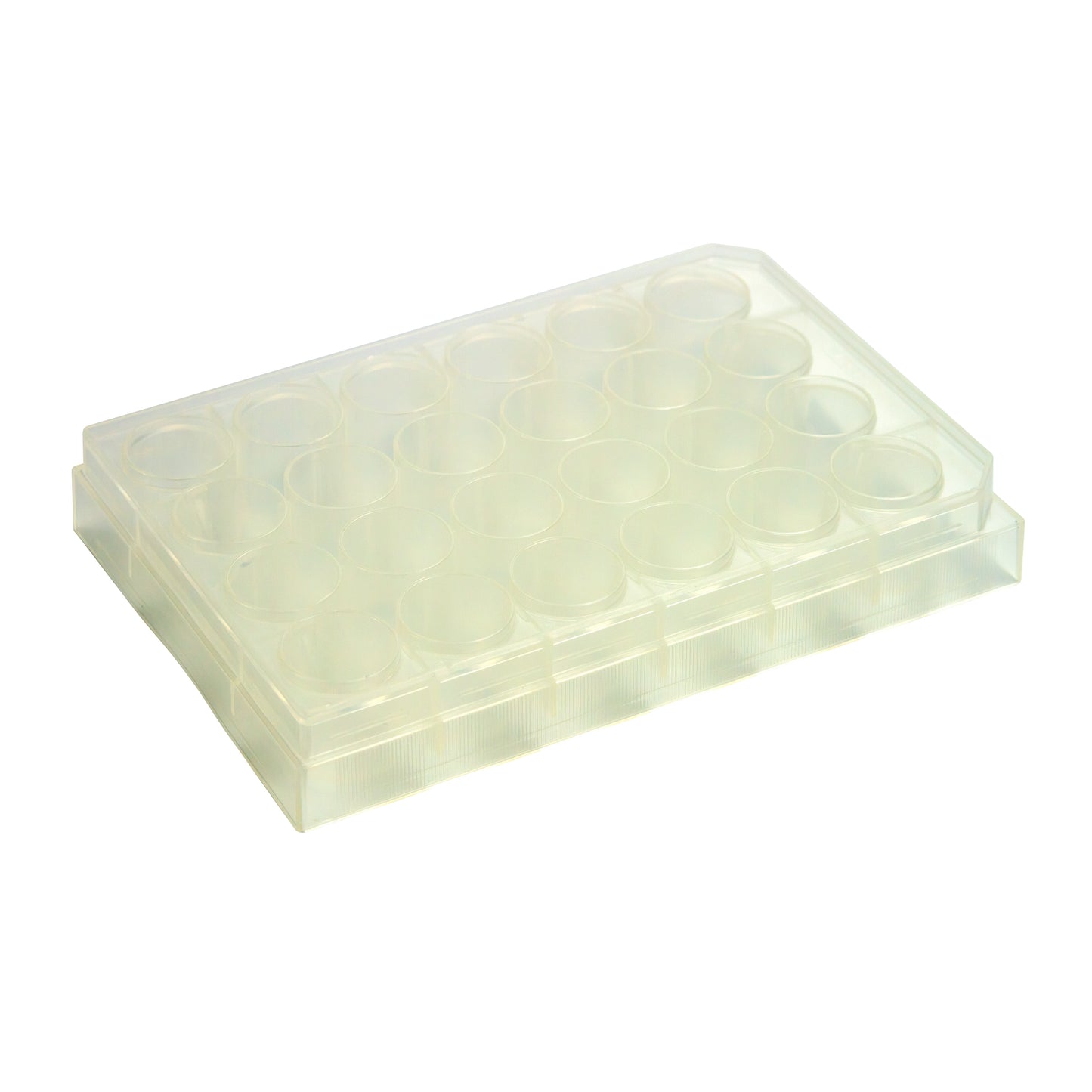
24-Well Flat Bottom Microplates, 3.5 mL Well Volume, PP, Natural — 290-8324-03F | 10/Bag (100/Case)
| Quick Reference — 290-8324-03F | |
|---|---|
| Well Format | 24-well SBS/ANSI standard footprint |
| Bottom | Flat Bottom |
| Well Volume | 3.5 mL per well |
| Material | Polypropylene (PP) |
| Color | Natural (transparent) |
| DMSO Compat. | ✓ All concentrations — key PP advantage over PS |
| Autoclave | ✓ Compatible (121°C / 15 psi) |
| Sterility | Non-Sterile |
| Pack Size | 10/Bag (100/Case) |
| Price | $159.51 / Bag ($1.5951 / plate) |
Technical Narrative
The Caplugs® Evergreen is a 24-well flat-bottom Polypropylene (PP) microplate — the chemical-resistant alternative to the PS 24-well format for cell culture and assay applications requiring DMSO tolerance or autoclave sterilization. PP is compatible with DMSO at all concentrations, where PS 24-well plates can crack, warp, or leach plasticizers at DMSO concentrations above approximately 10%. For drug discovery cell-based assays delivering DMSO compound formulations at working concentrations of 0.1–1% DMSO from 10–100% stock solutions, PP provides the material confidence that PS cannot. PP is also autoclave-compatible at 121°C for pre-sterilization — enabling sterile plate supply without irradiation or EO sterilization infrastructure.
The 3.5 mL well volume and flat bottom match the PS 24-well standard — cells, reagent volumes, and protocol parameters from validated PS 24-well methods transfer directly to PP format. PP's natural translucent finish provides visual cell monolayer assessment, though with slightly reduced transparency versus PS. PP's broad resistance to acids, alkalies, detergents (RIPA, NP-40, Triton X-100), and chlorinated solvents makes it the 24-well format of choice for assays involving lysis buffers, extraction reagents, or aggressive compound formulations.
At $159.51 per Bag of 10 — $1.5951 per plate — the PP plate carries a modest premium over the PS variant (290-8124-01F, $137.89/box) that is justified whenever DMSO compound delivery, organic solvent exposure, or autoclave sterilization are part of the workflow.
Technical Specifications — Caplugs® Evergreen
| Specification | Value |
|---|---|
| Part Number | |
| Caplugs Item # | 290832403FE1 |
| Well Format | 24-well SBS/ANSI standard footprint |
| Bottom | Flat Bottom |
| Well Volume | 3.5 mL (working volume ~1–3 mL) |
| Material | Polypropylene (PP) |
| Color | Natural (translucent) |
| DMSO Compat. | ✓ All concentrations — resistant where PS fails |
| Autoclave | ✓ Compatible (121°C / 15 psi) |
| Sterility | Non-Sterile |
| Pack Size | 10/Bag (100/Case) |
| vs PS plate | 290-8124-01F PS variant at $137.89/box — PP costs more but autoclave/DMSO advantage |
| BPA/Phthalate | BPA-free; no phthalate plasticizers |
| Country of Origin | Made in U.S.A. (California) |
PP 24-Well Plate Workflow Compatibility — DMSO & Autoclave Advantage
PP 24-well plates are specified over PS when DMSO tolerance or autoclave sterilization is required. Key applications:
| Application | Assay / Use | Notes |
|---|---|---|
| DMSO compound-treated culture | High-DMSO compound formulation cell treatments | PP resists DMSO at all concentrations — standard PS fails at >10% |
| Organic solvent-based assays | Lipophilic compound dissolution in DMSO/EtOH | PP broad organic solvent resistance vs PS |
| Autoclave-sterilized culture | Pre-sterilized 24-well plates for primary cells | PP autoclave-compatible — PS cannot be autoclaved |
| Harsh reagent cell assays | Acid/alkali treatment, solvent extraction steps | PP resists a broader range of reagents than PS |
| Virus propagation (sterile) | CPE assay, TCID50 in autoclave-sterilized plates | PP withstands autoclave for sterile virus propagation plates |
| Primary cell culture | Neurons, keratinocytes, hepatocytes requiring sterile plates | Autoclave PP before use for demanding primary cell protocols |
| Environmental / toxicology | Solvent or acid-based sample exposure assays | PP chemical resistance for non-aqueous sample matrices |
| Organoid culture (DMSO media) | 3D organoid culture with DMSO-containing supplements | PP tolerates DMSO supplements that stress PS plates |
PP plates are naturally translucent — slightly less transparent than PS, but sufficient for visual cell monolayer assessment. For standard aqueous cell culture without DMSO/autoclave requirements, PS 24-well (290-8124-01F) is the cost-effective choice.
Chemical Resistance — Polypropylene (PP)
PP provides the broadest chemical resistance of standard microplate polymers including full DMSO compatibility and autoclave sterilization capability.
| Reagent / Condition | Compatibility |
|---|---|
| Aqueous buffers | ✓ Excellent |
| Cell culture media | ✓ Excellent |
| DMSO (≤100%) | ✓ Excellent — key advantage over PS |
| Short-chain alcohols | ✓ Excellent |
| Dilute acids / alkalies (<30%) | ✓ Excellent |
| Chloroform / hexane (brief) | ✓ Good |
| Detergents (RIPA, NP-40) | ✓ Good |
| Autoclave (121°C / 15 psi) | ✓ Compatible — key advantage over PS |
| Concentrated strong acids | ✓ Good |
Laboratory Applications
The serves drug discovery cell-based assay programs delivering DMSO compound formulations; primary cell culture programs requiring autoclave-sterilized plates; virology programs needing sterile PP plates for virus propagation; environmental and toxicology assays with organic solvent or acid/alkali exposure; organoid culture with DMSO-containing supplement formulations; and any 24-well application where PS chemical resistance is a documented limitation.
U.S. Manufacturing, Quality & Institutional Procurement
Every Caplugs® Evergreen lot is precision-molded at our California manufacturing facility and subject to rigorous dimensional inspection and material purity verification. We supply reference laboratories, hospital systems, biotech firms, and federal procurement offices under institutional pricing programs with blanket-order support and same-day shipping on stocked inventory. Request a sample below to validate before committing to volume.
Frequently Asked Questions — Caplugs® Evergreen
When should I use PP 24-well instead of PS 24-well (290-8124-01F)?
Choose PP when your protocol involves: (1) DMSO at working concentrations >0.5% — PP resists all DMSO concentrations where PS can stress or leach; (2) Autoclave sterilization — PP withstands 121°C, PS cannot be autoclaved; (3) Organic solvent extraction — chloroform, hexane, EtOAc exposure; (4) Concentrated acid/alkali treatment; (5) Lysis buffers with RIPA or NP-40 at high concentration. For standard aqueous cell culture and plaque assay, PS is equivalent at lower cost.
Is the PP 24-well plate autoclave-compatible for sterile cell culture?
Yes. PP is autoclave-compatible at 121°C / 15 psi. Autoclave in a sealed pouch and allow to cool before use. PP maintains dimensional stability through repeated autoclave cycles — it does not warp like PS at elevated temperatures. This makes PP the material of choice for laboratories sterilizing plates between uses or pre-sterilizing for primary cell culture and pathogen propagation.
Are the PP 24-well plates BPA-free?
Yes. The is molded from virgin Polypropylene (PP) containing no BPA and no phthalate plasticizers.
Share