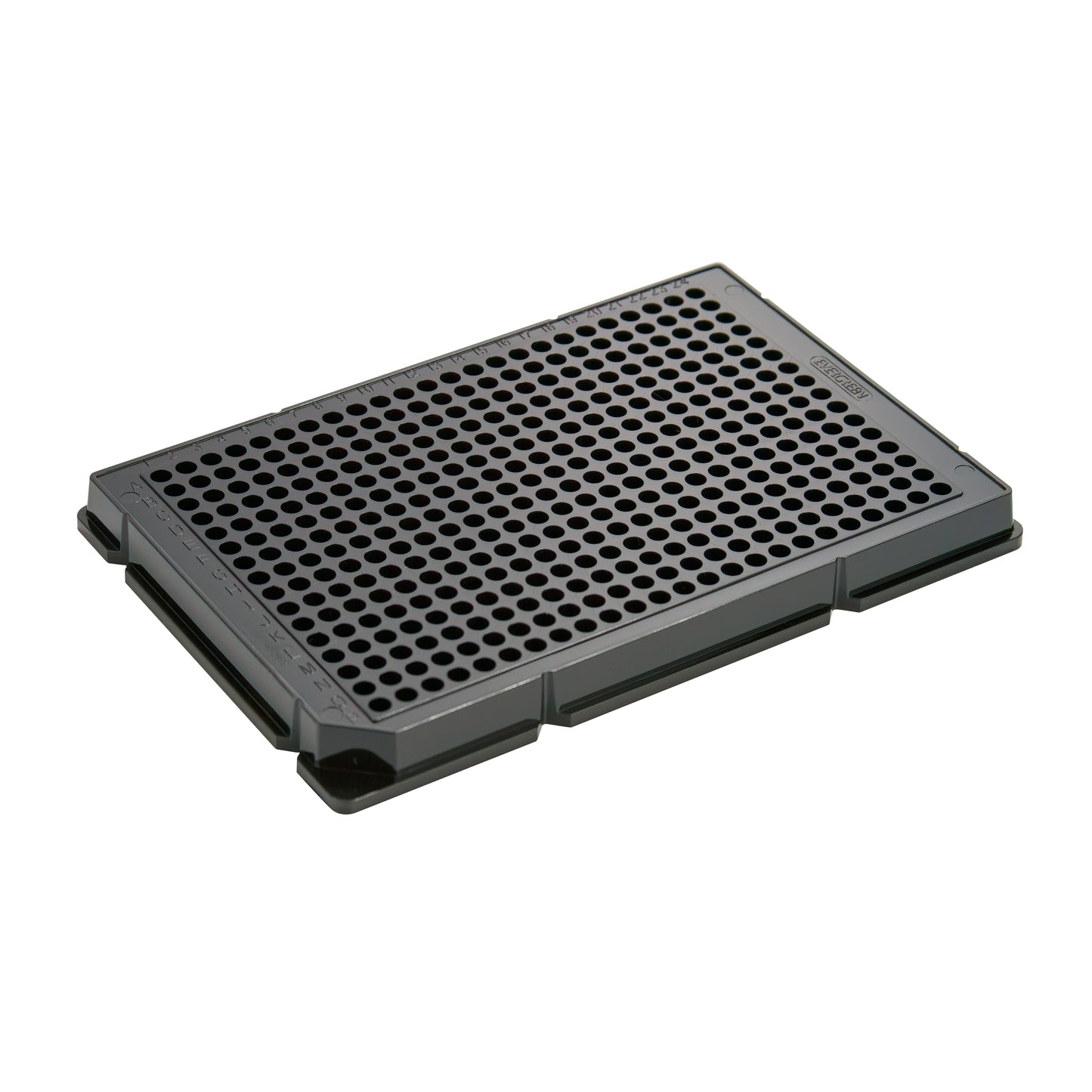

384-Well Flat-Bottom Black Microplates, 0.112 mL — Thermo Fisher® Compatible PS, 12/Box (290-8225-Z10)
These 384-well flat-bottom microplates from Caplugs® Evergreen deliver low-background fluorescence performance in polystyrene (PS) black construction, with a 0.112 mL well volume and SBS/ANSI standard footprint for seamless integration into automated HTS workflows. Black PS well walls absorb stray and reflected photons that cause well-to-well optical cross-talk — a particularly significant interference source at 384-well density — providing 5–20× lower fluorescence background versus natural or white 384-well plates. Supplied non-sterile in boxes of 12 (60 plates per case), part number 290-8225-Z10 is the preferred format for HTRF, TR-FRET, FRET, and fluorescence intensity assays at pharmaceutical and biotech HTS scale.
Technical Specifications
| Specification | Value |
|---|---|
| Part Number (MPN) | 290-8225-Z10 |
| Well Format | 384-well, SBS/ANSI standard footprint |
| Well Bottom | Flat Bottom |
| Well Volume | 0.112 mL |
| Material | Polystyrene (PS) |
| Color | Black |
| Fluorescence Performance | Low background — 5–20× lower than white or natural PS |
| Sterility | Non-Sterile |
| Pack Size | 12/Box (60/Case) |
| BPA / Phthalates | BPA-free; no phthalate plasticizers |
| Country of Origin | USA |
Applications
- HTRF & TR-FRET screening: Black 384-well is the industry standard for LanthaScreen, LANCE, and HTRF kinase/GPCR assays, where suppressing plate autofluorescence and donor-signal leakage is critical at high well density
- Fluorescence intensity HTS: GFP, RFP, and FITC fluorescence intensity assays at 384-well scale; black walls eliminate adjacent-well cross-talk that would inflate background in natural or white plates
- FRET assays: Donor/acceptor FRET pairs run at high throughput with minimized donor bleed-through across the dense 384-well array
- Fluorescent reporter gene screening: GFP/RFP reporter assays where low autofluorescence is required to resolve modest fold-changes in signal
- High-content imaging: Flat-bottom well geometry maintains a consistent optical path length for quantitative fluorescence intensity reads across all wells
Compatibility
These plates conform to the SBS/ANSI standard 384-well footprint and are designed as a Thermo Fisher®-compatible format, fitting standard 384-well-capable plate readers and liquid-handling automation without adaptation. Compatible fluorescence readers include the PHERAstar FSX, EnVision, Synergy Neo2, and CLARIOstar, as well as other instruments that accept standard SBS 384-well plates in fluorescence detection mode. For luminescence HTS workflows requiring maximum signal capture, Caplugs® Evergreen also offers the white 384-well plate (290-8221-W10); for ELISA and qPCR applications, the natural 384-well plate (290-8217-010) is available.
Chemical Resistance
| Reagent / Condition | Compatibility |
|---|---|
| Aqueous buffers / saline | Excellent |
| Dilute acids and bases | Good — typical assay concentrations |
| DMSO (low concentration, <1%) | Good — short-term contact at typical HTS concentrations |
| Ethanol / methanol (>70%) | Not recommended |
| Acetone | Not recommended |
| Chlorinated / aromatic solvents | Not recommended |
| Autoclave | Not compatible — PS is not autoclavable |
Quality & Procurement
Made in USA, these Caplugs® Evergreen microplates are produced from BPA-free, phthalate-free polystyrene resin under ISO 9001 quality management, ensuring lot-to-lot consistency in optical performance that HTS programs depend on. LabSupplies.com is an authorized Caplugs® Evergreen dealer shipping from USA inventory.
Frequently Asked Questions
Why choose a black plate over a white plate for fluorescence assays?
Black PS well walls absorb stray light and reflected photons from adjacent wells, yielding 5–20× lower fluorescence background compared with white or natural plates. White plates maximize signal by reflecting light back to the detector — which benefits luminescence assays — but that same reflectance amplifies well-to-well cross-talk in fluorescence intensity and FRET assays, especially at 384-well density where wells are closely spaced.
Are these plates compatible with standard 384-well plate readers and automation?
Yes. The SBS/ANSI standard footprint is accepted by all major 384-well-capable plate readers — including the PHERAstar FSX, EnVision, Synergy Neo2, and CLARIOstar — as well as robotic liquid handlers and stackers that support the standard 384-well format.
Are these microplates sterile?
No — they are supplied non-sterile. For cell-based fluorescence assays requiring sterile conditions, aseptic handling under a biosafety cabinet is recommended prior to use.
What DMSO tolerance should I expect for compound screening?
Polystyrene offers adequate short-term resistance to DMSO at the low concentrations typical of HTS compound additions (generally below 1%). Higher DMSO concentrations or prolonged contact are not recommended, as PS can be attacked by concentrated organic solvents.