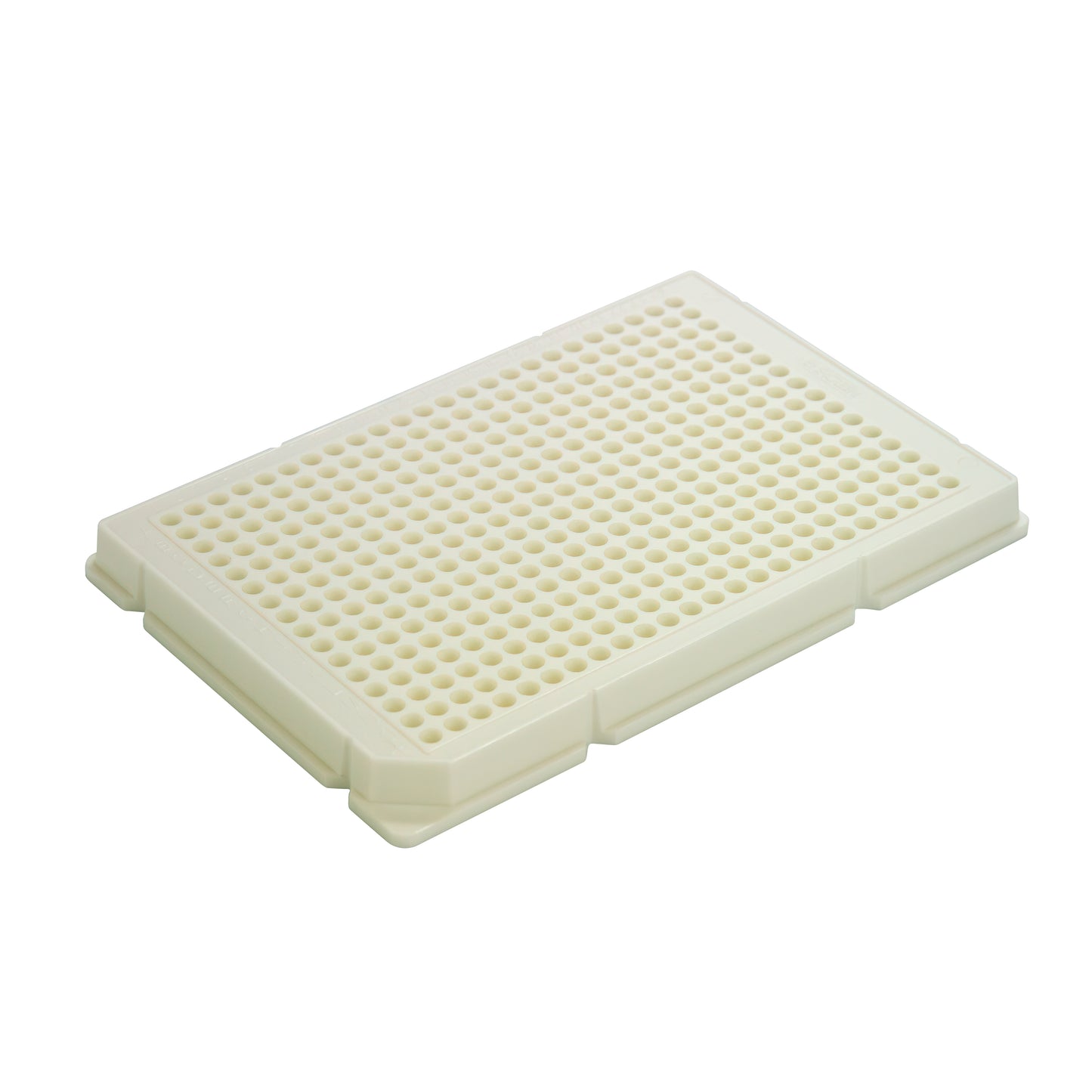

384-Well Flat-Bottom Microplates, White Polystyrene — HTS & Luminescence Assays, 12/Box (290-8221-W10)
These Caplugs® Evergreen 384-well flat-bottom microplates feature a white polystyrene (PS) construction in an SBS/ANSI standard footprint, with a 0.112 mL well volume suited to working volumes of 20–80 µL per well. The white well walls reflect photons back toward the plate reader detector, delivering significantly higher luminescence signal than natural PS plates — making this format the preferred choice for pharmaceutical HTS reporter programs, CellTiter-Glo viability assays, and chemiluminescence ELISAs run at 384-well scale. Supplied non-sterile in boxes of 12 (60/Case), part number 290-8221-W10 is engineered for labs transitioning compound screening or ELISA workflows from 96-well to 384-well to maximize throughput and reduce reagent consumption.
Technical Specifications
| Specification | Value |
|---|---|
| Part Number (MPN) | 290-8221-W10 |
| Well Format | 384-well, SBS/ANSI standard footprint |
| Bottom Style | Flat Bottom |
| Well Volume | 0.112 mL per well |
| Working Volume Range | 20–80 µL per well |
| Well Inner Diameter | ~3.7 mm |
| Material | Polystyrene (PS) |
| Color | White |
| Sterility | Non-Sterile |
| Pack Size | 12/Box (60/Case) |
| Country of Origin | USA (California) |
Applications
- Luminescence HTS: Luciferase and NanoLuc reporter gene screening in 384-well format — white wells reflect photons back toward the detector for 2–5× higher signal versus natural PS plates
- Cell Viability Assays: CellTiter-Glo and other ATP bioluminescence assays at 384-well HTS scale, where white-plate signal enhancement improves sensitivity and Z′ factor
- Chemiluminescence ELISA: HRP-ECL ELISA run in high-throughput 384-well format, with white well walls boosting chemiluminescent signal sensitivity
- BRET Assays: NanoBRET and standard bioluminescence resonance energy transfer assays where white-plate photon reflection supports donor/acceptor signal capture
- AlphaScreen / AlphaLISA: Bead-based proximity amplification assays that benefit from enhanced white-plate signal output in 384-well density
- Compound Library Screening: Pharmaceutical and biotech HTS programs shifting from 96-well to 384-well to achieve 4× assay throughput at the same SBS plate footprint and automation infrastructure
Compatibility
These plates conform to the SBS/ANSI 384-well standard footprint, ensuring drop-in compatibility with 384-channel liquid handlers, 384-well microplate readers (luminescence, fluorescence, and absorbance), automated plate stackers, and high-density storage systems. The flat-bottom well geometry provides a consistent optical path length for well-bottom luminescence detection, a requirement for quantitative HTS reporter and viability assays. Labs currently running 96-well workflows can migrate directly to this 384-well format without changing their automation or plate reader infrastructure — quadrupling compound throughput and reducing reagent volume per data point by approximately 75%.
Chemical Resistance
| Reagent / Condition | Compatibility |
|---|---|
| Aqueous buffers, PBS, HBSS | Excellent |
| Dilute salt solutions, serum, plasma | Excellent |
| DMSO (low concentration, ≤1%) | Acceptable — typical HTS compound dilution |
| Ethanol >70% / isopropanol | Not recommended |
| Acetone / chloroform / aromatic solvents | Not compatible — will craze or dissolve PS |
| Autoclaving | Not compatible — PS is not autoclavable |
Quality & Procurement
Made in USA at Caplugs® Evergreen's California manufacturing facility, these microplates are produced from BPA-free, phthalate-free polystyrene resin under ISO 9001 quality management. LabSupplies.com is an authorized Caplugs® Evergreen dealer, shipping from USA inventory.
Frequently Asked Questions
Why does white polystyrene outperform natural PS for luminescence assays?
White well walls act as a diffuse reflector, bouncing photons emitted from the bottom and sides of each well back toward the plate reader's luminescence detector. This effect typically produces 2–5× higher relative luminescence units (RLU) compared with natural (translucent) PS, improving signal-to-background ratios and assay sensitivity — particularly important in 384-well HTS where working volumes are small.
Are these microplates sterile, and can they be used for cell-based assays?
These plates are supplied non-sterile. For cell-based luminescence viability assays such as CellTiter-Glo, cells are typically lysed as part of the assay workflow, so sterility of the plate itself is not a requirement for the detection step. If your protocol requires culturing cells directly in the plate prior to the assay, consider whether a sterile format is needed and handle accordingly.
What liquid-handling and detection instruments are compatible with this plate format?
Any instrument that accepts the SBS/ANSI 384-well standard footprint — including most major 384-channel liquid handlers, 384-well microplate readers, and automated stacking/de-stacking systems — will accommodate these plates without modification.
How does 384-well format reduce reagent costs versus 96-well?
The 384-well format fits four times as many wells into the same SBS plate footprint, typically reducing per-well working volumes from 100–200 µL (96-well) to 20–80 µL (384-well). For programs screening large compound libraries, that reduction translates to roughly 75% less reagent consumed per data point — a meaningful cost saving for expensive detection reagents such as CellTiter-Glo or AlphaLISA beads.