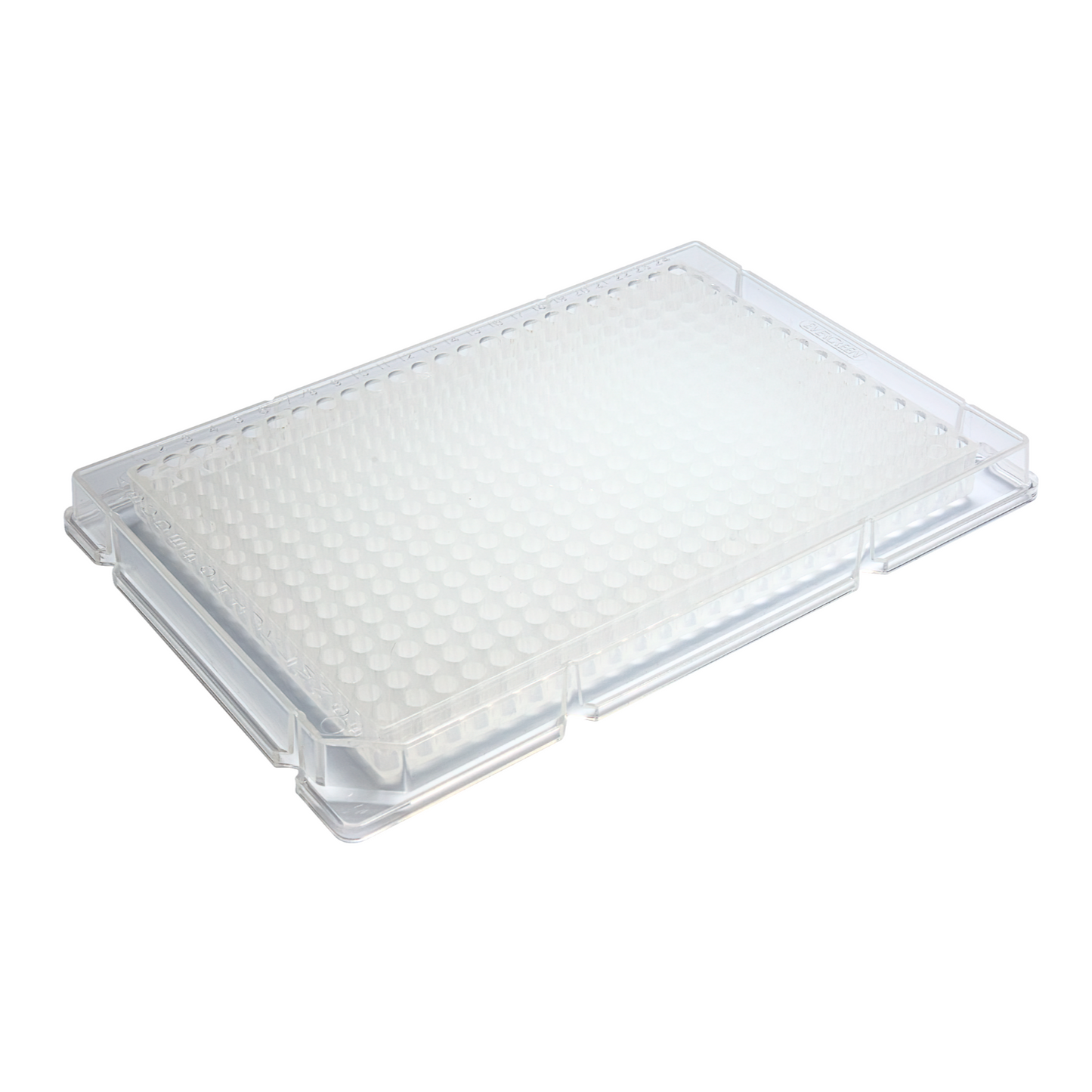

384-Well Flat-Bottom Microplates, Natural Polystyrene — SBS/ANSI Standard Footprint, 12/Box (290-8217-010)
These 384-well flat-bottom microplates from Caplugs® Evergreen are molded from natural polystyrene (PS) in a full SBS/ANSI standard footprint, with a 0.112 mL well volume suited to working volumes of 20–80 µL per well. The flat-bottom geometry delivers a consistent optical path length across all 384 wells, making part number 290-8217-010 a reliable choice for absorbance-based ELISA, fluorescence intensity assays, and qPCR workflows. Supplied non-sterile in 12/Box (60/Case), these plates drop directly into existing 96-well automation infrastructure while quadrupling assay throughput at the same plate footprint.
Technical Specifications
| Specification | Value |
|---|---|
| Part Number (MPN) | 290-8217-010 |
| Well Format | 384-well, SBS/ANSI standard footprint |
| Bottom Style | Flat Bottom |
| Well Volume | 0.112 mL (working volume typically 20–80 µL) |
| Well Inner Diameter | ~3.7 mm |
| Material | Polystyrene (PS) |
| Color | Natural (clear) |
| Sterility | Non-Sterile |
| Pack Size | 12/Box (60/Case) |
| BPA / Phthalates | BPA-free; no phthalate plasticizers |
| Country of Origin | Made in USA (California) |
Applications
- High-Throughput Screening (HTS): Small-molecule compound library screening at 384-well scale reduces reagent consumption approximately 4× versus 96-well format, enabling more compounds per plate run without additional automation investment.
- 384-Well ELISA: Flat-bottom geometry maintains consistent path length for absorbance reads at 450 nm, 405 nm, and 490 nm — a critical requirement when scaling serology or immunoassay workflows from 96-well to 384-well format.
- qPCR / RT-PCR: Natural PS optical properties support real-time PCR detection; pair with a compatible optical adhesive seal for closed-plate cycling.
- Fluorescence Intensity Assays: Natural, transparent PS transmits excitation and emission wavelengths effectively for fluorescence intensity-mode plate readers.
- Cell-Based Compound Screening: Suitable for proliferation and cytotoxicity assays where adherent cell attachment is not required; TC-treated variants are recommended for adherent cell lines.
Chemical Resistance
| Reagent / Condition | Compatibility |
|---|---|
| Aqueous buffers, PBS, saline | Excellent |
| Dilute acids and bases | Good — short-term contact |
| Ethanol (>70%) / isopropanol | Not recommended — PS may craze or cloud |
| Acetone / chloroform / aromatic solvents | Not compatible |
| DMSO (low concentration, ≤1%) | Acceptable for typical HTS working concentrations; verify at higher concentrations |
| Autoclave / heat sterilization | Not recommended — PS is not autoclavable |
Quality & Procurement
Made in USA at Caplugs® Evergreen's California facility, these microplates are produced under ISO 9001 quality management from BPA-free, phthalate-free polystyrene resin. The SBS/ANSI standard footprint is verified for compatibility with 384-channel liquid handlers, 384-well plate readers, and high-density plate stacking systems.
Frequently Asked Questions
What working volume range is recommended for these wells?
Although the maximum well volume is 0.112 mL, best assay performance is achieved with working volumes of 20–80 µL per well, which is standard for 384-well ELISA, HTS, and qPCR protocols.
Are these plates compatible with standard 384-well automation and plate readers?
Yes. The plates conform to the SBS/ANSI 384-well standard footprint, making them directly compatible with 384-channel liquid handlers, robotic plate stackers, and multimode plate readers already in use for 384-well workflows.
Why natural (clear) polystyrene rather than white or black for HTS?
Natural PS is the conventional choice for absorbance-based ELISA and transmission-mode fluorescence intensity reads, where plate transparency is required for the detection mode. White plates are preferred when maximizing reflected luminescence signal; black plates reduce background in low-signal fluorescence assays. Choose the plate color that matches your detection chemistry and instrument mode.
Are these plates sterile, and can they be autoclaved?
These plates are supplied non-sterile. Polystyrene is not autoclavable; if sterility is required for cell-based assays, handle under aseptic conditions or treat the working surface with 70% ethanol and allow to dry before use — noting that prolonged alcohol contact is not recommended for PS.