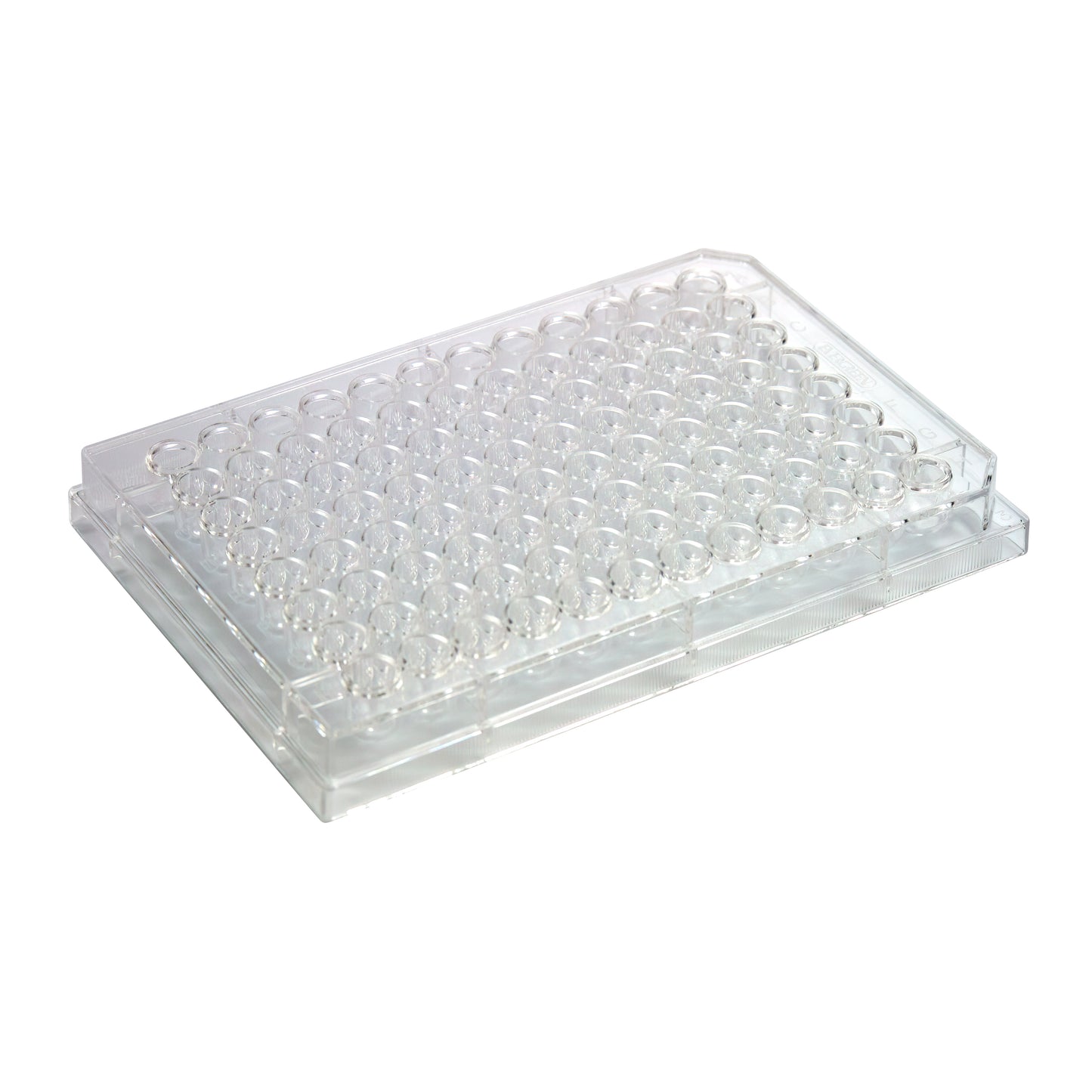

96-Well Conical V-Bottom Microplates, 0.30 mL — Polystyrene, Natural (290-8116-01V), 10/Box
These 96-well conical (V-bottom) microplates deliver complete cell and particle pelleting in a 0.30 mL polystyrene well, supplied non-sterile in a convenient 10/Box (100/Case) format. The V-bottom apex concentrates every cell or bead pellet at a single geometric point, enabling complete supernatant removal with a single aspirate pass and maximum sample recovery from minimal residual volume. The SBS/ANSI standard footprint ensures seamless drop-in compatibility with automated liquid handlers, plate readers, and robotic gripper systems without any deck reconfiguration.
Technical Specifications
| Specification | Value |
|---|---|
| Part Number (MPN) | 290-8116-01V |
| Well Format | 96-Well, SBS/ANSI Standard Footprint |
| Bottom Geometry | Conical (V-Bottom) |
| Well Volume | 0.30 mL |
| Material | Polystyrene (PS) |
| Color | Natural (Clear) |
| Sterility | Non-Sterile |
| Pack Size | 10/Box (100/Case) |
| BPA / Phthalates | BPA-Free; No Phthalate Plasticizers |
| Country of Origin | USA (California) |
Applications
- Complete cell pelleting: V-bottom apex concentrates any cell type at the exact well apex, minimizing pellet loss during supernatant removal
- Supernatant harvest assays: Cytokine quantification and similar workflows benefit from the sharp V-apex, which allows complete aspiration without disturbing the pellet
- Serial dilution (2-fold, 10-fold): V-bottom geometry ensures thorough mixing at small volumes during titration, dose-response, and viral dilution series
- Magnetic bead assays: Bead-based immunoassays and MACS depletion protocols rely on the V-bottom to focus the bead pellet for efficient supernatant aspiration
- Red blood cell (RBC) assays: Blood typing, crossmatch, and direct antiglobulin testing (DAT) — V-bottom is the standard format for RBC agglutination and button assays
- Compound dilution and sample storage: Maximum recovery from the well bottom makes these plates suitable for sample archiving and compound management workflows
Compatibility
The SBS/ANSI standard footprint (127.76 × 85.47 mm) ensures that plates supplied under part number 290-8116-01V integrate directly with all standard plate readers — including SpectraMax, PHERAstar, Synergy, Infinite, and EnVision platforms — as well as automated liquid handlers such as Hamilton and Tecan, Bravo-style pipetting systems, plate washers, and robotic gripper arm systems. No deck adapters or protocol changes are required when substituting these plates into existing workflows that already use SBS/ANSI-format microplates.
Chemical Resistance
| Reagent / Condition | Compatibility |
|---|---|
| Aqueous buffers and saline | Excellent |
| Standard culture media | Excellent |
| Dilute acids and bases | Good |
| Ethanol (>70%) | Not recommended |
| Acetone | Not recommended |
| Chlorinated / aromatic solvents | Not recommended |
| Autoclaving | Not compatible |
Quality & Procurement
Made in USA, these Caplugs® Evergreen microplates are manufactured in California from BPA-free, phthalate-free polystyrene. LabSupplies.com is an authorized Caplugs® Evergreen dealer and ships from USA inventory, with the 10/Box format supporting per-box ordering and the 100/Case configuration available for higher-volume programs.
Frequently Asked Questions
Are these microplates sterile?
No — they are supplied non-sterile. For applications where sterility is not required, such as bead-based assays, RBC typing, serial dilution, and most pelleting workflows, non-sterile plates are the appropriate and more economical choice.
Why does V-bottom geometry matter for cell pelleting?
The conical apex concentrates the entire cell or bead pellet at a single geometric point at the bottom of the well. This allows complete supernatant removal with a single aspirate pass and dramatically reduces cell or bead loss compared to flat-bottom or round-bottom geometries, which spread the pellet across a larger surface area.
Will these plates fit my automated liquid handler and plate reader?
Yes — the SBS/ANSI standard footprint is the industry-wide dimensional specification that all major liquid handler and plate reader manufacturers design to. Instruments including Hamilton, Tecan, Bravo, SpectraMax, PHERAstar, Synergy, Infinite, and EnVision are all compatible without the need for adapters or deck reconfiguration.
Can polystyrene V-bottom plates be used with organic solvents or DMSO?
Polystyrene has excellent compatibility with aqueous buffers and standard biological reagents, but it is not resistant to acetone, high-concentration alcohols, or chlorinated and aromatic solvents. For workflows involving significant organic solvent content, a polypropylene microplate should be considered instead.