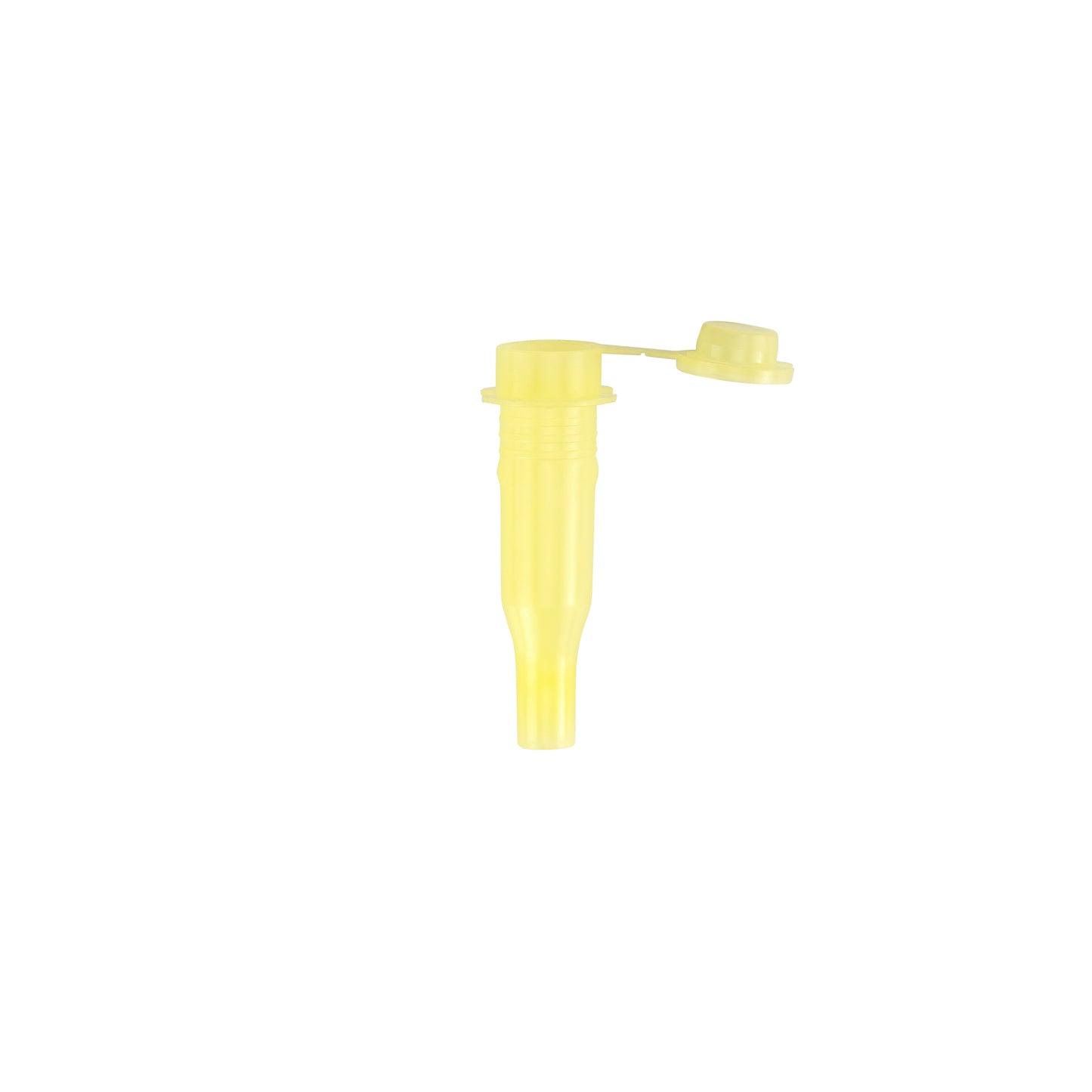

1.0 mL Tethered-Cap Sample Cups for Hitachi/Roche Analyzers — HDPE, Yellow, 1,000/Bag
These 1.0 mL tapered flat-bottom sample cups are precision-molded from High-Density Polyethylene (HDPE) to the dimensional specification of Roche/Hitachi autoanalyzers, and supplied in a 1,000/Bag pack for high-volume clinical chemistry labs. The permanently attached tethered hinged cap is the defining feature: because the cap never separates from the cup body, cap-loss events during rack loading and unloading are eliminated — reducing sample identification errors and contamination risks on busy processing benches. The bright yellow color provides high-visibility cup identification under fluorescent and LED laboratory lighting and supports color-coded workflow tracking across multi-analyte clinical panels.
Technical Specifications
| Specification | Value |
|---|---|
| Part Number (MPN) | 127-1758-Y20 |
| Volume | 1.0 mL |
| Geometry | Tapered Flat Bottom |
| Cap Style | Tethered — permanently attached hinged closure |
| Material | High-Density Polyethylene (HDPE) |
| Color | Yellow |
| Sterility | Non-Sterile |
| Pack Size | 1,000/Bag |
| BPA / Phthalates | BPA-free; no phthalate plasticizers |
| Country of Origin | USA |
Applications
- Primary sample cups for Roche/Hitachi clinical chemistry autoanalyzers running routine serum and plasma panels
- Open-system chemistry processing where tethered caps reduce cap-loss delays and contamination events during high-throughput rack handling
- Color-coded workflow tracking across multi-analyte clinical panels — yellow cups distinguish sample type or priority at a glance
- Stat and batch clinical chemistry runs where dead-volume minimization and consistent aspiration depth are critical
- Reference laboratory and hospital core lab applications requiring reliable bulk supply of analyzer-compatible sample cups
Compatibility
These cups are engineered to the Roche/Hitachi tapered flat-bottom cup specification, with primary compatibility verified for the Hitachi 717, 736, 737, and 747 autoanalyzers. They are also suited for Roche cobas c 111, cobas c 311, cobas c 501, and cobas c 502 platforms, where the tethered cap design is particularly valuable during high-throughput rack loading. The flat-bottom geometry is additionally compatible with flat-cup positions on Beckman Coulter CX3, CX4, CX5 Delta, DxC 600i, and DxC 700i analyzers, as well as Siemens Healthineers Dimension RxL, XL, and Vista instruments and Olympus/Beckman AU400 and AU600 systems — cup well dimensions should be confirmed in the instrument manual before deploying on platforms other than the primary Roche/Hitachi targets. For labs running multiple analyzers, the 127-1758 family is available in additional colors for color-coded workflow integration, allowing single-vendor procurement across cup types without compromising analyzer compatibility.
Chemical Resistance
| Reagent / Condition | Compatibility |
|---|---|
| Aqueous buffers / saline | Excellent |
| Dilute acids and bases | Excellent |
| EDTA and standard clinical chemistry preservatives | Excellent |
| Ethanol and isopropanol | Good — short-term contact acceptable |
| Chlorinated solvents (chloroform, DCM) | Not recommended |
| Aromatic solvents (toluene, xylene) | Not recommended |
Quality & Procurement
Made in USA, these Caplugs® Evergreen sample cups are produced from virgin, BPA-free, phthalate-free HDPE resin. HDPE's natural rigidity maintains the tapered flat-bottom geometry under centrifugation and rack-handling forces, ensuring consistent aspiration depth and minimal dead volume across every cup in the bag.
Frequently Asked Questions
What makes the tethered cap different from a standard snap cap?
The cap on these cups is permanently hinged to the cup body and cannot be separated from it. This eliminates the cap-loss events that cause workflow delays, sample mix-ups, and contamination risks when hundreds of cups are loaded and unloaded from analyzer racks in rapid succession.
Are these cups sterile?
No — they are supplied non-sterile in 1,000/Bag packaging, which is standard for clinical chemistry autoanalyzer sample cups used in routine open-system applications.
Which Hitachi and Roche analyzer models are these cups compatible with?
The tapered flat-bottom geometry is verified for the Hitachi 717, 736, 737, and 747 and for Roche cobas c 111, cobas c 311, cobas c 501, and cobas c 502 platforms. Compatibility with other analyzers that accept flat-bottom cups — including certain Beckman Coulter, Siemens, and Olympus/Beckman models — should be confirmed against instrument cup-well specifications before use.
Why choose HDPE over polystyrene for clinical chemistry sample cups?
HDPE offers superior chemical resistance to the dilute acids, EDTA, and clinical chemistry preservatives commonly encountered in serum and plasma sample processing. Unlike polystyrene, HDPE is not degraded by many of these reagents, and its rigidity helps maintain dimensional consistency under centrifugation and repeated rack handling.