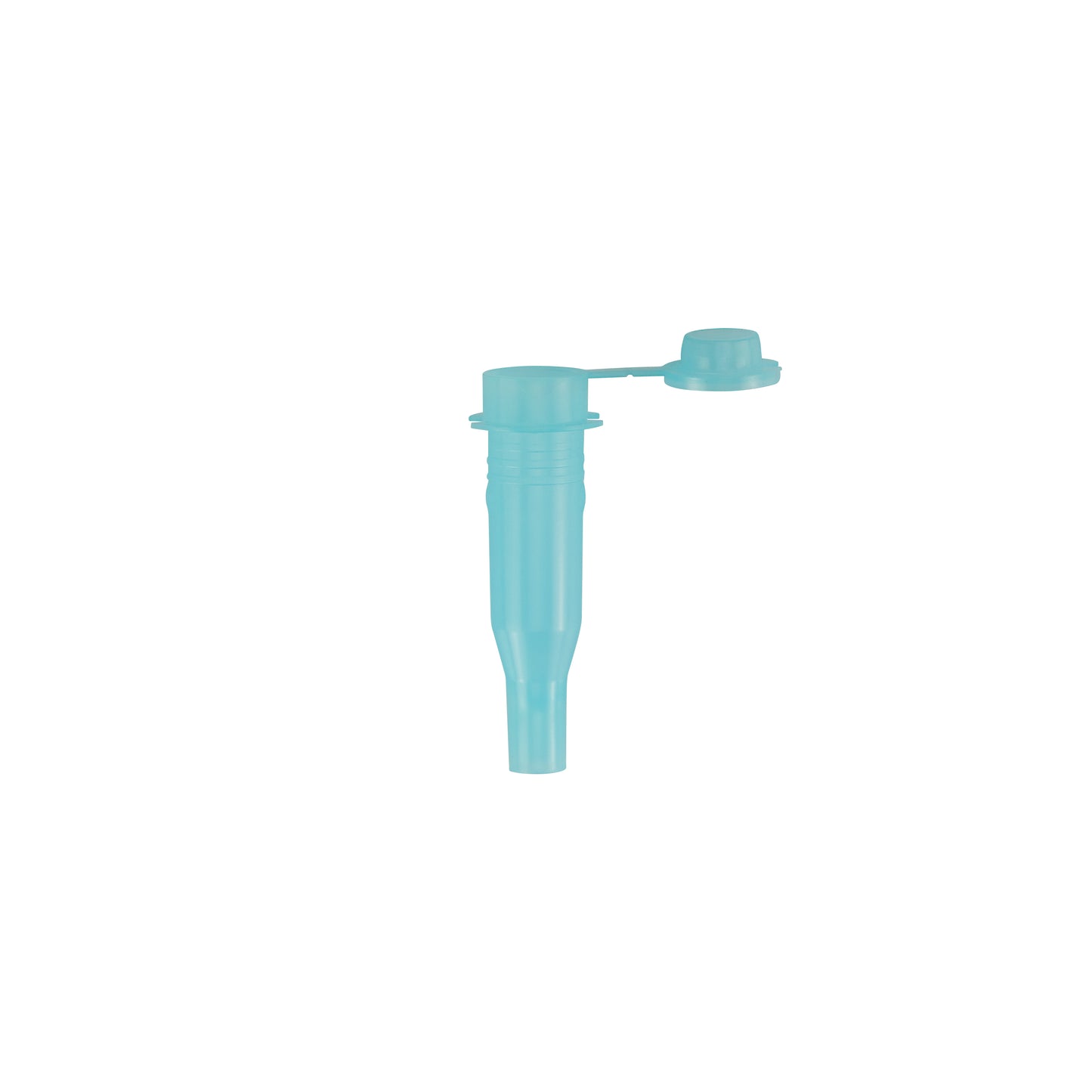

1.0 mL Tethered-Cap Sample Cups for Hitachi/Roche Analyzers — HDPE, Blue, 1,000/Bag
These 1.0 mL tapered flat-bottom sample cups are precision-molded from High-Density Polyethylene (HDPE) to the dimensional specification of Roche/Hitachi autoanalyzers, supplied non-sterile in a 1,000-count bag for high-throughput clinical chemistry workflows. The permanently attached hinged cap — the defining feature of part number 127-1758-B20 — stays tethered to the cup body at all times, eliminating cap-loss events during rack loading and unloading that can cause delays, sample mix-ups, and contamination risks on a busy processing bench. Blue color-coding supports color-sorted specimen staging and processing-lane identification across the instrument deck.
Technical Specifications
| Specification | Value |
|---|---|
| Part Number (MPN) | 127-1758-B20 |
| Volume | 1.0 mL |
| Geometry | Tapered Flat Bottom |
| Cap Style | Tethered — permanently attached, hinged closure |
| Material | High-Density Polyethylene (HDPE) |
| Color | Blue |
| Sterility | Non-Sterile |
| Pack Size | 1,000 / Bag |
| BPA / Phthalates | BPA-free; no phthalate plasticizers |
| Country of Origin | USA (California) |
Applications
- Primary sample cups on Roche/Hitachi clinical chemistry autoanalyzers (717, 736, 737, 747 and compatible cobas platforms)
- Open-system chemistry analyzers requiring a tapered flat-bottom cup position
- Serum, plasma, and whole-blood sample aliquoting for routine clinical chemistry panels
- High-throughput rack loading where tethered caps reduce cap-loss events and contamination risk
- Color-coded specimen staging and processing-lane management on multi-instrument benches
Compatibility
These cups are engineered to the Roche/Hitachi tapered flat-bottom cup specification, with primary compatibility verified for Hitachi 717, 736, 737, and 747 analyzers, as well as Roche cobas c 111, cobas c 311, cobas c 501, and cobas c 502 platforms, where the tethered cap design is especially valuable during high-throughput rack cycling. The tapered flat-bottom geometry has also been reported to fit flat-cup positions on Beckman Coulter CX3, CX4, CX5 Delta, and DxC 600i/700i systems, as well as Siemens Healthineers Dimension RxL, XL, and Vista instruments and Olympus/Beckman AU400, AU600, and AU640 analyzers — always confirm cup-well dimensions against your specific instrument manual before transitioning from OEM supply. For facilities running color-coded workflows, the 127-1758 family is also available in HDPE Natural (127-1758-020) and HDPE Yellow (127-1758-Y20), enabling single-vendor procurement across all three colors and eliminating compatibility risk when mixing cup batches on the same analyzer.
Chemical Resistance
| Reagent / Condition | Compatibility |
|---|---|
| Aqueous buffers / saline | Excellent |
| Dilute acids and bases | Excellent |
| EDTA and clinical chemistry preservatives | Excellent |
| Ethanol and lower alcohols | Good — short-term contact acceptable |
| Chlorinated solvents (chloroform, DCM) | Not recommended |
| Aromatic solvents (toluene, xylene) | Not recommended |
| Acetone | Not recommended |
| Autoclave sterilization | Not recommended |
Quality & Procurement
Made in USA at Caplugs® Evergreen's California manufacturing facility, these sample cups are molded from virgin HDPE resin that is BPA-free and free of phthalate plasticizers, supporting compliance with laboratory material-safety and patient-safety policies. LabSupplies.com is an authorized Caplugs® Evergreen dealer shipping from USA inventory.
Frequently Asked Questions
Are these cups sterile?
No — they are supplied non-sterile in 1,000-count bag packaging. For the vast majority of clinical chemistry autoanalyzer applications, non-sterile cups are the standard specification; consult your laboratory's SOPs if sterility is a protocol requirement.
What makes the tethered cap better than a loose cap for autoanalyzer work?
The cap is permanently hinged to the cup body and cannot be separated, so it cannot be lost during high-throughput rack loading and unloading. This eliminates a common source of processing delays, sample identification errors, and open-well contamination events on busy clinical chemistry benches.
Are these cups compatible with my specific Roche or Hitachi analyzer model?
The tapered flat-bottom geometry of these cups is verified for Hitachi 717, 736, 737, and 747 analyzers and Roche cobas c 111, c 311, c 501, and c 502 platforms. If your analyzer is not on that list, compare the cup-well dimensions in your instrument manual against the 127-1758-B20 dimensions before switching from OEM supply.
Is HDPE a better choice than polystyrene for clinical chemistry sample cups?
For most clinical chemistry applications, HDPE offers superior chemical resistance compared to polystyrene — particularly with EDTA, dilute acids, and standard preservative solutions that can stress or craze polystyrene cups. HDPE's natural rigidity also maintains the tapered flat-bottom geometry under centrifugation and rack-handling forces, supporting consistent aspiration depth and reliable dead-volume minimization.