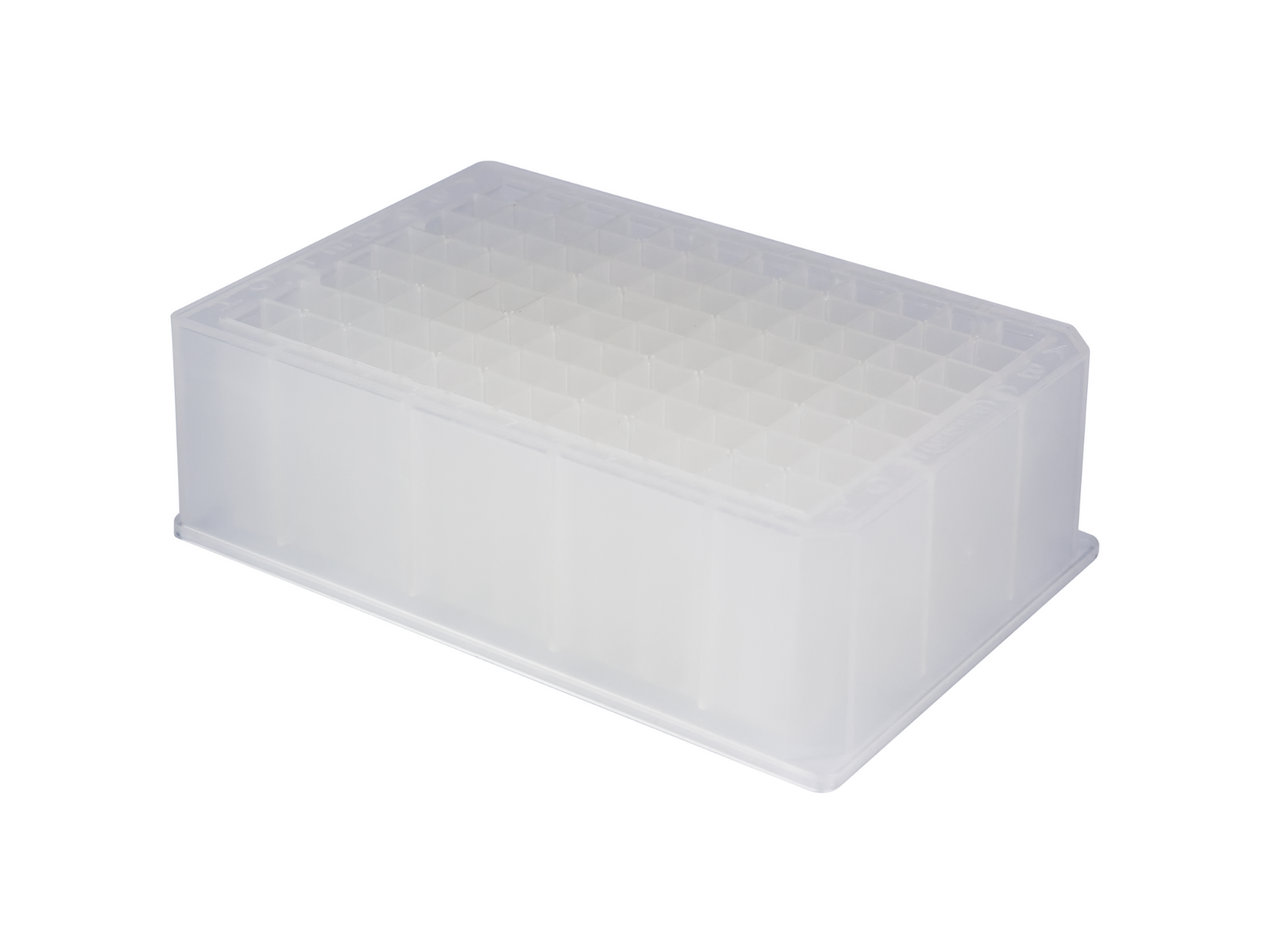

Caplugs® Evergreen 96-Well Deep Well Microplates, PPC, Chamfered Bottom, 2.0 mL, Sterile, Natural, 5/Bag
The Caplugs® Evergreen 96-Well Deep Well Microplate delivers 2.0 mL of usable well volume in a rigid polypropylene copolymer (PPC) format built for sample storage, high-throughput screening, and compound library archiving. Chamfered well bottoms aid complete fluid recovery and automated pipetting, while the sterile, natural-clarity construction supports clean transfer of biological and chemical samples.
Technical Specifications
| Product Type | 96-Well Deep Well Microplate |
| Well Volume | 2.0 mL per well |
| Well Geometry | Chamfered (V-style) bottom |
| Material | Polypropylene Copolymer (PPC) |
| Color | Natural |
| Sterility | Sterile |
| Pack Size | 5/Bag (sold per pack of 20) |
| Country of Origin | USA |
Applications
- Long-term storage of compound and sample libraries
- High-throughput screening and assay preparation
- Sample dilution, reformatting, and aliquoting on automated platforms
- Nucleic acid and protein sample collection prior to extraction
- Reagent reservoir and intermediate transfer in liquid-handling workflows
- Cold-storage banking of biological specimens at -20°C to -80°C
Quality & Procurement
labsupplies.com is an authorized Caplugs® Evergreen dealer shipping from US inventory, and these plates are Made in USA.
Frequently Asked Questions
What is the working volume of each well?
Each well holds a 2.0 mL deep well volume, suitable for sample storage, dilution series, and reformatting tasks that exceed standard microplate capacities.
Are these microplates sterile?
Yes. The plates are supplied sterile, making them appropriate for handling biological samples and cell-derived material without additional decontamination.
Does the chamfered bottom improve sample recovery?
The chamfered well geometry channels residual liquid toward the well base, improving fluid recovery and reducing dead volume during automated or manual aspiration.
What material are the wells made from?
The plates are molded from polypropylene copolymer (PPC), which offers broad chemical tolerance and reliable performance across frozen storage conditions.