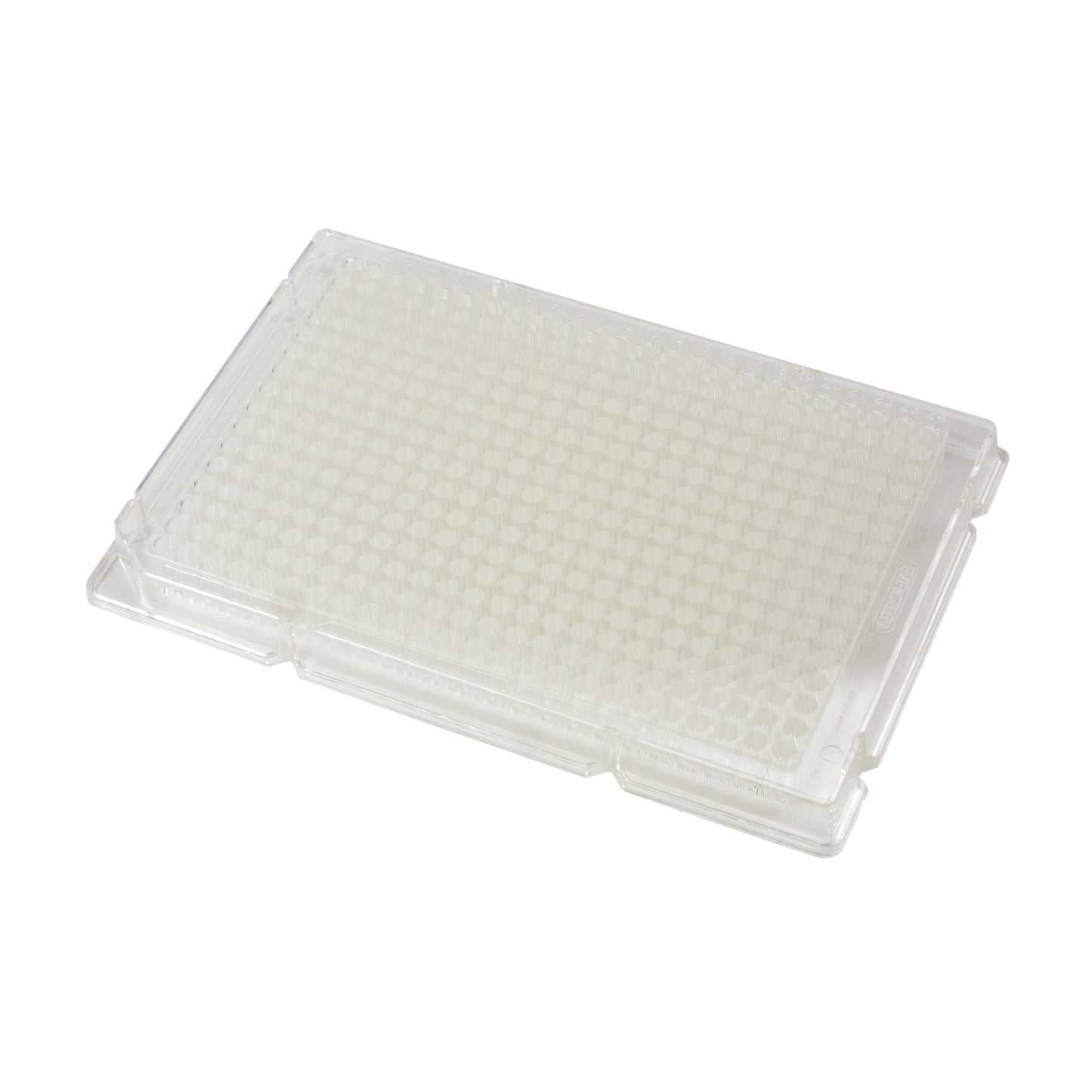

384-Well Flat-Bottom Sterile Microplates with Lid — PS, Natural, 112 µL/Well, 50/Box (222-8210-01I)
These 384-well flat-bottom polystyrene microplates deliver four times the well density of a standard 96-well plate within the same SBS footprint, making them ideal for high-throughput screening, miniaturized ELISA, and compound library workflows. Each well holds 0.112 mL (112 µL), and every plate ships sterile with a matching lid, individually packed — 50 plates per box. The surface-treated PS flat bottom supports adherent cell culture and ELISA coating, and the natural (clear) color enables absorbance plate-reader measurements across 400–750 nm.
Technical Specifications
| Specification | Value |
|---|---|
| Part Number (MPN) | 222-8210-01I |
| Format | 384-well microplate with matching lid |
| Well Bottom | Flat |
| Well Volume | 0.112 mL (112 µL) per well |
| Material | Polystyrene (PS) |
| Color | Natural |
| Lid | Included — individually packed with plate |
| Sterility | Sterile |
| Pack Size | 50/Box, individually packed |
| BPA / Phthalate / Latex | BPA-Free, Phthalate-Free, Latex-Free |
| Country of Origin | USA |
Applications
- High-throughput compound screening (HTS): The 384-well format processes 4× more compounds per run than a 96-well plate in the same footprint, reducing instrument time and reagent consumption proportionally.
- Miniaturized ELISA: The 112 µL well volume supports standard 100 µL/well ELISA protocols while cutting antibody and antigen costs compared with 96-well formats.
- Kinetic enzyme and biochemical assays: PS flat-bottom wells are fully compatible with 384-well plate-reader mode for absorbance, fluorescence, and luminescence readouts.
- DNA/RNA quantification: Compatible with fluorescence-based reagents such as PicoGreen and RiboGreen for high-throughput nucleic acid QC.
- Cell-based HTS assays: Surface-treated PS supports miniaturized cell viability, reporter gene, and compound-dosing assays in a 384-well format.
- Compound dilution libraries: Compatible with automated liquid handlers for 384-well serial dilution and compound cherry-picking workflows.
- PCR product staging: Suitable for post-PCR product transfer and sequencing plate submission in a miniaturized 384-well format.
Chemical Resistance
| Reagent / Condition | Compatibility | Notes |
|---|---|---|
| Aqueous buffers / saline | Excellent | Compatible across pH 4–10 |
| Cell culture media | Excellent | Standard cell culture material |
| Formalin (10%) | Excellent | Compatible for miniaturized cell fixation |
| DMSO (<1%) | Good | Compatible at standard compound screening concentrations |
| Detergents (Tween-20) | Good | Compatible at standard ELISA wash concentrations |
| Methanol (<100%) | Limited | Short-term contact only; avoid prolonged exposure |
| UV (<320 nm) | Not recommended | PS does not transmit UV wavelengths below 320 nm |
| Acetone / chlorinated solvents | Not recommended | PS is not resistant to aggressive organic solvents |
Quality & Procurement
Made in USA, these Caplugs® Evergreen microplates are manufactured from FDA-compliant, BPA-free, phthalate-free, latex-free polystyrene resin. Individual sterile packaging with a matching lid protects well integrity from the moment of manufacture through to point of use — eliminating the pre-use cleaning step and ensuring assay-ready plates every time. LabSupplies.com is an authorized Caplugs® Evergreen dealer and ships from USA inventory, typically same business day for stocking items.
Frequently Asked Questions
Are these microplates sterile, and does that include the lid?
Yes — each plate is individually packed sterile and ships with a matching sterile lid, so the well array is protected without any additional preparation required at the bench.
Will these plates fit standard 384-well plate readers and liquid handlers?
The plates follow the SBS/ANSI footprint standard for microplates, which is compatible with the vast majority of 384-well-capable plate readers, automated liquid handlers, and washers. Confirm 384-well mode is enabled on your specific instrument before running assays.
Can I use these plates for cell culture?
Yes — the polystyrene surface is treated to support adherent cell culture and ELISA coating. They are well suited to miniaturized cell-based assays such as cell viability and reporter gene readouts in the 384-well format.
What pipetting equipment do I need for efficient dispensing into 384-well plates?
For manual dispensing, a 16-channel or 384-channel multichannel pipette is recommended to fill rows or the entire plate efficiently and minimize positional error. Automated liquid handlers with 384-well head configurations are the standard choice in high-throughput screening environments.