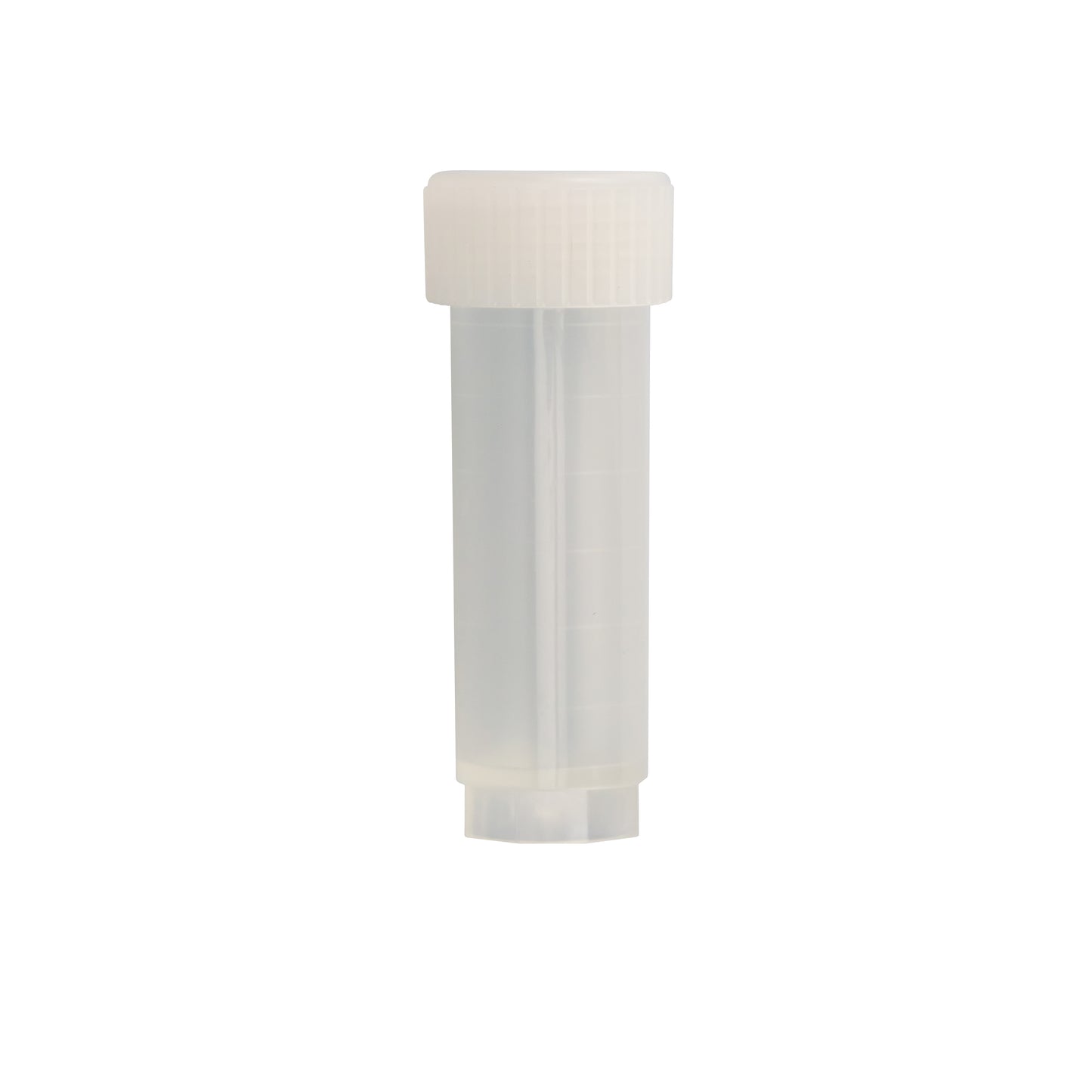

7.0 mL Sterile PPC Transport Vials with Natural Screw Cap — 25/Bag Unassembled
These 7.0 mL sterile transport vials are manufactured from polypropylene copolymer (PPC) and supplied unassembled — tube and natural screw cap together in the same bag — for specimen transport and short-term storage workflows. The 7.0 mL format fills the practical gap between 5.0 mL and 10 mL vials, making it well-suited to stool, urine, and body fluid specimens where collection volume is variable. PPC delivers better optical clarity than standard HDPE for direct visual inspection through the vial wall, full organic solvent and fixative compatibility, and improved flexibility at refrigerator and ice-pack temperatures.
Technical Specifications
| Specification | Value |
|---|---|
| Part Number (MPN) | 222-3007-080 |
| Capacity | 7.0 mL |
| Material | Polypropylene Copolymer (PPC) |
| Color | Natural |
| Cap | Natural screw cap — unassembled (tube + cap in same bag) |
| Sterility | Sterile |
| Pack Size | 25/Bag Unassembled |
| BPA / Phthalate / Latex | BPA-Free, Phthalate-Free, Latex-Free |
| Country of Origin | USA |
Applications
- Clinical specimen transport — screw cap provides leak-resistant closure for courier and mail-in workflows; PPC clarity supports visual specimen inspection on receipt
- Urine collection and transport — 7.0 mL capacity accommodates standard mid-stream urine aliquots with room for preservative addition
- Blood and body fluid sub-aliquoting — sterile vials for analytical sub-fractions split from primary collection tubes at reference laboratories
- Point-of-care specimen collection — compact sterile format integrates into clinic-side or bedside collection kits
- Short-term storage at 4 °C or with ice packs — PPC's cold-temperature flexibility reduces brittleness risk during refrigerated transport
- Small-volume organic extraction protocols — full organic solvent compatibility makes these vials suitable for extraction steps requiring methanol, acetonitrile, or formalin
- Pre-loaded transport media kits — sterile vials for dispensing UTM, VTM, or other transport media ahead of specimen collection
Chemical Resistance
| Reagent / Condition | Compatibility |
|---|---|
| Aqueous buffers / saline (pH 2–12) | Excellent |
| Boric acid (urine preservative) | Excellent |
| Methanol / acetonitrile (<100%) | Excellent |
| Formalin (10%) | Excellent |
| Serum / plasma / urine | Excellent |
| Viral and universal transport media (UTM/VTM) | Excellent |
| Cold storage / ice-pack transport | Excellent |
| Dilute acids (<10%) | Excellent |
Quality & Procurement
Made in USA, these Caplugs® Evergreen vials are produced from FDA-compliant, BPA-free, phthalate-free, and latex-free PPC resin. LabSupplies.com is an authorized dealer and ships from USA inventory, typically same business day for stocking items.
Frequently Asked Questions
Are these vials supplied sterile?
Yes — part number 222-3007-080 is sterile as supplied. The tube and cap ship unassembled in the same bag; caps should be applied using aseptic technique appropriate to your specimen handling protocol.
Why choose PPC over standard polypropylene or HDPE for transport vials?
PPC (polypropylene copolymer) offers improved optical clarity compared with HDPE, allowing visual inspection of specimen color and turbidity through the vial wall. It also retains flexibility at refrigerator and ice-pack temperatures and is fully compatible with organic solvents and fixatives such as formalin — properties that standard HDPE does not consistently provide.
Is 7.0 mL an unusual size — will it work in standard transport racks?
The 7.0 mL format is specifically designed to bridge the gap between 5.0 mL and 10 mL vials for specimens with variable or intermediate collection volumes, such as stool or body fluids. Verify rack and carrier compatibility with your specific transport system before deploying at scale.
Can these vials be used with urine preservatives such as boric acid?
Yes. PPC is fully compatible with boric acid and other standard urine transport preservatives, making these vials appropriate for urine culture and urinalysis transport workflows.