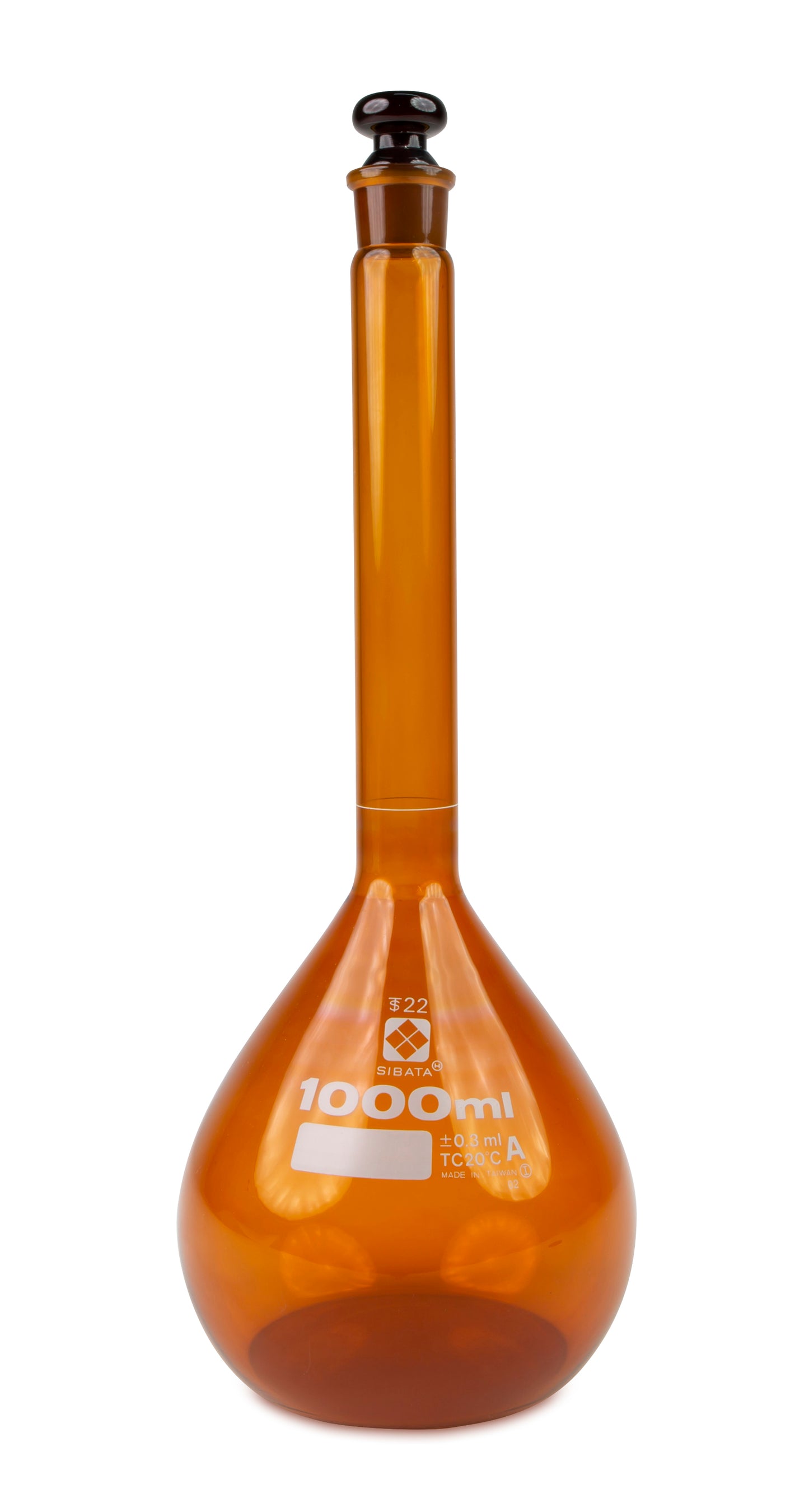

Standard clear borosilicate volumetric flasks expose their contents to the full visible and UV spectrum every moment they sit on a bench. For most solutions this is inconsequential — but for photosensitive compounds, the light exposure during solution preparation and short-term storage is enough to cause measurable degradation. Phenolphthalein indicator solutions, silver nitrate standards, certain drug compounds, dye-based assays, and photolabile chelates all require amber glass protection during the volumetric preparation step itself, not just during final storage. The SIBATA 2307A Series Amber Volumetric Flask is manufactured from low-actinic amber borosilicate glass that blocks the wavelengths responsible for photodegradation while maintaining the full ASTM E-288 Class A accuracy and USP compliance required for quantitative analytical work. The standard taper glass stopper provides a leakproof, solvent-compatible seal. This is the same flask as the 2306A Series in every measurable analytical respect — the amber glass is the only difference, and that difference matters when your analyte is light-sensitive.
Features and Benefits
Low-actinic amber glass blocks photodegradation-causing wavelengths: The 2307A Series is manufactured from low-actinic amber borosilicate glass — the same glass type used in amber reagent bottles and pharmaceutical vials for light-sensitive products. Low-actinic amber blocks the near-UV and short visible wavelengths (typically 300–500nm) that drive photolytic reactions in most photosensitive laboratory compounds. This protection is built into the glass itself, not a coating that can degrade.
Full ASTM E-288 Class A certification and USP compliance: The amber glass does not affect volumetric accuracy. The 2307A Series carries identical ASTM E-288 Class A certification and USP compliance as the clear 2306A Series — with TC calibration at 20°C, sharply defined graduation lines, and individually verified tolerance values. Using an amber flask when your method specifies Class A glassware requires no caveats or corrections.
Standard taper glass stopper included — leakproof and solvent-inert: Every flask ships with a matching ground-glass taper stopper that provides a leakproof seal compatible with virtually all laboratory solvents. The glass-on-glass seal is appropriate for volatile organic solvents, concentrated acids (excluding HF), and other aggressive reagents that would compromise a rubber or plastic closure. Stopper matching ensures a proper fit without the risk of mismatched sizes.
Machine-blown borosilicate body — uniform wall thickness for thermal stability: The machine-blown production process produces consistent wall thickness across every flask in the series, ensuring uniform thermal expansion behavior and reliable resistance to autoclave and hot-plate heating conditions. The heavy-beaded neck is designed for standard taper stopper engagement with the mechanical strength to withstand repeated use without deformation.
Sharply defined graduation line and large marking square: The single volumetric graduation mark is white-fired into the amber glass at uniform width — visible against the amber background and resistant to cleaning agents and solvents. The large marking square is molded into the flask body, providing space for identifying the solution, concentration, preparation date, and analyst information with a laboratory marker.
Autoclavable for sterility-critical light-sensitive preparations: All 2307A Series sizes are autoclavable at 121°C, 15 psi, for standard 20-minute cycles — allowing sterilization of the amber flask before preparing light-sensitive biological media, pharmaceutical solutions, or reagents that require both sterility and photodegradation protection.
Specifications
| Property | Value |
|---|---|
| SKU Series | 2307A Series (2307A-10, 2307A-25, 2307A-50, 2307A-100, 2307A-200, 2307A-250, 2307A-500, 2307A-1000) |
| Brand | SIBATA |
| Type | Volumetric Flask, Amber, Class A, Glass Stopper |
| Glass Type | Low-actinic amber borosilicate |
| Calibration | To Contain (TC) at 20°C (68°F) |
| Accuracy Standard | ASTM E-288 Class A; USP compliant |
| Stopper Type | Standard taper glass stopper (included) |
| Color | Amber |
| Country of Origin | Taiwan |
| Autoclavable | Yes |
| 10 mL | Dims: 28 × 95 mm | Pack of 6 |
| 25 mL | Dims: 39 × 122 mm | Pack of 6 |
| 50 mL | Dims: 49 × 150 mm | Pack of 4 |
| 100 mL | Dims: 60 × 180 mm | Pack of 4 |
| 200 mL | Dims: 75 × 220 mm | Pack of 4 |
| 250 mL | Dims: 78 × 239 mm | Pack of 4 |
| 500 mL | Dims: 100 × 280 mm | Pack of 2 |
| 1000 mL | Dims: 127 × 325 mm | Pack of 2 |
| HTS Code | 7017.20.0000 |
| UNSPSC Code | 41121803 |
| Warranty | 1 Year |
Laboratory Applications
Silver nitrate and halide-sensitive standard preparation: Silver nitrate (AgNO₃) solutions decompose on exposure to light, forming colloidal silver that darkens the solution and shifts the concentration. Preparing and storing AgNO₃ standards in amber Class A volumetric flasks is standard practice in argentometric titrations and halide analysis by ion chromatography or precipitation titration.
Pharmaceutical photosensitive compound assay: Many active pharmaceutical ingredients (APIs) and excipients are photolabile — including riboflavin, certain antibiotics, nitroprusside, and anthracene-based compounds. Preparing assay standards in amber Class A flasks reduces the light-exposure variable during the most critical step of the analytical process: the volumetric preparation of the reference solution.
HPLC fluorescence and UV-Vis standards for light-sensitive analytes: Fluorescent compounds used as HPLC standards (fluorescein, rhodamine, certain PAHs) undergo photobleaching when exposed to ambient light. Preparing calibration standards in amber volumetric flasks and transferring directly to amber HPLC vials eliminates ambient light as a concentration-accuracy variable.
Phenolphthalein and other indicator solution preparation: Phenolphthalein solutions in ethanol or methanol are commonly prepared as 1% or 0.1% standards for acid-base titrations. Extended light exposure causes gradual bleaching of the indicator. Preparing and storing the stock solution in an amber volumetric flask extends the working life of the indicator and reduces indicator-related endpoint variability.
Colorimetric and spectrophotometric standard preparation: Many colorimetric reagents used in environmental and food testing — including iron complexes, chromogenic substrates, and diazonium salt reagents — are sensitive to light-induced decomposition. Preparing calibration curves from standards made in amber Class A volumetric flasks eliminates photodegradation as a source of calibration error.
Frequently Asked Questions
What wavelengths does low-actinic amber glass block?
Low-actinic amber borosilicate glass typically transmits less than 10% of light below approximately 450nm — blocking most near-UV (300–390nm) and blue-violet visible light (390–450nm). These are the wavelengths responsible for photolytic decomposition in the majority of light-sensitive laboratory compounds. The glass transmits green, yellow, and red wavelengths normally, which is why amber glass appears orange-brown rather than opaque.
Is the graduation line readable against the amber glass?
Yes. The graduation line on the 2307A Series is white-fired into the amber glass, providing adequate contrast for meniscus reading under normal lab lighting. For very small sizes (10mL, 25mL) where the neck diameter is narrow, reading against a white card background — standard practice for any volumetric flask — provides additional contrast.
Can I store solutions directly in the amber flask for extended periods?
Yes, for most applications. The glass stopper and amber borosilicate body provide both chemical inertness and light protection for extended storage — this combination is the reason amber volumetric flasks are the preferred container for light-sensitive reference standards that need to be prepared once and used over several weeks. For very long-term storage (months), transfer the solution to an amber reagent bottle with a tightly sealed cap — the volumetric flask stopper seal is reliable but not hermetic enough for multi-month storage of volatile or hygroscopic solutions. Pack quantities: 10mL and 25mL in packs of 6, 50mL through 250mL in packs of 4, 500mL and 1000mL in packs of 2. Each flask includes a matching glass stopper.
Do I need amber flasks for all photosensitive work, or only some steps?
Use amber volumetric flasks at the preparation step for any solution where the compound is known to be photolabile. For subsequent transfers to storage containers, use amber reagent bottles or amber HPLC vials as appropriate. If your SOP specifies protection from light at all handling steps, use amber glassware throughout. If only the preparation step is specified, the 2307A Series covers that specific requirement.
What is the difference between amber glass and aluminum foil wrapping of a clear flask?
Foil wrapping a clear flask provides complete light exclusion but requires operator discipline at every use — rewrapping after every reading or addition. Amber glass provides continuous passive protection without any handling overhead, and the protection is uniform across the entire flask surface rather than depending on wrapping integrity. For regulated environments, amber glass is also easier to document in SOPs and audit logs.
Quality Assurance
SIBATA Scientific Technology has manufactured precision analytical glassware since 1932. The 2307A Series Amber Volumetric Flasks are certified to ASTM E-288 Class A specifications and comply with USP glassware standards. Each flask undergoes individual calibration verification before shipment from SIBATA's ISO 9001-certified production facility. Every flask carries a 1-year manufacturer warranty.
As an authorized dealer, we ship directly from USA inventory.