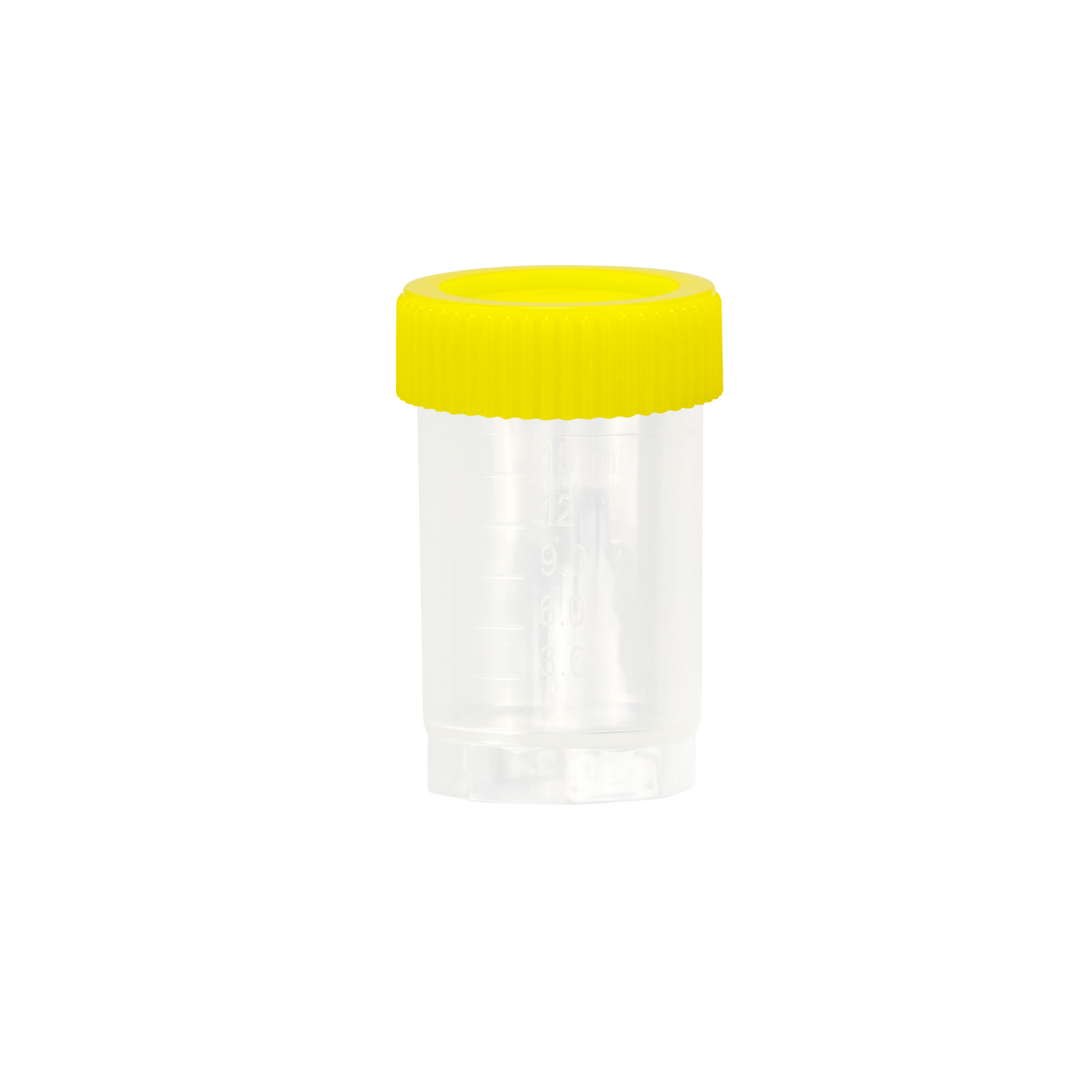

20 mL Freestanding Vials with Yellow Caps — Polypropylene Copolymer, Non-Sterile, 1000/Bag (240-3519-Y80)
These 20 mL polypropylene copolymer freestanding vials from Caplugs® Evergreen feature a stable flat-bottom base, a yellow cap for color-coded specimen management, and are supplied non-sterile in 1000/Bag unassembled format for cost-effective storage and shipping. The large 20 mL capacity accommodates generous specimen volumes for urine culture, environmental collection, molecular banking, and multi-analyte archival workflows where smaller vials create insufficiency risks. Yellow cap coding supports multi-color vial systems used in clinical and research labs to distinguish specimen type, assay batch, department, or processing priority at a glance.
Technical Specifications
| Specification | Value |
|---|---|
| Part Number (MPN) | 240-3519-Y80 |
| Product Type | Freestanding Vial |
| Volume | 20 mL |
| Material | Polypropylene Copolymer (PPC) |
| Cap Color | Yellow |
| Vial Body Color | Natural |
| Base Style | Freestanding Flat Bottom |
| Sterility | Non-Sterile |
| Pack Size | 1000/Bag |
| Format | Unassembled |
| BPA / Phthalate Free | Yes |
| Country of Origin | USA |
Applications
- Urine culture collection and processing — 20 mL volume accommodates full-void specimens without risk of insufficiency
- Swab transport medium elution and environmental specimen collection requiring large-volume containment
- Molecular specimen banking and DNA/RNA archival storage in PPC-compatible format
- Large-volume reagent aliquoting and multi-analyte archival storage in clinical and research workflows
- Color-coded specimen management — yellow cap assignment for specimen type, assay batch, department, or processing priority in multi-cap-color laboratory systems
- Direct bench-top collection, capping, labeling, and processing without external rack infrastructure, enabled by the self-supporting flat-bottom base
- LIMS integration and barcode scanning workflows via label-compatible vial body surfaces
Chemical Resistance
| Reagent / Condition | Compatibility |
|---|---|
| Aqueous buffers and saline | Excellent |
| Dilute acids and bases | Excellent |
| Alcohols (ethanol, isopropanol) | Good — short-term contact |
| Biological specimens (urine, swab media, serum) | Excellent |
| Chlorinated solvents (chloroform, DCM) | Not recommended |
| Aromatic solvents (toluene, xylene) | Not recommended |
Quality & Procurement
Made in USA, these Caplugs® Evergreen vials are manufactured from BPA-free, phthalate-free polypropylene copolymer resin. LabSupplies.com is an authorized dealer carrying USA inventory. The unassembled 1000/Bag format minimizes packaging footprint and simplifies storeroom management for labs ordering in volume.
Frequently Asked Questions
Are these vials sterile?
No — part number 240-3519-Y80 is supplied non-sterile. They are intended for specimen collection, processing, aliquoting, and storage workflows that do not require a sterility guarantee, such as urine culture, environmental sampling, and molecular archival applications.
Do the vials require a rack, or can they stand on their own?
The flat-bottom freestanding base is self-supporting, so no rack or tube holder is needed. Vials can be placed directly on the bench for collection, capping, labeling, and short-term processing without additional infrastructure.
Why are the caps yellow, and can I mix these with other cap colors from the same product line?
Yellow cap color is intended for color-coded laboratory specimen management — commonly assigned to specific specimen types, assay batches, departments, or storage conditions in multi-cap-color vial systems. Caplugs® Evergreen offers freestanding vials in multiple cap colors, so labs running color-coding programs can order by cap color to match their internal coding scheme.
What is polypropylene copolymer, and how does it differ from standard polypropylene?
Polypropylene copolymer (PPC) incorporates a co-monomer into the polymer backbone, which improves impact resistance and low-temperature flexibility compared to standard homopolymer polypropylene while retaining broad chemical compatibility with aqueous buffers, biological specimens, and dilute acids and bases. This makes PPC particularly well suited for specimen storage vials that may be handled repeatedly or refrigerated.