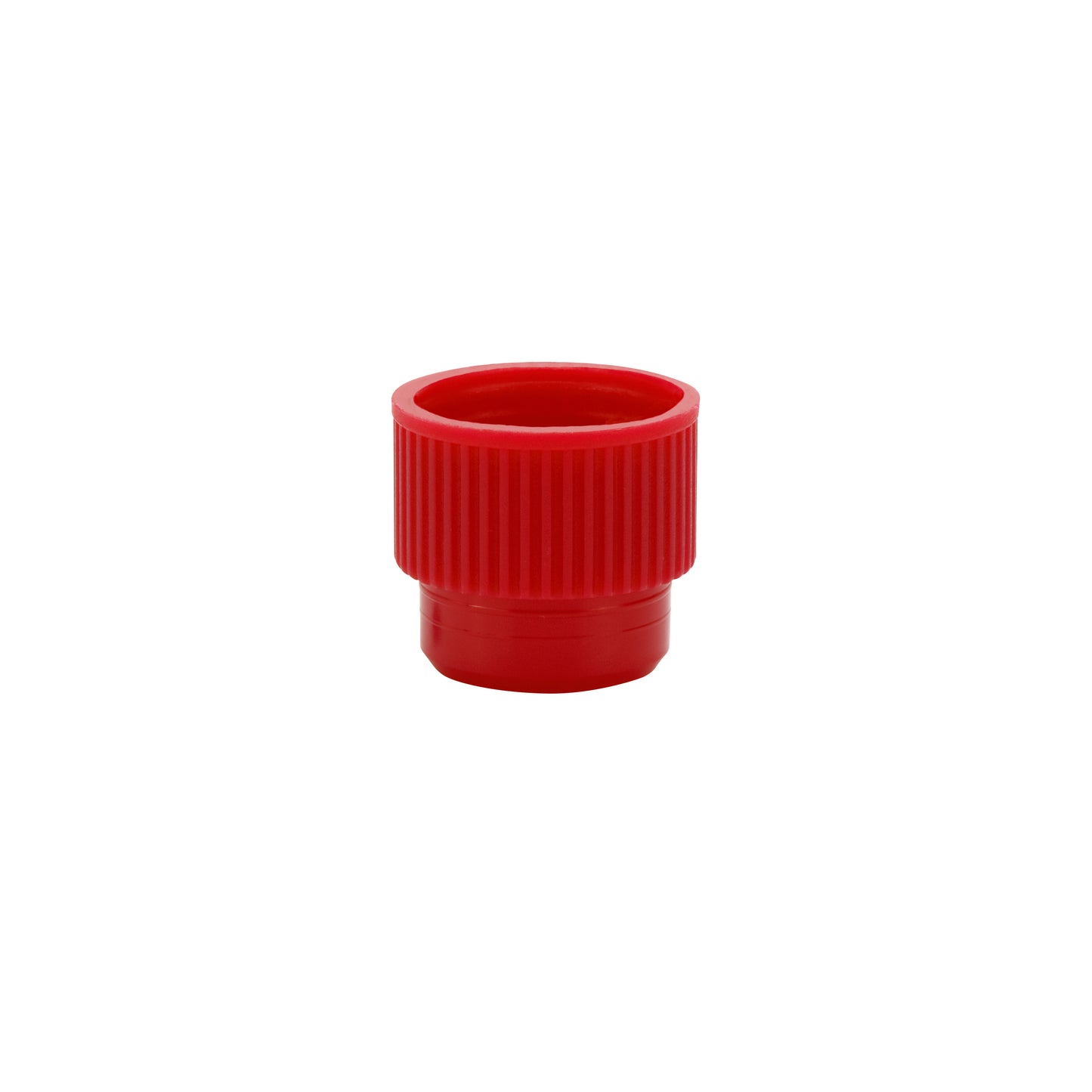

16 mm Test Tube Stoppers — LDPE, Red, 1000/Bag (300-2916-R20)
These red low-density polyethylene (LDPE) stopper caps are engineered for 16 mm OD test tubes — including standard 16 × 100 mm formats — used in clinical chemistry, serology, microbiology culture, and specimen archiving workflows. The plug-in friction-fit design relies on LDPE's characteristic flex modulus to provide consistent compression and spring-back across repeated insertion and removal cycles, maintaining a reliable seal without adhesives or secondary closures. Supplied non-sterile in 1000/Bag, they offer a cost-effective solution for high-throughput tube management at the bench or in clinical sample-processing areas.
Technical Specifications
| Specification | Value |
|---|---|
| Part Number (MPN) | 300-2916-R20 |
| Tube OD | 16 mm |
| Compatible Tube Format | 16 × 100 mm |
| Cap Style | Stopper — plug-in friction fit |
| Material | Low-Density Polyethylene (LDPE) |
| Color | Red |
| Temperature Range | -20°C to +60°C |
| Sterility | Non-Sterile |
| Pack Size | 1000/Bag |
| BPA / Phthalates | BPA-free; no phthalate plasticizers |
| Country of Origin | USA |
Applications
- Clinical specimen archiving: Seals serum, plasma, and whole-blood tubes during refrigerated or frozen long-term storage, preventing evaporation and cross-contamination.
- Microbiology culture tube capping: Retains flexibility at 37°C incubation temperatures, providing a stable closure for TSB, BHI, LB broth, and similar liquid media tubes.
- Cell culture and virus propagation: Stopper-style fit allows controlled gas exchange while blocking environmental contamination during suspension culture workflows.
- Clinical tube color routing: Red mirrors the CLSI H3 red-top serum convention, supporting color-coded specimen-type identification and routing without relabeling.
- Pneumatic tube transport: LDPE flexibility absorbs acceleration forces encountered in clinical pneumatic transport systems without compromising the friction-fit seal.
- Research reagent and buffer tubes: Stopper seals reusable glass and polystyrene tubes between uses during reagent preparation and stock solution archiving.
- Hematology and coagulation: Color-coded stoppers support anticoagulant tube designation for EDTA and citrate tube formats.
Chemical Resistance
| Reagent / Condition | Compatibility |
|---|---|
| Aqueous buffers and saline | Excellent |
| Serum and plasma | Excellent — inert, no leaching |
| Broth media (TSB, BHI, LB) | Excellent |
| Dilute acids and bases | Good |
| Ethanol and isopropanol | Good — short-term contact; avoid prolonged immersion |
| Chlorinated solvents (chloroform, DCM) | Not recommended |
| Aromatic solvents (toluene, xylene) | Not recommended |
| Frozen storage (-20°C) | Excellent — LDPE retains flexibility; no brittle failure |
| Incubation (up to +60°C) | Excellent — seal engagement maintained |
Quality & Procurement
Made in USA, these Caplugs® Evergreen stoppers are produced from BPA-free, phthalate-free LDPE resin under ISO 9001 quality management, ensuring lot-to-lot dimensional consistency critical for reliable friction-fit retention across 16 mm tube formats. LabSupplies.com is an authorized Caplugs® Evergreen dealer shipping from USA inventory. Always validate fit against your specific tube brand before committing to bulk purchase, as 16 mm OD tubes can vary in opening diameter depending on wall thickness — contact us to request a sample.
Frequently Asked Questions
Are these stoppers compatible with all 16 mm test tubes?
They are designed for standard 16 mm OD tubes, including the common 16 × 100 mm format. Because wall thickness varies by manufacturer, the actual opening diameter can differ slightly between tube brands. We recommend validating fit with your specific tubes — contact LabSupplies.com to request a sample before placing a bulk order.
Can these stoppers be used for frozen specimen storage?
Yes. LDPE retains its characteristic flexibility down to -20°C, so the stopper will not become brittle or crack during removal from frozen archives — a common failure mode with more rigid cap materials.
Why is the red color significant in a clinical setting?
Red mirrors the CLSI H3 red-top serum tube convention, making these stoppers a natural fit for color-coded specimen routing that designates serum-containing or no-additive tubes. Staff can identify tube type by color at a glance without retraining.
Are these stoppers sterile, and can they be autoclaved?
These stoppers are supplied non-sterile. LDPE is not autoclavable — sustained exposure to steam autoclave temperatures (121°C) exceeds the material's safe temperature range of -20°C to +60°C and will deform the stopper. For sterile applications, treat with appropriate cold sterilization methods and validate before use.