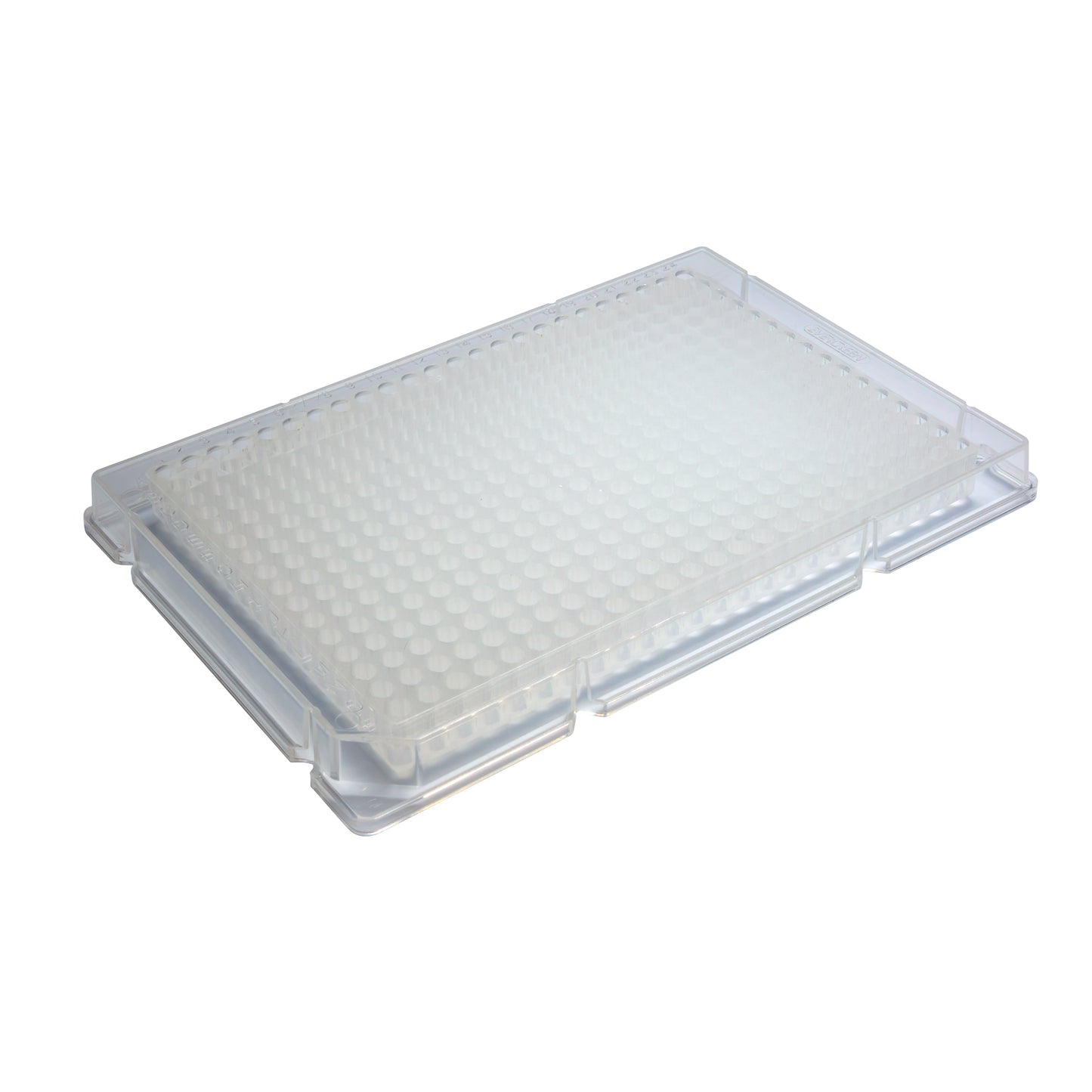

384-Well Flat-Bottom PPC Microplates, 0.112 mL — SBS/ANSI Format, Natural, 10/Box (290-8388-08F)
These 384-well flat-bottom microplates are manufactured from Polypropylene Copolymer (PPC), the highest-performance material in the Caplugs® Evergreen 384-well range, delivering a combination of full DMSO compatibility at all concentrations, -80°C cryogenic archive stability, and 121°C autoclave capability that neither standard polypropylene nor polystyrene can match simultaneously. Each well holds 0.112 mL, plates conform to SBS/ANSI footprint standards, and the natural (translucent) color allows visual inspection of well contents. Supplied 10 plates per box (100 plates per case), part number 290-8388-08F is the material-of-choice for compound library management programs, high-concentration DMSO stock archiving, and any workflow demanding all three performance properties in a single plate format.
Technical Specifications
| Specification | Value |
|---|---|
| Part Number (MPN) | 290-8388-08F |
| Well Format | 384-well |
| Footprint Standard | SBS/ANSI |
| Bottom Geometry | Flat Bottom |
| Well Volume | 0.112 mL |
| Material | Polypropylene Copolymer (PPC) |
| Color | Natural (translucent) |
| DMSO Compatibility | Excellent — all concentrations |
| Cryogenic Storage | Compatible to -80°C |
| Autoclave Compatibility | 121°C / 15 psi |
| BPA / Phthalates | BPA-free; no phthalate plasticizers |
| Pack Size | 10/Box (100/Case) |
| Country of Origin | USA |
Applications
- Compound library archiving at 384-well density, where DMSO tolerance and -80°C cryogenic stability are simultaneous requirements
- High-concentration DMSO compound stock storage (>50% DMSO) where standard PS and PP materials are unsuitable
- Acoustic dispensing source plates (e.g., Echo®, Mosquito®) requiring repeated DMSO-rich dispensing cycles without dimensional drift or material degradation
- Sterile compound plate preparation requiring autoclave-compatible labware
- Ultra-low temperature (-80°C) long-term sample archiving where standard PP may become brittle under sustained cryogenic conditions
- High-throughput screening workflows demanding a single plate format that can move from cryo storage through ambient dispensing to autoclaved sterile supply
Material Advantage: PPC vs. PS and Standard PP
Polypropylene Copolymer (PPC) outperforms both polystyrene (PS) and standard polypropylene (PP) across the three critical performance axes that define compound library management. Standard PS is not autoclavable and degrades with high-concentration DMSO, making it suitable for aqueous HTS and ELISA applications but not for compound archiving. Standard PP is autoclavable and tolerates moderate DMSO, but its dimensional stability and crack resistance under sustained -80°C cryogenic storage are inferior to PPC's copolymer matrix. PPC combines full DMSO resistance at all concentrations, reliable -80°C cryogenic archive performance without cracking or brittleness, and 121°C autoclave capability in one material — a combination that is uniquely required at 384-well scale, where each plate position may represent an irreplaceable compound stock.
Chemical Resistance
| Reagent / Condition | Compatibility |
|---|---|
| DMSO — all concentrations | Excellent — superior to standard PP and PS |
| Aqueous buffers and saline | Excellent |
| Dilute acids and bases | Excellent |
| Alcohols (ethanol, methanol) | Good — short-term contact |
| Cryogenic storage (-80°C) | Compatible — enhanced toughness vs. standard PP |
| Autoclave (121°C / 15 psi) | Compatible |
| Chlorinated solvents (chloroform, DCM) | Not recommended |
| Aromatic solvents (toluene, xylene) | Not recommended |
Quality & Procurement
Made in USA, these Caplugs® Evergreen microplates are produced from BPA-free, phthalate-free PPC resin under ISO 9001 quality management, ensuring consistent dimensional tolerances critical for automated 384-well liquid handling and acoustic dispensing instruments. LabSupplies.com is an authorized Caplugs® Evergreen dealer stocking inventory in the USA. Orders for stocking items typically ship the same business day.
Frequently Asked Questions
Why choose PPC over standard polypropylene or polystyrene for 384-well compound storage?
PPC is the only standard microplate material that simultaneously delivers full DMSO resistance at all concentrations, -80°C cryogenic stability without brittleness, and autoclave compatibility at 121°C. Standard PP is autoclavable but underperforms PPC in DMSO tolerance and sustained cryo toughness. PS handles aqueous assays well but is not autoclavable and degrades with high-concentration DMSO. For compound library programs requiring all three properties, PPC is the appropriate material selection.
Are these microplates compatible with acoustic dispensing systems such as the Echo® or Mosquito®?
Yes — PPC's enhanced dimensional stability and DMSO resistance make these plates well suited for use as source plates in acoustic liquid-handling workflows that involve repeated high-DMSO dispensing cycles. As always, verify plate geometry compatibility with your specific instrument model before committing to a large stock.
Can I move the same plate from -80°C cryogenic storage directly to an acoustic or robotic dispenser at ambient temperature?
PPC's copolymer toughness is specifically designed to withstand the thermal cycling inherent in compound archive workflows — from cryogenic archive at -80°C through ambient-temperature dispensing sessions and back. This resistance to thermal shock-induced cracking is one of PPC's key advantages over standard PP at 384-well density.
Are these plates sterile as supplied?
The plates are not described as sterile in their standard supply configuration. However, because PPC is autoclavable at 121°C / 15 psi, laboratories can sterilize plates in-house prior to use in sterile compound plate preparation workflows.