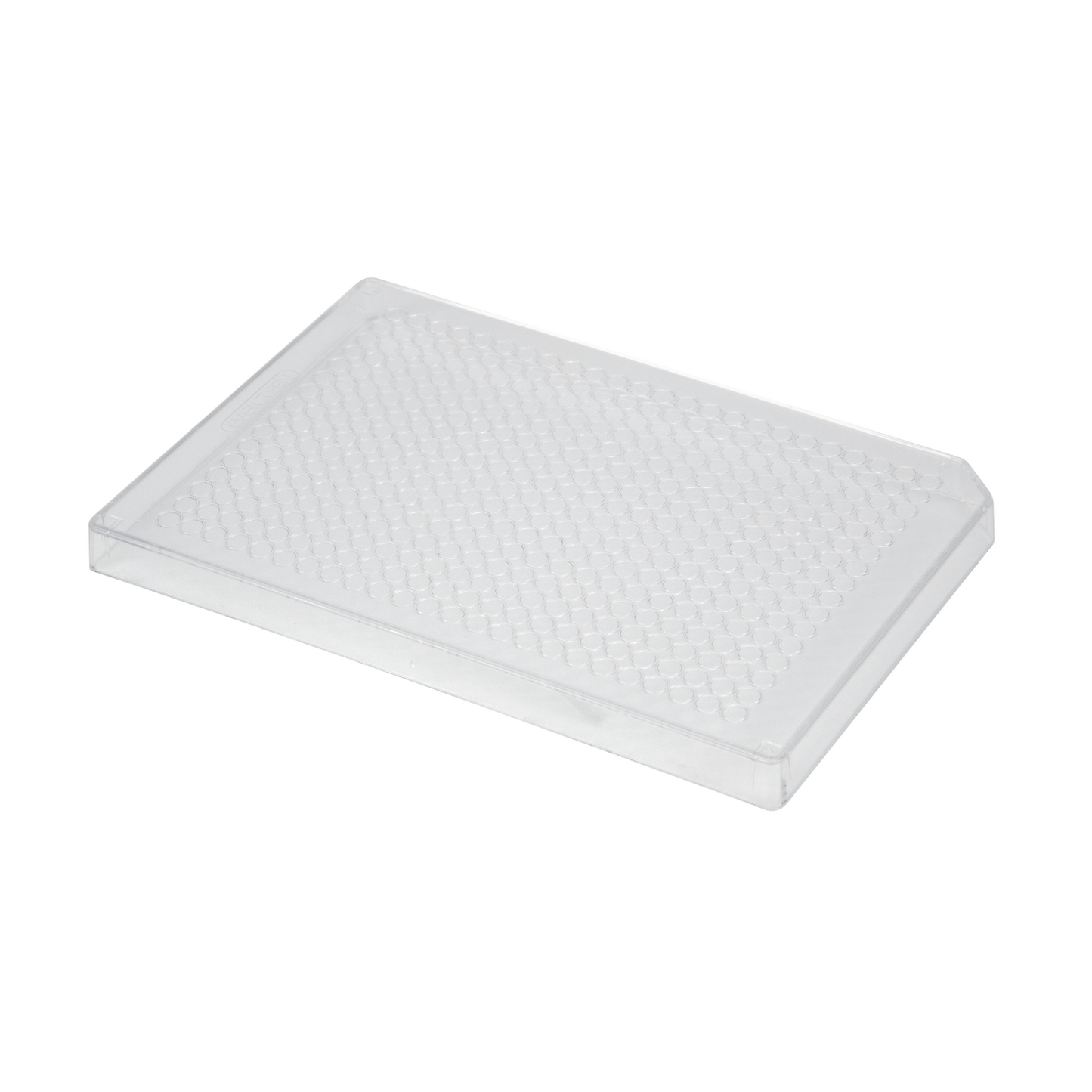

384-Well Microplate Lids, Polypropylene — Natural Transparent, 15/Box (290-8219-03L)
These 384-well polypropylene microplate lids are designed to minimize evaporation from the small-volume wells of SBS/ANSI-standard 384-well plates during incubation, storage, and transport. Because each well holds only 20–120 µL, even modest evaporation produces assay-significant concentration changes — making reliable lid coverage essential for HTS dose-response curves, enzyme kinetics, and cell-based assays. The natural (transparent) PP construction allows visual inspection of plate contents without removing the lid, and PP's broader DMSO tolerance and autoclave compatibility make part number 290-8219-03L a strong choice for compound library workflows and sterilization-required protocols.
Technical Specifications
| Specification | Value |
|---|---|
| Part Number (MPN) | 290-8219-03L |
| Well Format | 384-Well, SBS/ANSI Standard Footprint |
| Material | Polypropylene (PP) |
| Color | Natural (Transparent) |
| Sterility | Non-Sterile |
| DMSO Compatibility | Good — ≤30% |
| Autoclave Compatible | Yes — 121°C / 15 psi |
| Pack Size | 15/Box (105/Case) |
| BPA / Phthalates | BPA-Free; No Phthalate Plasticizers |
| Country of Origin | USA |
Applications
- HTS compound treatment and dose-response assays — lid maintains a humid microenvironment around each well to prevent differential edge-well evaporation during incubation
- Enzyme kinetics and biochemical assays in 384-well format where small absolute volume loss is concentration-significant
- Cell-based 384-well assays in CO₂ incubators — covered incubation supports consistent humidity across the plate
- DMSO compound library plate storage and batch-processing holds between instrument runs
- Overnight 4°C incubations (antibody binding, enzyme assays) where extended incubation amplifies evaporation risk
- Robotic arm plate transport — lid prevents contamination and cross-well splash during automated handling
Chemical Resistance
| Reagent / Condition | Compatibility |
|---|---|
| Aqueous buffers / saline / cell culture media | Excellent |
| Dilute acids and bases | Excellent |
| DMSO (≤30%) | Good — suitable for compound library plates |
| Ethanol (<70%) | Good — short-term contact |
| Autoclave (121°C / 15 psi) | Compatible |
| Acetone / chloroform / aromatic solvents | Not recommended |
Quality & Procurement
Made in USA, these Caplugs® Evergreen 384-well microplate lids are manufactured from BPA-free, phthalate-free polypropylene resin. LabSupplies.com is an authorized dealer of Caplugs® Evergreen laboratory consumables and ships from USA inventory, typically same business day for stocking items. Case pricing (105/Case) is available for high-throughput programs and institutional procurement offices managing multi-plate screening campaigns.
Frequently Asked Questions
Are these lids sterile?
No — they are supplied non-sterile. For cell-based applications requiring sterility, the polypropylene construction is autoclave-compatible at 121°C / 15 psi, allowing labs to sterilize lids before use.
How does the PP lid compare to the polystyrene (PS) 384-well lid?
PP offers broader DMSO tolerance (≤30% vs. ≤10% for PS) and withstands autoclave sterilization cycles, making it the better choice for compound library plates and any workflow where lids are sterilized before use. The PS variant (290-8218-01L) remains an option for standard aqueous assays where neither DMSO compatibility nor autoclaving is required.
Will this lid fit any SBS-standard 384-well microplate?
The lid is designed for the SBS/ANSI standard 384-well footprint. Most 384-well plates from major manufacturers follow this standard, but it is good practice to confirm footprint dimensions against your specific plate brand before committing to a high-volume order.
Why does evaporation matter more in 384-well format than in 96-well format?
Because each 384-well holds only 20–120 µL, a modest evaporation event that would be negligible in a 96-well assay translates to a proportionally larger concentration change per well. Edge-well evaporation in particular can create plate-position effects that distort dose-response curves and Z′-factor calculations in HTS workflows, so consistent lid coverage throughout incubation is critical.