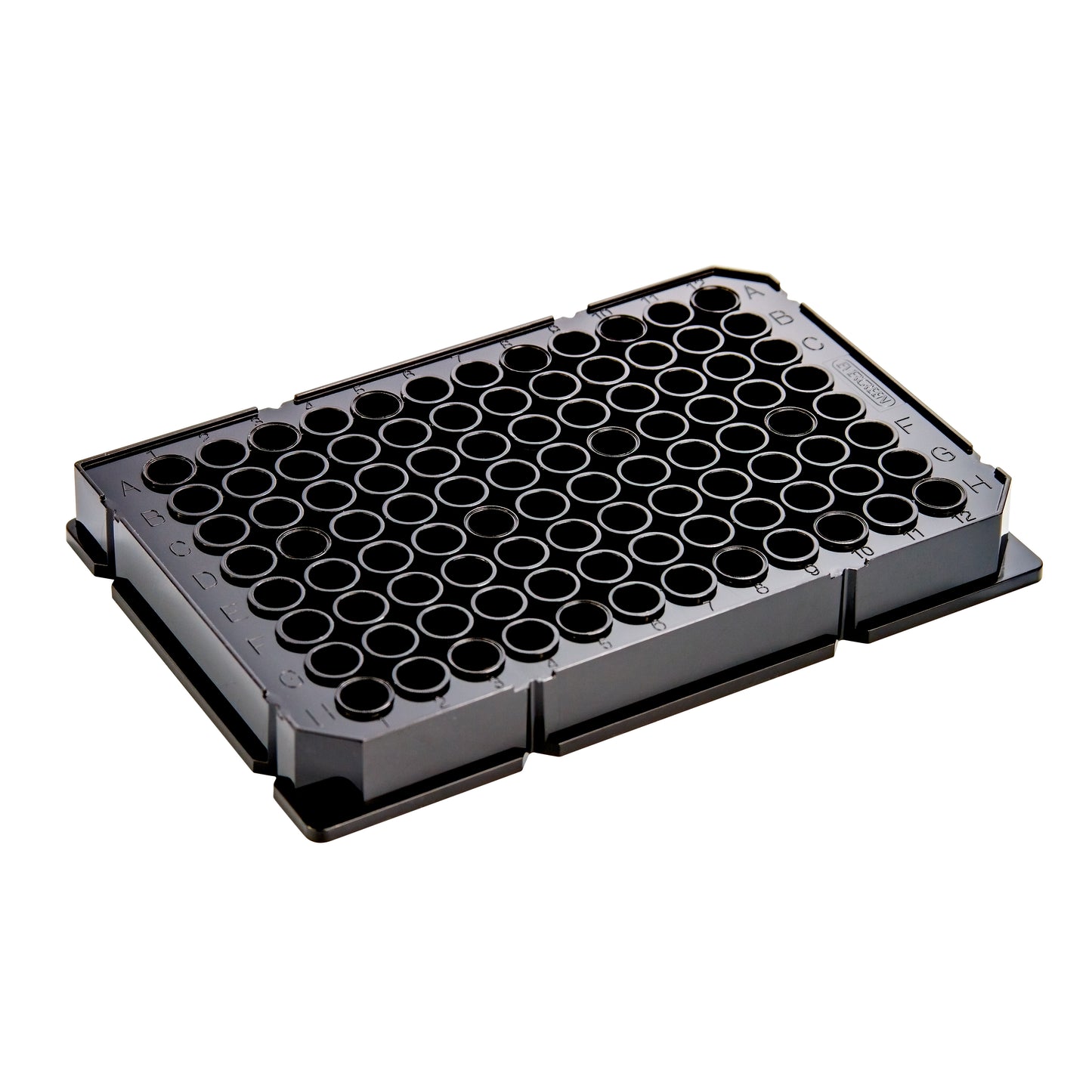

0.32 mL 96-Well Round-Bottom Microplates — Black Polystyrene, SBS/ANSI Footprint (290-8196-Z1R)
These 96-well round-bottom black polystyrene microplates deliver a low-fluorescence-background format engineered for fluorescence intensity, FRET, HTRF, and TR-FRET assays where signal-to-noise ratio is the defining analytical parameter. Each plate carries a 0.32 mL per-well volume in an SBS/ANSI standard footprint, supplied non-sterile in 9/Box (90/Case) for high-throughput programs. The black PS well walls absorb stray and scattered photons, minimizing plate autofluorescence and well-to-well cross-talk that would otherwise mask weak analyte signals.
Technical Specifications
| Specification | Value |
|---|---|
| Part Number (MPN) | 290-8196-Z1R |
| Well Format | 96-well, SBS/ANSI standard footprint |
| Well Bottom Geometry | Round bottom (U-bottom) |
| Well Volume | 0.32 mL |
| Material | Polystyrene (PS) |
| Color | Black |
| Sterility | Non-Sterile |
| Pack Size | 9/Box (90/Case) |
| BPA / Phthalates | BPA-free; no phthalate plasticizers |
| Country of Origin | USA (California) |
Applications
- Fluorescence intensity assays: Low-background black PS dramatically reduces plate autofluorescence for weak-signal fluorophores, improving assay sensitivity across the visible and near-IR spectrum.
- FRET, HTRF, and TR-FRET: Black walls suppress donor bleed-through, acceptor cross-excitation, and inter-well scatter — the primary noise sources in energy-transfer assays.
- Suspension cell fluorescence: The round-bottom (U-bottom) geometry allows suspension cells (Jurkat, lymphocytes, PBMCs) and fluorescent beads to settle uniformly by gravity, minimizing spatial variability in the fluorescence read.
- Fluorescent reporter assays: GFP, RFP, and other fluorescent protein reporters in cell-based formats benefit from black plate background suppression.
- Hemagglutination inhibition (HAI) with fluorescent detection: Round-bottom geometry supports RBC settling patterns while black walls reduce assay background for fluorescence-detected endpoints.
Plate Color Selection Guide
Choosing the correct plate color is a fundamental assay design decision. Black plates absorb stray and reflected photons, making them the correct choice for fluorescence intensity, FRET, HTRF, and TR-FRET — any mode where plate material autofluorescence or inter-well cross-talk limits sensitivity. White plates reflect photons toward the detector and are the correct choice for luminescence-based assays such as luciferase reporters and ATP bioluminescence, where maximizing signal collection is the objective. Natural (clear) PS plates are appropriate for absorbance-based ELISA and UV-mode measurements, where plate color does not affect the measurement mode.
Chemical Resistance
| Reagent / Condition | Compatibility |
|---|---|
| Aqueous buffers, saline, PBS | Excellent |
| Cell culture media, serum | Excellent |
| Dilute aqueous acids and bases | Good |
| Ethanol >70% / isopropanol | Not recommended — PS may craze or swell |
| Acetone / chlorinated solvents | Not recommended — PS is not resistant |
| DMSO (low concentrations, short contact) | Limited — verify for your application |
| Autoclaving | Not autoclavable |
Quality & Procurement
Made in USA (California), these Caplugs® Evergreen microplates are manufactured from BPA-free, phthalate-free polystyrene using processes that ensure consistent well geometry and uniform black pigment distribution across every plate in the lot. LabSupplies.com is an authorized Caplugs® Evergreen dealer and ships from USA inventory.
Frequently Asked Questions
Why choose a black plate over a white plate for fluorescence assays?
Black PS well walls absorb stray and scattered photons, reducing plate autofluorescence and inter-well cross-talk. This yields a significantly lower background signal compared to white or natural PS plates — critical when the analyte fluorescence signal is weak relative to noise. White plates are the correct choice for luminescence (e.g., luciferase) where reflecting photons toward the detector maximizes signal; black plates are correct for fluorescence intensity, FRET, HTRF, and TR-FRET where background suppression matters most.
Why is round bottom the right geometry for suspension cell assays?
The U-bottom curvature allows suspension cells and fluorescent beads to settle uniformly at the geometric center of the well by gravity alone, without centrifugation. This produces a consistent, spatially reproducible cell monolayer for fluorescence reads and minimizes well-to-well variability caused by uneven cell distribution.
Are these microplates sterile?
No — the 290-8196-Z1R is supplied non-sterile. For cell-based fluorescence assays requiring sterile conditions, standard aseptic technique should be applied, or sterile-packaged options should be considered based on your protocol requirements.
Are these plates compatible with standard microplate readers and liquid handlers?
Yes — the SBS/ANSI standard footprint is compatible with the vast majority of commercial microplate fluorescence readers, washers, and automated liquid-handling platforms. Always confirm that your reader's optics are configured for bottom-read or top-read fluorescence as appropriate for your assay format.