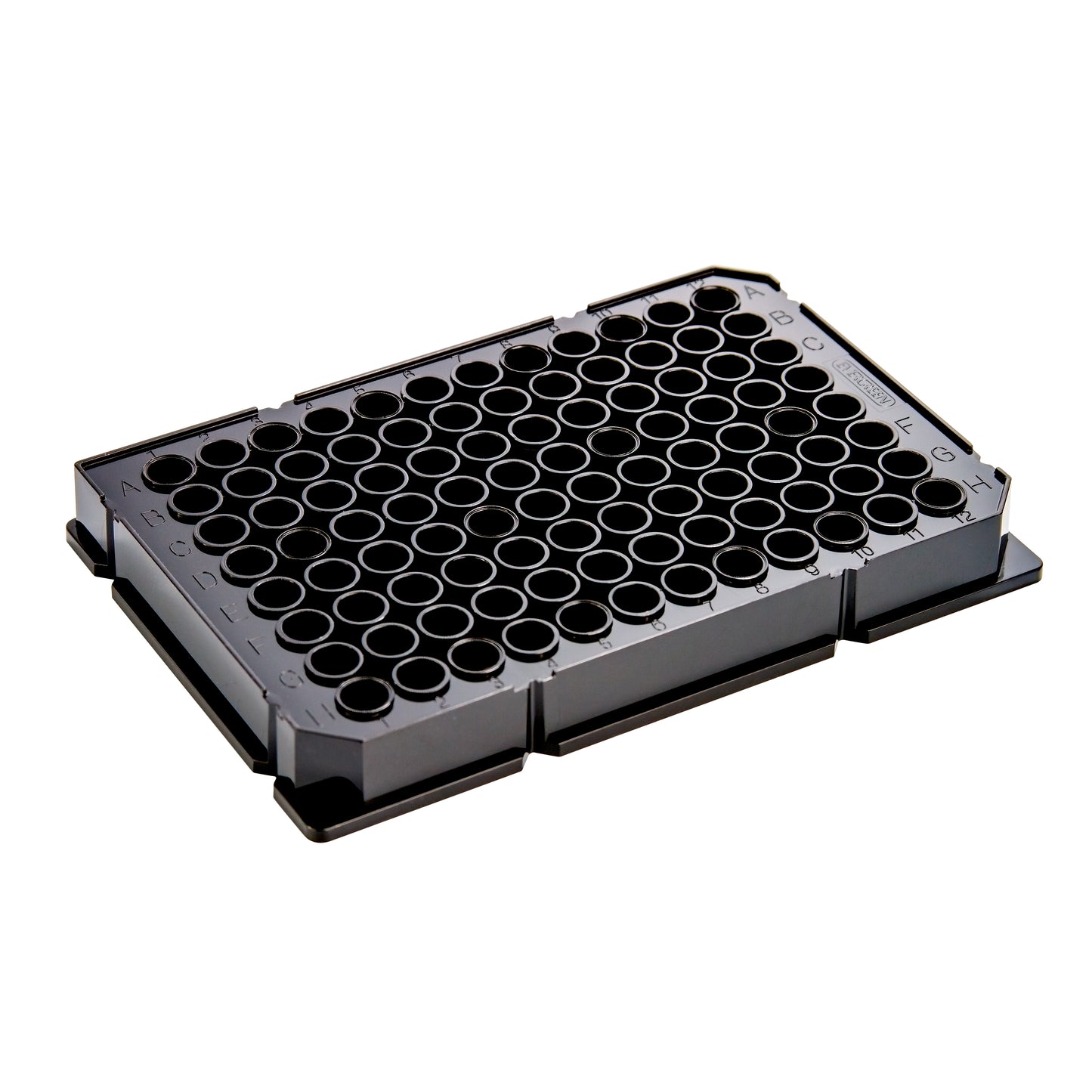

96-Well Flat-Bottom Black PS Microplates, 0.37 mL — Fluorescence Intensity, FRET & TR-FRET (290-8195-Z1F)
These 96-well flat-bottom microplates in black polystyrene (PS) are engineered for fluorescence-based assays where signal-to-noise ratio is the defining analytical constraint. Supplied non-sterile in 9/Box (90/Case), each plate conforms to the SBS/ANSI standard footprint and holds 0.37 mL per well. The black PS construction absorbs stray and scattered photons, delivering low fluorescence background and minimal well-to-well cross-talk — the recognized standard format for fluorescence intensity, FRET, HTRF, and TR-FRET workflows.
Technical Specifications
| Specification | Value |
|---|---|
| Part Number (MPN) | 290-8195-Z1F |
| Well Format | 96-well, SBS/ANSI standard footprint |
| Bottom Style | Flat Bottom |
| Well Volume | 0.37 mL |
| Material | Polystyrene (PS) |
| Color | Black |
| Sterility | Non-Sterile |
| Pack Size | 9/Box (90/Case) |
| BPA / Phthalates | BPA-free; no phthalate plasticizers |
| Country of Origin | USA (California) |
Applications
- Fluorescence intensity (FI) reads: GFP, RFP, FITC, Cy3, DAPI, and Hoechst stain-based assays where black walls suppress stray-light background and well cross-talk
- FRET and TR-FRET: Donor/acceptor pair assays where donor bleed-through, acceptor cross-excitation, and plate autofluorescence are the primary noise sources limiting sensitivity
- HTRF assays: Homogeneous time-resolved fluorescence (Europium, Terbium) benefiting from the reduced background that black PS provides versus natural or white plates
- Fluorescent reporter assays: Cell-based and biochemical assays read in fluorescence mode on standard microplate readers
- Enzyme kinetics in fluorescence mode: Flat-bottom geometry maintains consistent optical path length for quantitative, time-course fluorescence intensity reads
- Imaging-based cell assays: Uniform flat bottom supports consistent focal depth across all 96 wells during fluorescence microscopy or plate-imaging workflows
Black vs. White vs. Natural PS — Choosing the Right Plate Color
Plate color is determined by detection mode, not preference. Black PS absorbs all stray and reflected photons, minimizing plate autofluorescence and well cross-talk — making it the correct choice for fluorescence intensity, FRET, HTRF, and TR-FRET assays where analyte signal is weak relative to background. White plates reflect photons toward the detector, maximizing signal for luminescence-based assays such as luciferase reporters and ATP bioluminescence — but they are not appropriate for fluorescence work where that reflected light becomes background noise. Natural PS plates are the standard choice for absorbance-based ELISA and UV-mode assays, where plate color does not influence the measurement. Selecting the right color for the detection mode is the single most impactful plate-format decision for assay sensitivity.
Chemical Resistance
| Reagent / Condition | Compatibility |
|---|---|
| Aqueous buffers, PBS, saline | Excellent |
| Dilute acids and bases | Good — short-term contact |
| Ethanol (<70%) | Limited — short-term exposure only; test before use |
| Ethanol (>70%), methanol, isopropanol | Not recommended — risk of well wall degradation |
| Acetone | Not recommended |
| Chlorinated / aromatic solvents | Not recommended |
| DMSO (<1% in aqueous) | Generally tolerated — verify for your specific assay conditions |
| Autoclave | Not autoclavable |
Quality & Procurement
Made in USA (California), these Caplugs® Evergreen microplates are produced from BPA-free, phthalate-free polystyrene resin. LabSupplies.com is an authorized Caplugs® Evergreen dealer, shipping from USA inventory. The 9/Box (90/Case) configuration supports both smaller-scale screening programs and bulk procurement for core facilities and contract research organizations.
Frequently Asked Questions
Why use a black plate instead of a white or clear plate for fluorescence assays?
Black PS well walls absorb stray and scattered photons that would otherwise register as background signal or bleed into adjacent wells. This lowers plate autofluorescence and minimizes well cross-talk, improving signal-to-noise ratio for weak fluorescent signals. White plates are the better choice for luminescence detection, and natural PS is preferred for absorbance-based assays — plate color should match the detection mode.
Are these microplates sterile?
No — the 290-8195-Z1F plates are supplied non-sterile. For most fluorescence biochemical and plate-reader assays this is standard. If sterility is required for live-cell work, verify your decontamination protocol is compatible with polystyrene before use.
Does the flat bottom matter for fluorescence reads?
Yes — a flat bottom maintains a consistent optical path length across all wells, which is important for quantitative fluorescence intensity reads, enzyme kinetics in fluorescence mode, and imaging-based applications that require uniform focal depth. Round-bottom wells (such as the companion 290-8196-Z1R) are better suited to cell pelleting and mixing applications rather than direct-read fluorescence quantitation.
Can these plates be used with DMSO-containing compounds, such as small-molecule screening libraries?
Polystyrene has limited solvent resistance. Low concentrations of DMSO (typically below 1% in aqueous solution) are generally tolerated for short contact times, but higher concentrations or prolonged exposure risk degrading the well walls and introducing artifacts into fluorescence reads. Validate your specific solvent concentration and contact time before committing a full screening run.