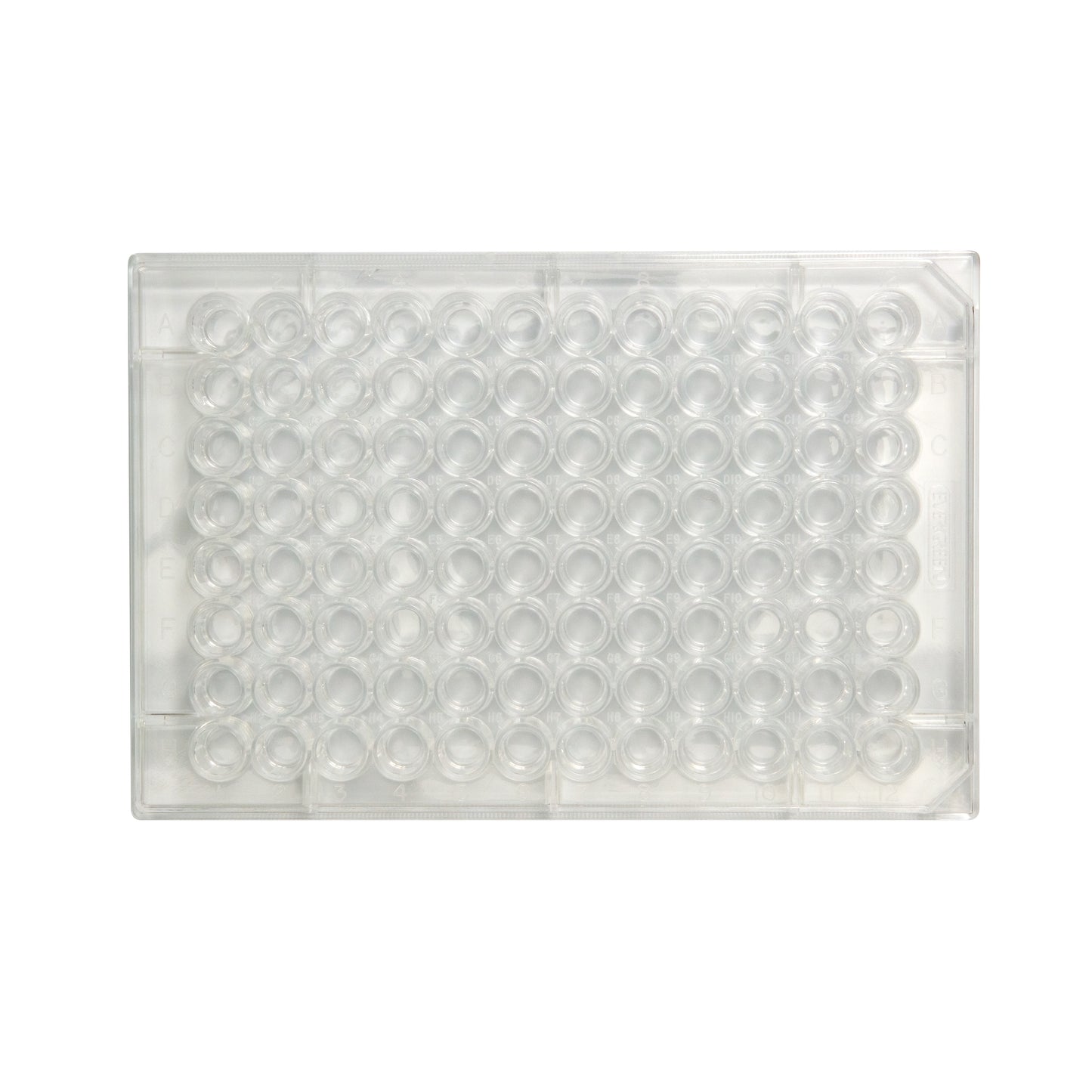

96-Well Chamfered-Bottom Microplates, 0.35 mL, Polystyrene, Natural — Automation-Optimized (290-8118-01C)
These 96-well polystyrene microplates feature a chamfered-bottom geometry — a beveled taper in the upper portion of each well wall — that guides pipette tip and needle alignment during high-speed robotic dispensing and aspiration while preserving a flat well floor for consistent absorbance path length. Supplied non-sterile in 10-plate boxes (100 plates per case), they are engineered for automated high-throughput screening environments where tip-crash reduction and edge-effect control directly affect assay data quality. The SBS/ANSI standard footprint ensures compatibility with standard robotic liquid handlers and plate readers.
Technical Specifications
| Specification | Value |
|---|---|
| Part Number (MPN) | 290-8118-01C |
| Well Format | 96-well, SBS/ANSI standard footprint |
| Bottom Geometry | Chamfered bottom — flat base with beveled upper well walls |
| Well Volume | 0.35 mL |
| Material | Polystyrene (PS) |
| Color | Natural (transparent) |
| Sterility | Non-Sterile |
| Pack Size | 10/Box (100/Case) |
| Automation | Optimized for robotic liquid handler needle alignment |
| Edge Effect | Reduced versus standard cylindrical flat-bottom wells |
| BPA / Phthalates | BPA-free; no phthalate plasticizers |
| Country of Origin | USA |
Applications
- High-throughput screening (HTS): Small-molecule compound screening and IC50/EC50 dose-response assays where edge-well concentration drift during 24–72 hour incubations must be minimized
- Robotic liquid handling: Automated dispensing and aspiration with needle arrays, where the chamfered well geometry reduces tip-crash events at maximum robot speed
- ELISA and colorimetric absorbance reads: OD405, OD450, and other quantitative photometric assays that require a flat well floor for consistent optical path length
- Compound dilution and reformatting: Intermediate dilution plates in automated compound management workflows
- Cell-based assays: Extended incubation cell culture applications where differential evaporation between edge and interior wells introduces systematic artifacts
Automation & Assay Advantages of Chamfered-Bottom Geometry
The defining feature of these plates is the chamfered well geometry, which modifies only the upper portion of each well wall, leaving the flat base intact for photometric measurements. In robotic liquid handlers operating at the edges of SBS positional tolerance, the beveled upper walls physically guide dispensing needles and pipette tips toward well center, reducing the tip-crash events and well-wall contact that slow throughput and contaminate samples. Because the chamfer also modifies the meniscus geometry and surface area at the well opening, differential evaporation rates between edge and interior wells are reduced compared with standard cylindrical flat-bottom plates — a meaningful advantage in long-incubation HTS programs where edge-well concentration drift over 24–72 hours can introduce systematic errors into dose-response curves.
Chemical Resistance
| Reagent / Condition | Compatibility |
|---|---|
| Aqueous buffers, PBS, saline | Excellent |
| Dilute acids and bases | Good |
| DMSO (low concentrations typical in HTS) | Limited — verify with application-specific conditions |
| Ethanol / methanol (>70%) | Not recommended |
| Acetone | Not recommended |
| Chlorinated / aromatic solvents | Not recommended |
| Autoclave sterilization | Not recommended — PS is not autoclavable |
Quality & Procurement
Made in USA, these Caplugs® Evergreen microplates are manufactured from BPA-free, phthalate-free polystyrene under ISO 9001 quality management.
Frequently Asked Questions
What is a chamfered-bottom well, and how does it differ from a standard flat-bottom well?
A chamfered-bottom well retains a flat base — which preserves consistent absorbance path length — but adds a beveled taper to the upper portion of the well wall. That bevel guides pipette tips and robotic needles toward well center during high-speed dispensing, reducing tip crashes and wall contact. Standard flat-bottom wells have straight cylindrical walls from top to bottom with no guiding geometry.
Are these microplates suitable for absorbance-based assays such as ELISA?
Yes. The chamfer affects only the upper well geometry; the base remains flat, so optical path length is consistent across all 96 wells. These plates are compatible with OD405, OD450, and other standard colorimetric read formats.
Are these plates sterile, and can they be autoclaved?
These plates are supplied non-sterile. Polystyrene is not autoclavable; surface sterilization with UV or appropriate chemical methods should be used if sterility is required for cell-based assays.
Do the plates conform to SBS/ANSI footprint standards for use with robotic systems?
Yes. These plates follow the SBS/ANSI standard footprint, making them dimensionally compatible with standard robotic liquid handlers, plate stackers, and plate readers used in automated HTS environments.