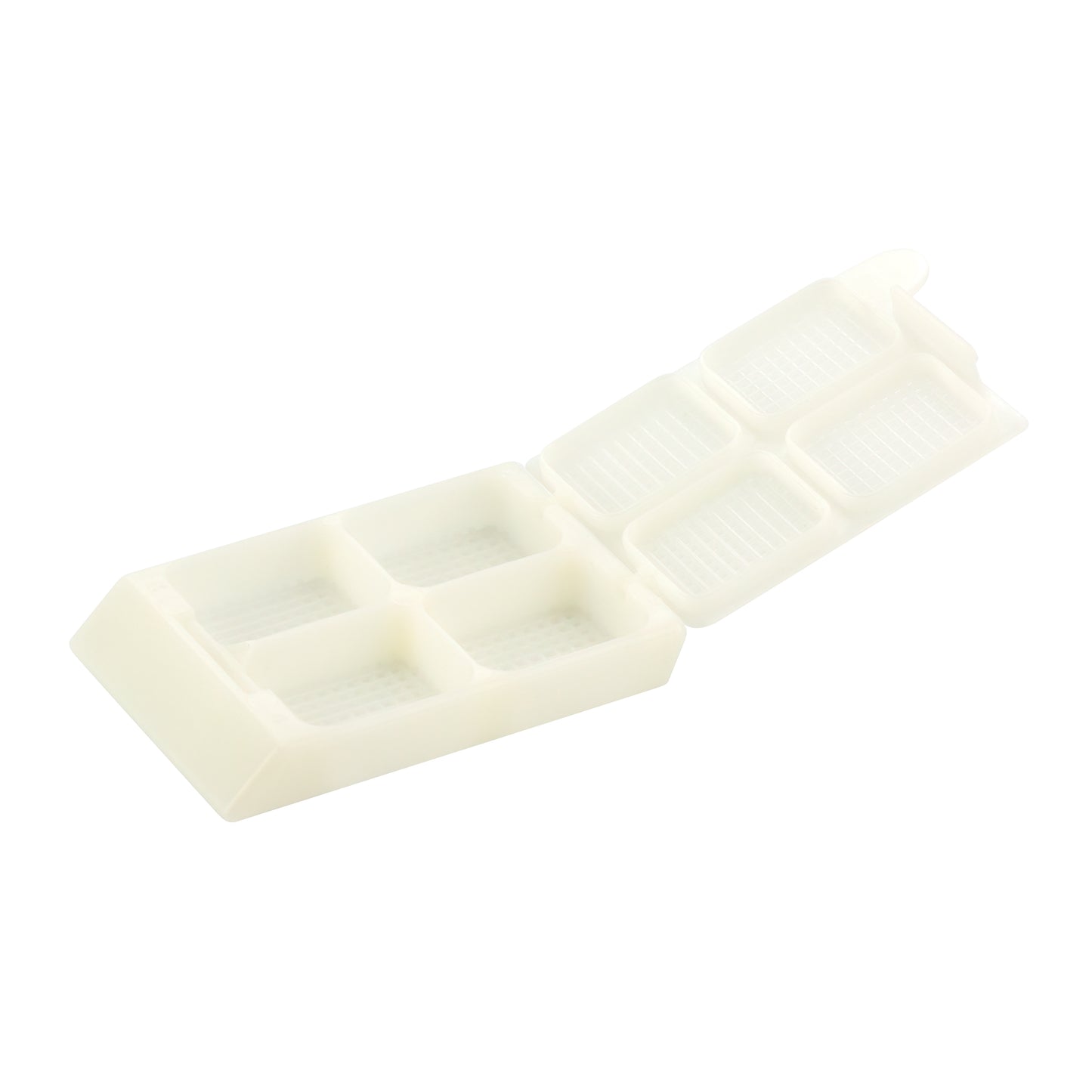

4-Compartment Acetal (POM) Biopsy Cassettes with Covers — White, 0.6 mm Holes, 500/Bag (258-4264-W90)
These white Acetal (POM) biopsy cassettes feature four isolated compartments with 0.6 mm apertures per compartment, purpose-built for multi-site biopsy panels, 4-quadrant gastric mapping, and endoscopic biopsy sets where maintaining discrete site identity through tissue processing, embedding, and sectioning is a diagnostic requirement. Supplied unassembled as 500 cassettes plus 500 covers per bag, the non-sterile format is ready for routine histology workflow. The crystalline polyoxymethylene (POM) construction delivers exceptional dimensional stability through xylene immersion and paraffin infiltration at 56–65°C — a performance advantage that matters particularly at the 0.6 mm aperture size, where any polymer creep or hole deformation would directly compromise specimen retention.
Technical Specifications
| Specification | Value |
|---|---|
| Part Number (MPN) | 258-4264-W90 |
| Compartments | 4 isolated compartments — integral molded dividers |
| Material | Acetal (POM) — Polyoxymethylene |
| Color | White |
| Hole Size | 0.6 mm per compartment |
| Xylene Resistance | Excellent |
| Paraffin Compatibility | Excellent — dimensional stability at 56–65°C |
| Formalin Compatibility | Excellent — 10% NBF, extended exposure |
| Assembly State | Unassembled — 500 cassettes + 500 covers per bag |
| Sterility | Non-Sterile |
| Pack Size | 500/Bag |
| BPA / Phthalates | BPA-free; no phthalate plasticizers |
| Country of Origin | USA |
Applications
- 4-quadrant gastric mapping — four discrete biopsy sites from a single endoscopic procedure retained in one cassette through the full processing sequence
- Systematic prostate biopsy protocols — site-specific preservation of up to four biopsy cores per cassette, reducing cassette count per patient case
- Endoscopic biopsy sets — multi-site colorectal, esophageal, or duodenal specimens requiring individually identifiable tissue sections
- Multi-site biopsy panels where inter-compartment specimen isolation must survive xylene, alcohol dehydration, and paraffin infiltration without cross-contamination
- Histopathology laboratories processing high case volumes that benefit from consolidating four biopsy sites into a single uniquely labeled cassette
Chemical Resistance
| Reagent / Condition | Compatibility |
|---|---|
| Xylene (deparaffinization / processing) | Excellent — POM maintains aperture geometry under prolonged immersion |
| 10% Neutral Buffered Formalin (NBF) | Excellent — suitable for extended fixation exposure |
| Paraffin infiltration (56–65°C) | Excellent — crystalline POM structure resists thermal deformation |
| Graded alcohols (dehydration series) | Excellent |
| Aqueous buffers / saline rinses | Excellent |
Quality & Procurement
Made in USA, these Caplugs® Evergreen cassettes are manufactured from BPA-free, phthalate-free Acetal (POM) resin. The four compartment dividers are molded as an integral part of the cassette body — not removable inserts — so inter-compartment isolation is structurally guaranteed through every step of the processing solvent sequence.
Frequently Asked Questions
Why are these cassettes made from Acetal (POM) rather than polypropylene?
The 0.6 mm aperture size is the key reason. At sub-millimeter hole sizes, any polymer creep or dimensional change under xylene exposure can cause apertures to deform enough to compromise specimen retention. Acetal's crystalline POM structure maintains the precise 0.6 mm geometry through prolonged xylene immersion, rapid-cycle processor agitation, and repeated paraffin infiltration at up to 65°C — a level of dimensional stability that polypropylene cannot consistently deliver at this aperture size.
Are the compartment dividers removable, or are they fixed?
The four dividers are molded as an integral part of the cassette body and are not removable. This ensures that inter-compartment specimen isolation is maintained structurally throughout processing, embedding, and sectioning — there is no risk of a divider shifting or being inadvertently removed during laboratory handling.
Do these cassettes come pre-assembled with their covers?
No — each bag contains 500 cassettes and 500 covers supplied unassembled. Covers are applied by the laboratory after specimens are loaded, which is standard practice for biopsy cassette processing workflows.
What protocols are these cassettes most commonly used for?
The four-compartment format is most frequently used for 4-quadrant gastric mapping, systematic prostate biopsy protocols, and multi-site endoscopic biopsy sets — any workflow where four discrete biopsy specimens from a single patient procedure must retain individual site identity through processing, embedding, and sectioning in one cassette.