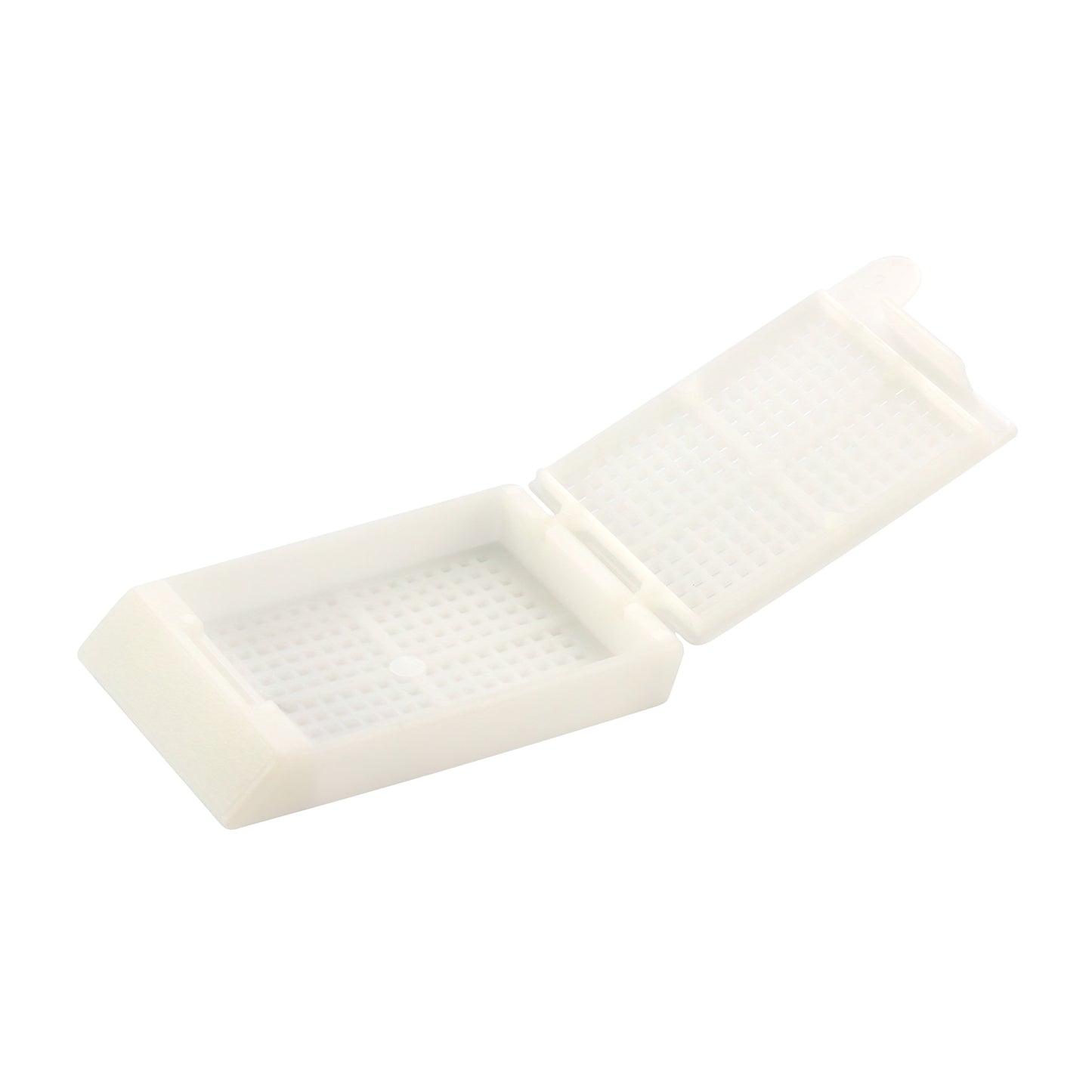

Biopsy Cassettes with Covers — Acetal (POM), White, 1.0 mm Holes, 500/Bag (258-4247-W90)
These white Acetal (Polyoxymethylene, POM) biopsy cassettes feature 1.0 mm holes engineered to retain small tissue fragments — prostate needle cores, GI mucosal biopsies, endocervical biopsies, and shave or punch specimens — that would pass through standard 1.5–2.0 mm apertures during xylene clearing and paraffin infiltration. Supplied unassembled as 500 cassettes plus 500 matching covers per bag, part number 258-4247-W90 is the high-throughput solution for histology labs that cannot afford fragment loss in small biopsy programs. Acetal's crystalline polymer structure delivers superior xylene resistance and dimensional stability at paraffin wax infiltration temperatures (56–65°C), maintaining the critical 1.0 mm aperture geometry throughout the cassette's service life.
Technical Specifications
| Specification | Value |
|---|---|
| Part Number (MPN) | 258-4247-W90 |
| Material | Acetal (POM) — Polyoxymethylene |
| Color | White |
| Hole Size | 1.0 mm (small biopsy fragment retention) |
| Assembly State | Unassembled — 500 cassettes + 500 covers per Bag |
| Pack Size | 500/Bag |
| Sterility | Non-Sterile |
| Xylene Resistance | Excellent — superior to polypropylene cassettes |
| Paraffin Compatibility | Excellent — dimensional stability at 56–65°C |
| Formalin Compatibility | Excellent |
| BPA / Phthalates | BPA-free; no phthalate plasticizers |
| Country of Origin | USA |
Applications
- Processing of prostate needle core biopsies, where 1.0 mm holes prevent fragment loss during xylene clearing
- GI mucosal and endoscopic biopsy embedding — retaining diminutive fragments that shrink further during tissue dehydration
- Endocervical and cervical biopsy processing in gynecologic pathology workflows
- Skin shave and punch biopsy specimens requiring secure fragment containment through all processor cycles
- High-throughput small biopsy programs on automated tissue processors (Leica, Thermo Fisher, Sakura) where cassette dimensional stability is critical to workflow integrity
- General histopathology labs using white cassettes as the universal default for standard labeling with pencil, pen, or laser engraving
Compatibility
These cassettes are dimensionally compatible with all standard automated tissue processors from Leica, Thermo Fisher Scientific, and Sakura, fitting standard cassette baskets and embedding molds used in routine histology. The acetal construction resists the warping and hole deformation that can occur with polypropylene cassettes under repeated xylene exposure and thermal cycling on rapid-cycle processor programs — a material advantage that matters most in high-volume labs running aggressive processing protocols. White is universally accepted across these platforms and supports all tissue identification methods, including pencil, permanent pen, and laser engraving directly on the cassette body.
Chemical Resistance
| Reagent / Condition | Compatibility |
|---|---|
| Xylene (clearing agent) | Excellent — superior to polypropylene; no dimensional creep |
| Formalin (10% neutral buffered) | Excellent |
| Paraffin wax (56–65°C infiltration) | Excellent — dimensional stability maintained |
| Aqueous buffers / saline | Excellent |
| Alcohols (ethanol, isopropanol — dehydration series) | Excellent |
Quality & Procurement
Made in USA, these Caplugs® Evergreen biopsy cassettes are manufactured from BPA-free, phthalate-free acetal resin under ISO 9001 quality management. LabSupplies.com is an authorized Caplugs® Evergreen dealer and ships from USA inventory.
Frequently Asked Questions
Why choose 1.0 mm holes instead of the more common 1.5–2.0 mm cassette holes?
Small tissue fragments — particularly prostate needle cores, GI mucosal biopsies, and endocervical specimens — can physically pass through 1.5–2.0 mm apertures during the xylene clearing step, when dehydration reduces specimen dimensions and increases fragment mobility within the cassette. The 1.0 mm aperture is specifically sized to prevent this fragment loss, which is a recognized pre-analytical error risk in surgical pathology.
Why are these cassettes made from acetal (POM) rather than polypropylene?
Acetal's crystalline polymer structure provides superior xylene resistance and greater dimensional stability under repeated thermal cycling at paraffin infiltration temperatures (56–65°C). Polypropylene cassettes can exhibit subtle hole enlargement and dimensional creep under aggressive rapid-cycle tissue processor conditions, which increases the risk of fragment loss over time. Acetal eliminates this degradation pathway, keeping the 1.0 mm aperture intact throughout the cassette's service life.
Are these cassettes sterile, and do they require any preparation before use?
These cassettes are supplied non-sterile, which is standard for histology processing consumables. They are shipped unassembled — each bag contains 500 cassette bodies and 500 covers — and require no washing or other preparation before use in routine tissue processing workflows.
Are these cassettes compatible with our existing tissue processor and embedding station?
Yes. These cassettes use standard biopsy cassette dimensions that fit the baskets and molds of all major automated tissue processor platforms, including those from Leica, Thermo Fisher Scientific, and Sakura. If your lab currently uses standard-format cassettes from any of these manufacturers, these are a direct drop-in replacement for the small biopsy workflow.