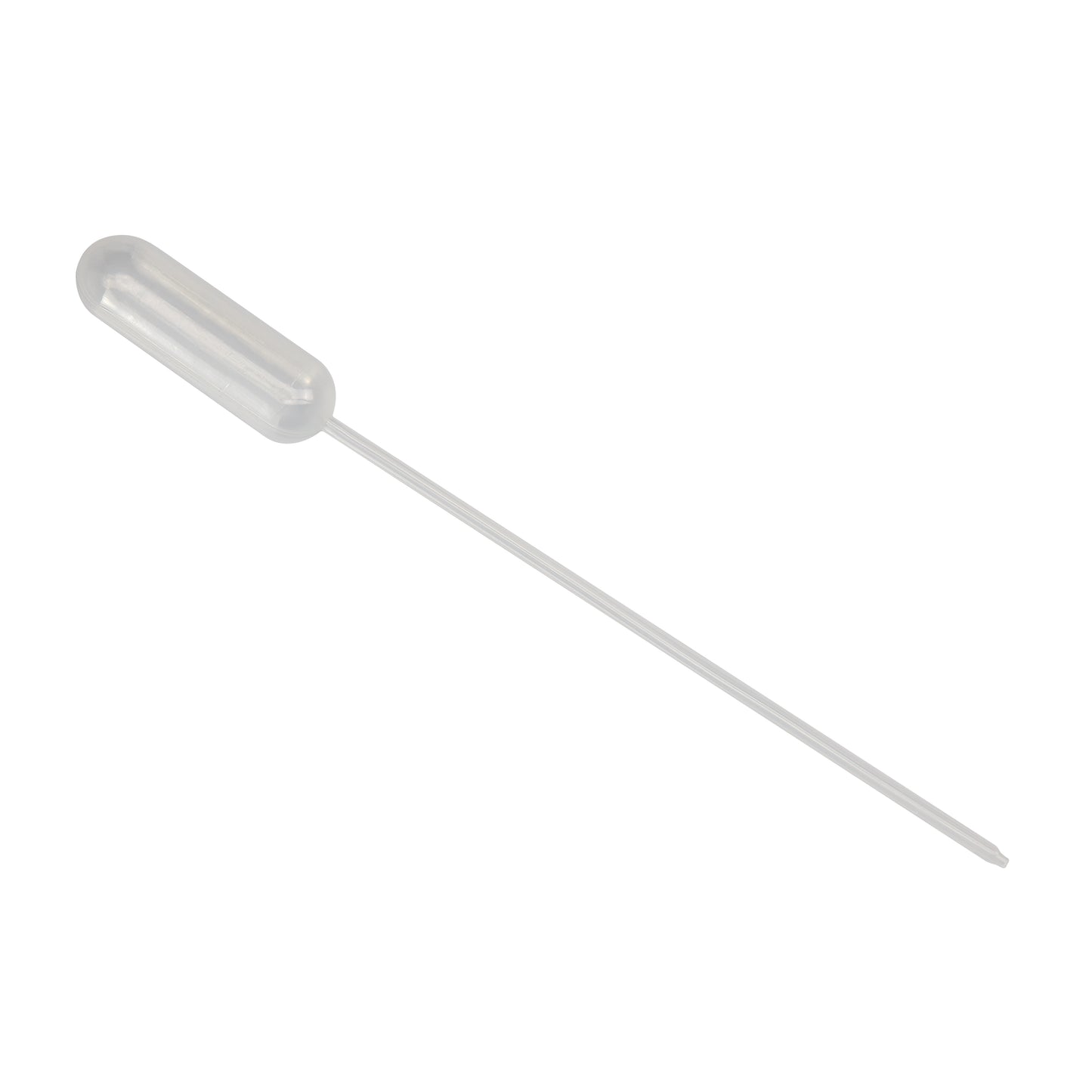

3.5 mL Blood Bank Transfer Pipets — Sterile, LDPE, Natural (222-1585-02I) | 500/Bag
These 3.5 mL blood bank transfer pipets are individually sterile-packed, single-use pipets manufactured from low-density polyethylene (LDPE) for direct contact with serum, plasma, whole blood, and biological reagents. The blood bank–optimized tip geometry delivers controlled ~40 µL drops for consistent, reproducible reagent addition in tube serology workflows where drop-size variability directly affects agglutination read sensitivity and specificity. Supplied 500 per bag, part number 222-1585-02I is a ready-to-use solution for high-volume blood bank and transfusion service settings.
Technical Specifications
| Specification | Value |
|---|---|
| Part Number (MPN) | 222-1585-02I |
| Capacity | 3.5 mL |
| Tip Type | Blood Bank |
| Drop Size | ~40 µL per drop |
| Material | Low-Density Polyethylene (LDPE) |
| Color | Natural |
| Sterility | Sterile — individually sterile-packed |
| Pack Size | 500/Bag |
| BPA / Phthalate / Latex | BPA-Free, Phthalate-Free, Latex-Free |
| Country of Origin | USA |
Applications
The blood bank–optimized tip geometry makes these pipets the preferred choice wherever controlled drop delivery and single-use sterility are critical to result integrity:
- ABO/Rh typing (tube method): Forward and reverse grouping require consistent ~40 µL drops to maintain the correct serum-to-cell ratio in each tube.
- Antibody screening and identification (IAT/Coombs): LISS- or PEG-enhanced indirect antiglobulin test panels demand reproducible drop delivery across every cell in the panel.
- Compatibility crossmatch: Immediate spin, 37 °C incubation, and AHG phases each benefit from individually sterile pipets — one pipet per patient-donor combination.
- Direct antiglobulin test (DAT): Polyspecific and monospecific AHG phases require controlled anti-IgG and anti-C3d drop volumes for accurate grading.
- Elution procedures: Fine, progressive bulb control supports precise eluate recovery from sensitized red blood cells.
- Reagent red cell dispensing: Transfer from reagent red cell vials to tube panels with consistent drop volume for antibody ID workup.
- Plasma fractionation and protein isolation: LDPE's low extractable profile is well suited to plasma-contact applications.
Chemical Resistance
| Reagent / Condition | Compatibility |
|---|---|
| Aqueous buffers and saline (PBS, LISS, PEG) | Excellent |
| Serum, plasma, and whole blood | Excellent |
| Dilute acids and dilute bases | Good |
| Ethanol (<70%) | Good — short-term contact |
| Concentrated acids or strong oxidizers | Not recommended |
| Aromatic solvents (toluene, xylene) | Not recommended |
| Chlorinated solvents (chloroform, DCM) | Not recommended |
Quality & Procurement
Made in USA, these Caplugs® Evergreen transfer pipets are produced from FDA-compliant, BPA-free, phthalate-free, and latex-free LDPE resin. Individually sterile-packed pipets eliminate the need for in-house autoclaving and reduce contamination risk in regulated transfusion service environments.
Frequently Asked Questions
Are these transfer pipets sterile, and do I need to autoclave them before use?
Yes — each pipet is individually sterile-packed and ready to use straight from the bag. No autoclaving is required, which simplifies workflow and reduces turnaround time in busy blood bank environments.
What makes the "blood bank" tip different from a standard transfer pipet tip?
The blood bank tip geometry is specifically shaped to produce even, reproducible ~40 µL drops when delivering reagents to tube panels. Consistent drop size is critical in tube serology because variations in the serum-to-cell ratio can affect agglutination grade and lead to false reads in ABO/Rh typing, antibody screening, and crossmatch interpretation.
Is LDPE appropriate for direct contact with patient serum and reagent red cells?
Yes. Low-density polyethylene has a low extractable profile and excellent compatibility with aqueous biological matrices including serum, plasma, and whole blood, making it the material of choice for clinical transfer pipets used in transfusion medicine.
How does the 222-1585-02I blood bank pipet differ from other pipets in the Caplugs® Evergreen 222-15xx series?
The 222-15xx series offers several tip formats for different lab needs: the standard tip (222-1577-02I, ~45 µL drop), graduated tip (222-1580-02I, ~40 µL drop), fine tip (222-1590-02I, ~20 µL drop), and long stem (222-1595-02I, ~40 µL drop). The blood bank model (222-1585-02I) is distinguished by its tip geometry, which is optimized specifically for consistent drop delivery in tube serology rather than general liquid transfer.