

TrippNT Narrow Clear Dual Dispensing Paper Towel Holder — Compact PETG Dispenser for 9.2″ × 9.4″ Multifold Paper Towels
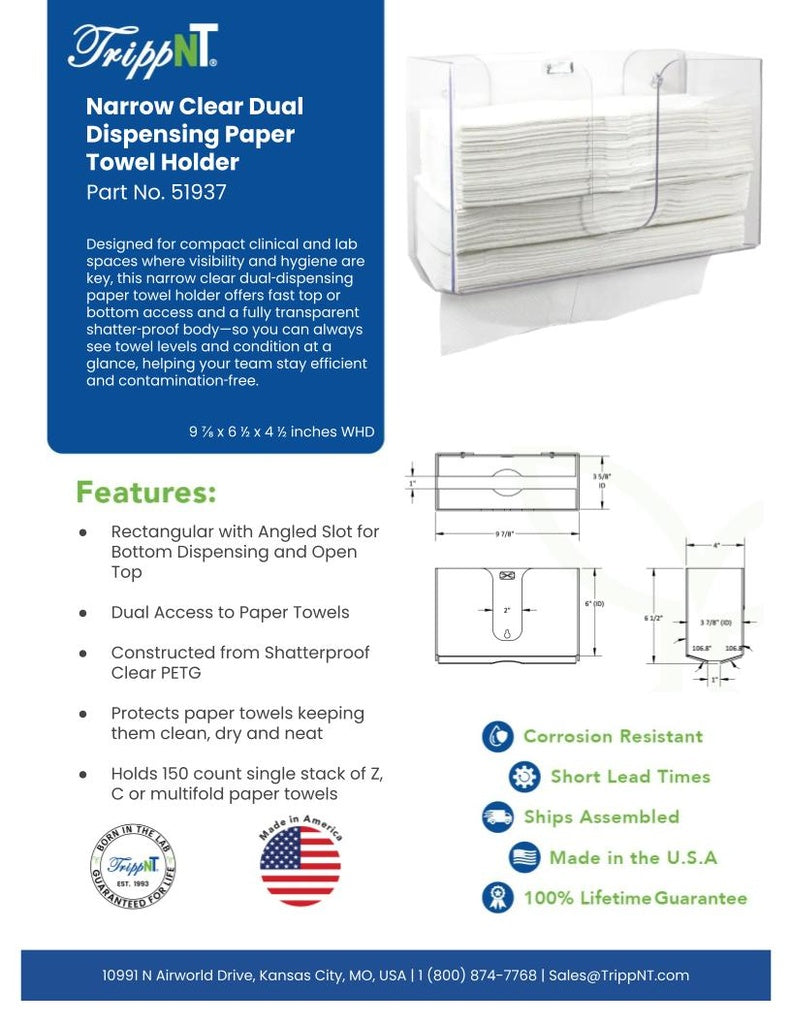
The TrippNT Narrow Clear Dual Dispensing Paper Towel Holder (SKU 51937) is the narrow-format single-stack paper towel dispenser in TrippNT’s clear PETG dual-access dispenser family, sized specifically for the common 9.2″ × 9.4″ multifold paper towel format (Scott Essential Multifold 01804, Kleenex Multifold 01890, and compatible equivalents). At 9⅞″ W × 6½″ H × 4″ D, the 51937 is approximately 1 inch narrower than the 51912 Wide version (10⅞″ W), making it the correct specification for spaces where the slightly narrower footprint matters: narrow wall bays between equipment, lateral positions on cabinet doors, or side-by-side pairs where two holders must fit within a 21-inch span without overlap.
The dual-dispensing design — open-top multi-sheet access + angled-slot single-sheet bottom dispensing — provides the same versatility as the Wide version in both standard lab use (one-towel-at-a-time wipe and dry) and high-demand events (multi-sheet grab for larger spill response). Clear .100-inch PETG (tougher than acrylic) allows stock-level monitoring without opening the holder. Keyhole back with included hardware for wall installation; countertop-stable. Ships fully assembled, 0.90 lb.
Technical Specifications
| Specification | Detail |
|---|---|
| Material | .100-inch Clear PETG (shatterproof) |
| Color / Finish | Clear (fully transparent) |
| Capacity | 1 stack (~150-count) 9.2″ × 9.4″ multifold paper towels |
| Compatible Towel Size | 9.2″ × 9.4″ multifold (Scott 01804, Kleenex 01890, compatible) |
| Dispensing Modes | Top-open (multi-sheet) + bottom angled slot (single-sheet) |
| Mount Type | Keyhole wall mount — hardware included; countertop-stable |
| Product Dimensions (W × H × D) | 9⅞″ × 6½″ × 4″ |
| Product Weight | 0.90 lb |
| Shipping Carton (L × W × H) | 12″ × 12″ × 6″ |
| Shipping Weight | 2 lb (Small Parcel) |
| UPC | 692041660253 |
| HTS Code | 3926.9 |
| Country of Origin | United States (Kansas City, MO) |
Laboratory and Clinical Applications
The 51937 is specified wherever the 9.2″ × 9.4″ multifold paper towel format is the site standard and the narrower 9⅞″ footprint is preferred over the 51912 Wide: laboratory bench sink positions (narrow between-equipment wall bay), hospital nursing unit positions with constrained horizontal wall space, dental operatory lateral wall positions, food production handwash stations with narrow wall bays, school and university lab positions with close-spaced equipment, and any environment where the 51912’s 10⅞″ width exceeds the available wall span. The 51937 is not suitable for wider multifold towel formats (10″+ width towels) — for those, specify the 51912 Wide or 51281 Gliding Rods version.
Product Documentation
Made in the U.S.A. & Lifetime Guarantee
Proudly manufactured in the United States by TrippNT. Backed by a 100% Lifetime Guarantee.
Frequently Asked Questions
What is the difference between the 51937 Narrow and the 51912 Wide paper towel holders?
Both are clear PETG single-stack dual-dispensing holders with the same 6½″ height and keyhole mounting. The 51937 Narrow is 9⅞″ wide and sized for 9.2″ × 9.4″ multifold towels. The 51912 Wide is 10⅞″ wide and accommodates a broader range of multifold towel widths up to approximately 10½″. If your facility uses Scott 01804 or Kleenex 01890 multifold packs (9.2″ wide), both fit the 51937. If your facility uses wider multifold or C-fold packs (10″+), specify the 51912. When in doubt about towel brand compatibility, measure your towel stack width and compare to the 51937’s 9⅞″ interior width before ordering in quantity.
Can the 51937 be installed upside-down for bottom-only dispensing?
No — the 51937 has a fixed orientation with the angled slot at the bottom and the open top for multi-sheet access. The holder must be installed right-side up with the angled slot facing down. If only single-sheet bottom dispensing is needed and the top access is not desired, the open top can be left as-is (it does not present a contamination risk in most lab environments) or a separate closed-top model should be specified.