

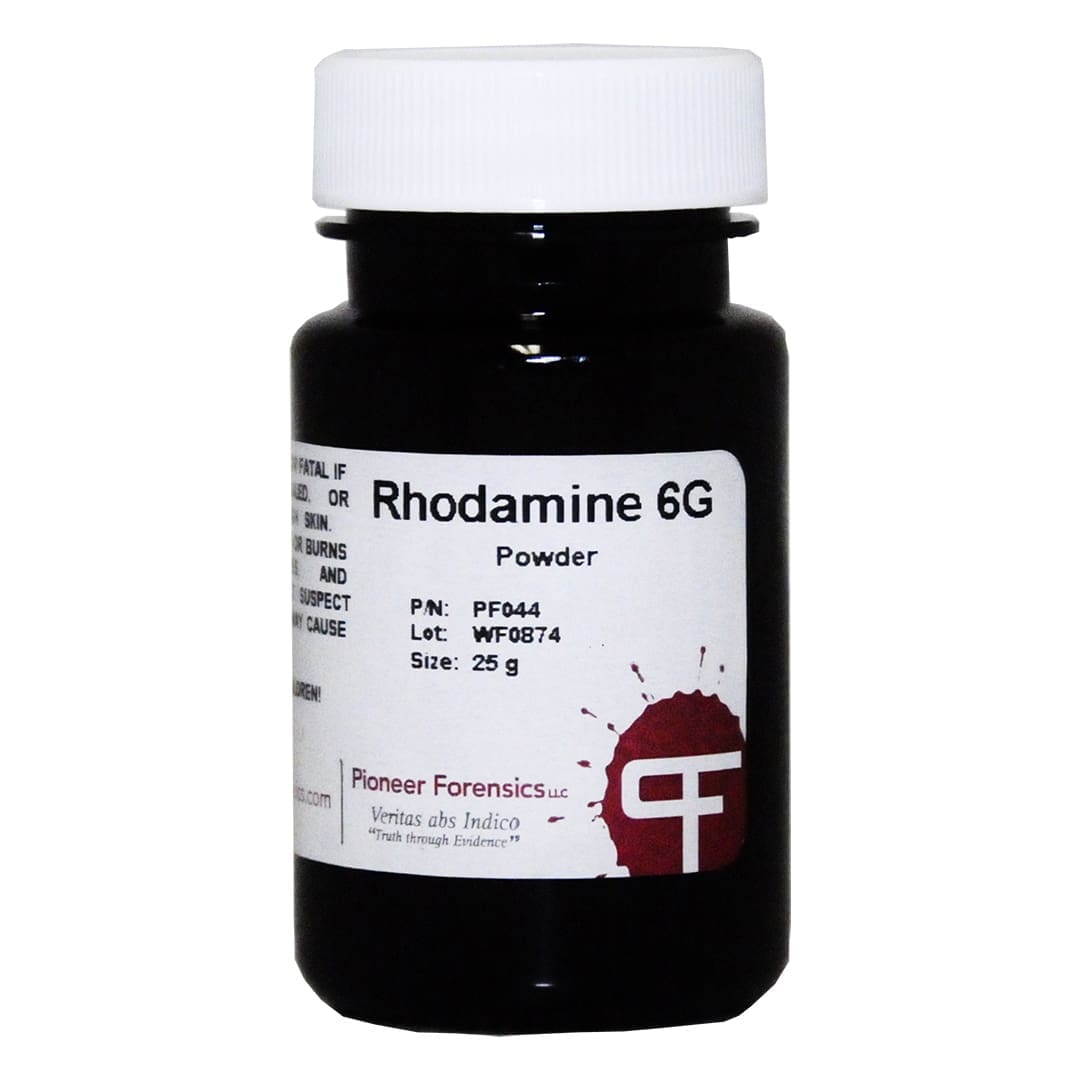
Rhodamine 6G Powder Features
Formulated for advanced latent print development, the Rhodamine 6G Powder provides exceptional fluorescent capabilities. Used extensively by forensic professionals, this high-purity dye binds selectively to polymerized cyanoacrylate residues on non-porous surfaces. The compound produces a brilliant orange-yellow fluorescence when exposed to alternate light sources. Investigators rely on this specific formulation to maximize contrast on dark, multicolored, or heavily patterned evidence.
Engineered for laboratory customization, the dry powder format allows technicians to formulate specific working solutions based on operational needs. By mixing the dye with appropriate carrier solvents, examiners can control the exact concentration of the fluorescent stain. When integrated into standard operating procedures, this flexibility ensures court-admissible visual enhancements across a wide variety of challenging substrates. The fine particulate structure dissolves readily.
To prevent sample degradation, the prepared liquid solution should be applied carefully to avoid washing away fragile, fumed friction ridges. Maintaining strict control over the application process keeps the active fluorophores firmly attached to the targeted print. For optimal laboratory safety, preparation and mixing should always occur within a certified fume hood. Technicians must utilize appropriate personal protective equipment to prevent inhalation.
Available Sizes and Configurations
| SKU | Volume | Format |
|---|---|---|
| PF15044-25g | 25 g | Powder/Bottle |
Technical Specifications
| Specification | Detail |
|---|---|
| Product Type | Fluorescent Dye Powder |
| Target Material | Cyanoacrylate (Superglue) fumed prints |
| Developed Color | Orange-Yellow (under ALS/Laser) |
| Application Phase | Post-fuming enhancement |
| Preparation Requirement | Must be dissolved in solvent prior to use |
Laboratory Applications
For high-throughput forensic environments, integrating this fluorescent dye is critical after the initial superglue fuming sequence. Crime scene investigators rely on this step when processing items like aluminum cans, plastic bottles, or dark firearms. Because it selectively adheres to the cyanoacrylate polymer, the solution is highly valuable when standard dusting powders fail. Extracting usable intelligence from complex surfaces requires targeted wavelengths.
When processing fumed evidence, the prepared working solution is typically applied via complete submersion or a controlled wash. Technicians gently rinse the item with a clearing solvent to remove excess background fluorescence before examining it in a darkened room. Upon achieving the desired ridge contrast, the evidence is photographed using specific barrier filters. This critical documentation step ensures the capture of highest possible resolution.
Forensic Reagent Comparison: Why Choose Rocky Mountain Reagents?
| Feature | Rocky Mountain Reagents Rhodamine 6G | Typical Competitor |
|---|---|---|
| Quality Control | High purity / COA available | Unverified purity |
| Format | Dry powder for custom mixing | Pre-mixed only (higher shipping cost) |
| Pricing | Below retail pricing | Full retail |
| Ships From | USA inventory | Varies |
Academic and Institutional Pricing
LabSupplies.com offers tiered quantity pricing for academic and research institutions. As an authorized dealer, we ship directly from USA inventory.
Product Documentation
Frequently Asked Questions
What is Rhodamine 6G Powder used for?
This specialized forensic dye is used to enhance latent fingerprints that have been previously developed with cyanoacrylate (superglue) fuming. It reacts with the polymer to produce a bright orange-yellow fluorescence under alternate light sources, allowing examiners to photograph ridge details on difficult non-porous surfaces.
Does this powder need to be mixed with a solvent?
Yes, this product is a raw dye powder and must be dissolved into a compatible carrier solvent system before application to any evidence. Technicians must follow validated laboratory protocols, typically involving methanol, ethanol, or water bases, to create the correct working solution strength.
What type of light source is required to view Rhodamine 6G?
Rhodamine 6G requires an alternate light source (ALS) or forensic laser (typically in the 495nm to 540nm range) to excite the fluorophores. The resulting brilliant orange-yellow emission must then be viewed and photographed through an orange or red barrier filter.