

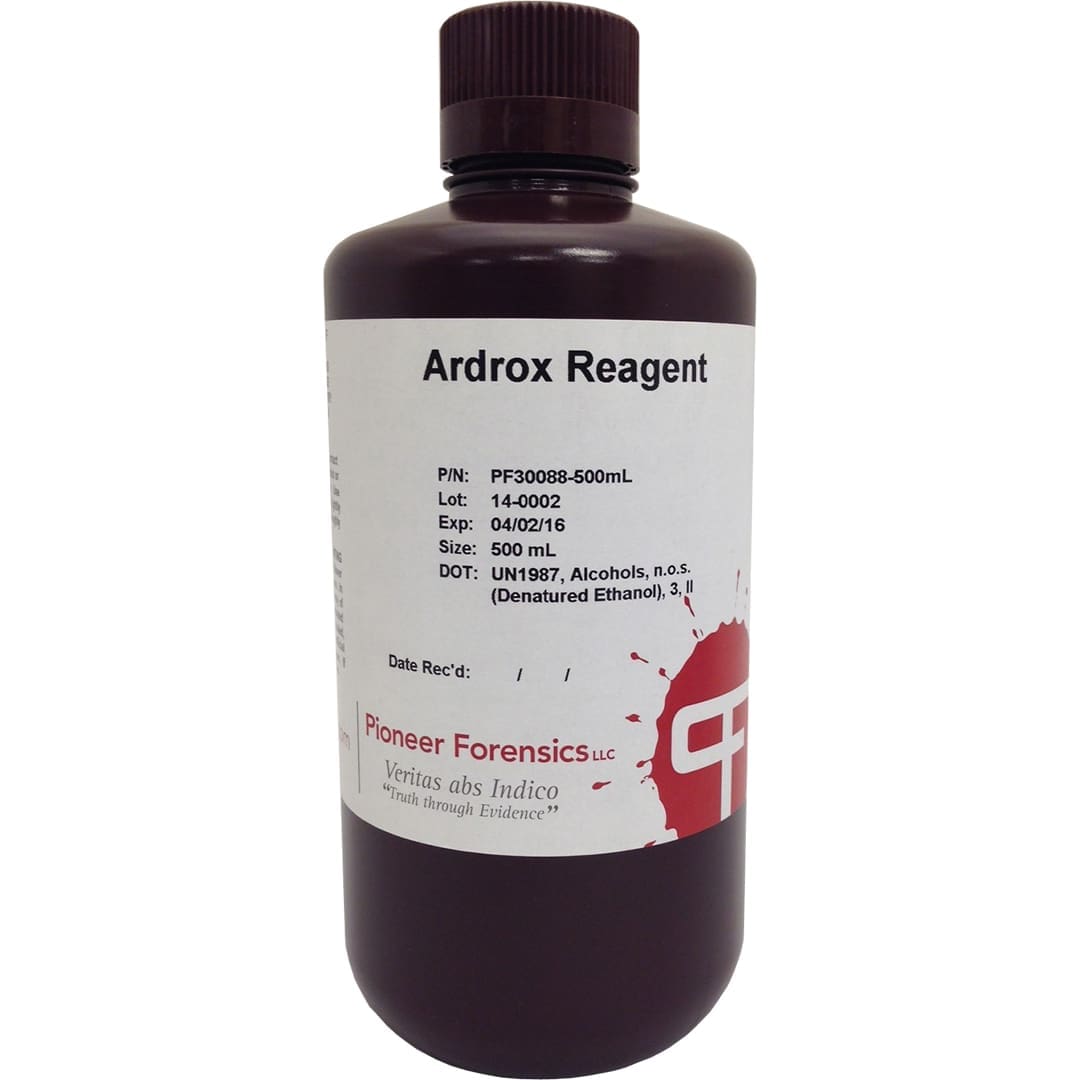
Ardrox Forensic Reagent Features
Pioneer Forensics Ardrox is a fluorescent liquid forensic reagent applied to latent fingerprints after cyanoacrylate fuming to produce high-contrast fluorescent images across a wide range of surfaces. Ardrox stains the cyanoacrylate polymer on ridge detail, causing it to fluoresce under 450–480nm blue light for optimal visualization, with additional fluorescence at 365nm UV. Suitable for forensic lasers, alternate light sources, and UV lamps, Ardrox is one of the most widely used post-CA fluorescent dyes in forensic laboratory practice.
Supplied in a 500mL poly bottle by Pioneer Forensics, Ardrox can be applied full-strength or diluted with ethanol or methanol to reduce background fluorescence on substrates that retain dye. A one-year shelf life supports reliable performance across typical procurement cycles. See the Safety Data Sheet before use: View / Download Safety Data Sheet (SDS).
Technical Specifications
| Specification | Detail |
|---|---|
| Manufacturer | Pioneer Forensics |
| Item # | PF30088 |
| Size | 500mL |
| Packaging | Poly bottle |
| Reagent Type | Fluorescent liquid dye |
| Application Stage | Post-cyanoacrylate fuming |
| Optimal Excitation | 450–480nm (blue light) |
| Also Fluoresces At | 365nm UV |
| Compatible Sources | Lasers, alternate light sources (ALS), UV lamps |
| Dilution | Use full-strength or diluted with ethanol or methanol |
| Shelf Life | 1 year |
| Safety Data Sheet | View / Download Safety Data Sheet (SDS) |
Forensic Applications
To enhance contrast of cyanoacrylate-developed latent prints, Ardrox is applied in forensic laboratory and field settings to non-porous and semi-porous surfaces including plastic bags, glass, glossy card, metal, and vinyl. High-contrast fluorescent images support direct examination and photographic documentation. Ardrox is also a component of the RAY dye stain — a mixture of Rhodamine, Ardrox, and Basic Yellow — used when a single reagent must perform across variable substrates.
How to Use Ardrox
Apply Ardrox after cyanoacrylate fuming has deposited polymer on ridge detail. Apply by dipping, pouring, or spraying depending on the item being examined. Examine under 450–480nm blue light using barrier filters matched to the emission wavelength. For substrates with high background fluorescence, dilution with ethanol or methanol or switching to 365nm UV may improve contrast. Consult the SDS and laboratory protocols before use.
Ardrox vs. Basic Yellow 40 — Fluorescent Post-CA Dye Comparison
| Feature | Ardrox | Basic Yellow 40 |
|---|---|---|
| Excitation Optimum | 450–480nm (blue) | 365–485nm |
| Secondary Excitation | 365nm UV | Strong at 365nm |
| Dilution Options | Full-strength or ethanol/methanol | Varies by formulation |
| Post-CA Use | Yes — standard post-CA dye | Yes |
| Format | Liquid dye | Liquid dye |
| Complementary Dye | RAY dye combines Ardrox + Rhodamine + Basic Yellow | Can combine with Ardrox in RAY |
Academic and Institutional Pricing
LabSupplies.com offers tiered quantity pricing for academic and research institutions. As an authorized dealer, we ship directly from USA inventory.
Frequently Asked Questions
What is Ardrox and when is it used in forensic examination?
Ardrox is a fluorescent liquid dye applied to latent fingerprints after cyanoacrylate (superglue) fuming as the development step. Cyanoacrylate fuming deposits a white polymer on latent print ridge detail, making prints visible but not necessarily high-contrast on all surfaces. Ardrox stains the cyanoacrylate deposit, causing it to fluoresce vividly when illuminated with blue or UV light — producing high-contrast images on backgrounds that would otherwise make photography difficult. It is one of the most widely used post-CA fluorescent dyes in forensic laboratories worldwide.
What light sources are compatible with Ardrox?
Ardrox-treated prints fluoresce under blue light in the 450–480nm range, which is the output of most forensic alternate light sources (ALS) set to their blue channel. Examination under 365nm UV also produces fluorescence, though forensic examiners commonly report stronger results at the 450–480nm range. Ardrox is compatible with argon-ion and other forensic lasers, handheld UV lamps, and laboratory-grade ALS systems. The specific goggles or barrier filter appropriate for each light source should be selected to match the emission wavelength of Ardrox fluorescence.
Can Ardrox be diluted, and what solvents are compatible?
Yes. Ardrox can be used full-strength for maximum fluorescence intensity or diluted with ethanol or methanol depending on the examination context. Dilution is commonly used to reduce background fluorescence on substrates that retain dye and compete with print fluorescence, or to extend the reagent volume when processing large evidence items. The appropriate dilution ratio depends on the substrate, ambient conditions, and the light source available — laboratory protocols and the published SDS should be consulted when working with diluted preparations.
How should Ardrox be stored to maintain its one-year shelf life?
Pioneer Forensics rates Ardrox at one year shelf life from the date of manufacture. As a fluorescent liquid dye in a poly bottle, it should be stored away from direct light, heat sources, and ignition sources. Refer to the Safety Data Sheet for specific storage temperature requirements, ventilation needs, and incompatibility information for the formulation. Containers should be kept tightly closed when not in use to prevent evaporation of the solvent component and contamination of the reagent.
Safety Information and Documentation
Ardrox requires appropriate PPE including gloves, eye protection, and ventilation during handling. Refer to the View / Download Safety Data Sheet (SDS) for complete hazard classification, first aid, storage, disposal guidance, and regulatory information. Pioneer Forensics is an FDA-registered, ISO 9001:2015 certified supplier based in Golden, Colorado.