


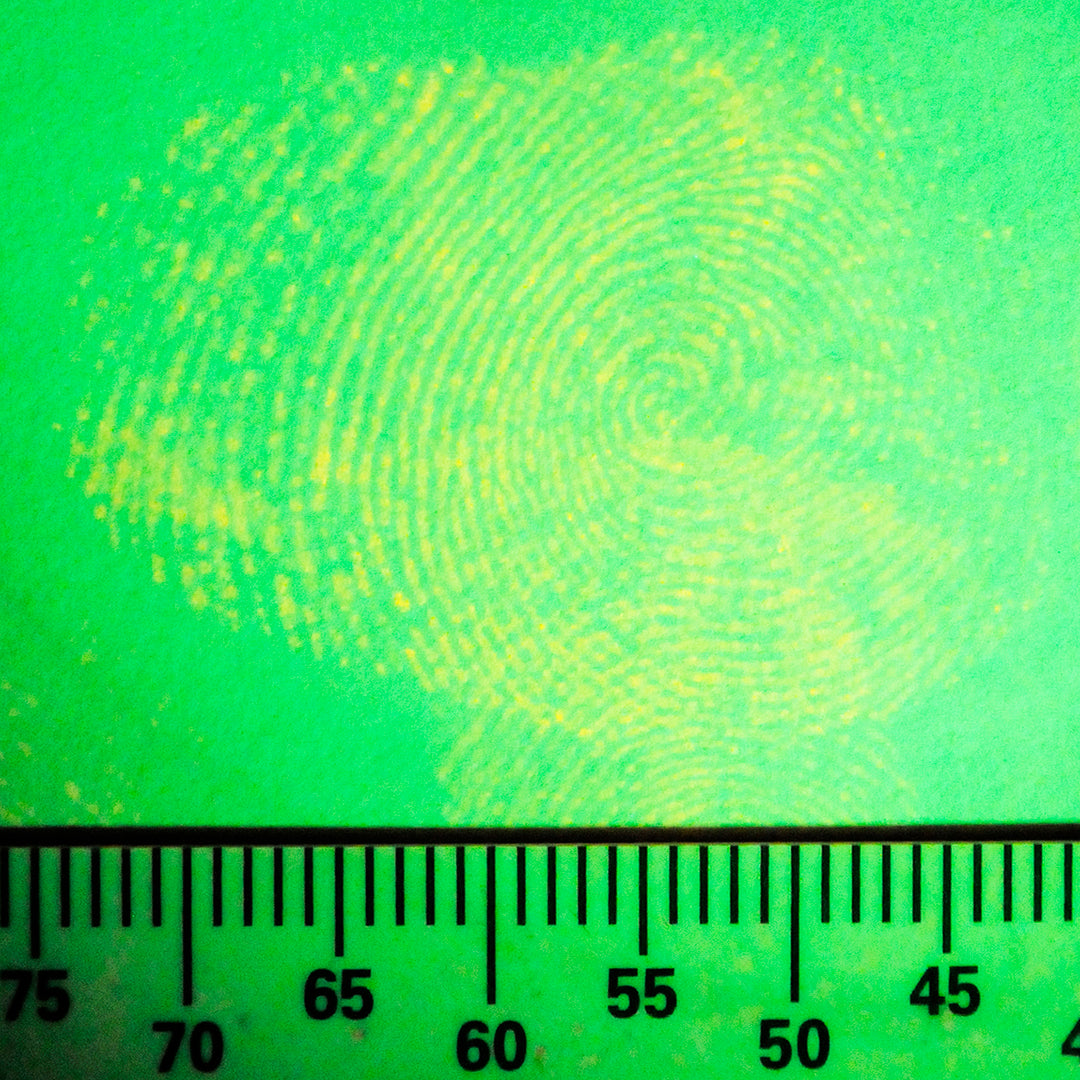
1,2-Indandione Forensic Reagent Features
Pioneer Forensics 1,2-Indandione is a 99%-purity amino acid forensic reagent in powdered form for latent fingerprint detection on paper and other porous surfaces. Reacting with amino acids in fingerprint residue, it produces faint visible prints and intense fluorescence under 520nm green forensic light examined through 570–590nm orange or red filters. Research documents it develops approximately 46% more latent prints than DFO on equivalent substrates. Packaged in an amber poly bottle to protect the light-sensitive compound, it is available in 1g and 5g.
As a powdered reagent, 1,2-Indandione is dissolved to working concentration per the laboratory's validated protocol before use. High 99% purity supports consistent batch-to-batch reactivity. Note that it is not recommended for low-quality porous substrates such as newsprint or cardboard. Refer to the View / Download Safety Data Sheet (SDS) and established protocols for preparation, handling, PPE, and disposal requirements.
Technical Specifications
| Specification | Detail |
|---|---|
| Manufacturer | Pioneer Forensics |
| Item # | PF15095 |
| Chemical Name | 1,2-Indandione (1,2-Indanedione) |
| Purity | 99% |
| Form | Powder |
| Sizes Available | 1g — $59.00 | 5g — $242.00 |
| Packaging | Amber poly bottle (light-sensitive) |
| Application | Amino acid reagent for latent fingerprints on porous surfaces |
| Mechanism | Reacts with amino acids in fingerprint deposits |
| Optimal Excitation | 520nm (green forensic light) |
| Filters | 570–590nm orange or red barrier filters |
| Not Recommended For | Low-quality porous substrates (newsprint, cardboard) |
| Safety Data Sheet | View / Download Safety Data Sheet (SDS) |
Forensic Applications
To detect amino acid-bearing latent fingerprints on porous evidence, 1,2-Indandione is applied in forensic laboratories processing paper documents, envelopes, labels, cardstock, and glossy printed materials. High-sensitivity amino acid reactivity makes it effective for aged or low-deposit fingerprints where DFO or ninhydrin may fail to develop sufficient detail. Document examination units and crime laboratory fingerprint sections processing mail, ransom notes, checks, and paper-based evidence rely on 1,2-Indandione as their primary amino acid reagent for porous surface cases.
How to Use 1,2-Indandione Powder
Dissolve 1,2-Indandione powder at the concentration specified by the laboratory's validated protocol, typically in a non-polar solvent with a polar additive. Apply to evidence by dipping, immersion, or spraying, then allow the solvent to evaporate fully. Examine under 520nm green light with 570–590nm orange or red barrier filters. Document prints photographically before applying any subsequent reagents. Consult the View / Download Safety Data Sheet (SDS) for solvent handling, ventilation requirements, and PPE specifications before preparing working solutions.
1,2-Indandione vs. DFO
| Feature | 1,2-Indandione | DFO |
|---|---|---|
| Sensitivity | Develops ~46% more prints than DFO (research validated) | Reference standard for porous surface prints |
| Mechanism | Amino acid reaction — same as DFO | Amino acid reaction |
| Excitation | 520nm green light | 450–490nm blue-green light |
| Filters | 570–590nm orange / red | 520–540nm yellow-green |
| Form | Powder (mix to required concentration) | Powder or solution |
| Limitation | Not for newsprint or cardboard | Similar substrate limitations |
Academic and Institutional Pricing
LabSupplies.com offers tiered quantity pricing for academic and research institutions. As an authorized dealer, we ship directly from USA inventory.
Frequently Asked Questions
What makes 1,2-Indandione more sensitive than DFO for latent print detection?
Research documents 1,2-Indandione develops approximately 46% more latent prints than DFO on paper-based substrates. Both reagents react with amino acids in fingerprint residue, but 1,2-Indandione shows greater reactivity with amino acid constituents in aged and degraded deposits — the conditions most commonly encountered on recovered evidence. For agencies processing paper evidence where maximizing print yield is a priority, it is the research-supported choice over DFO.
What light source and filters are required for 1,2-Indandione visualization?
Developed prints fluoresce under 520nm green light — the green channel of forensic alternate light sources and argon-ion lasers. Examination requires 570–90nm orange or red barrier filters. Blue-light ALS channels or yellow-green filters appropriate for DFO will not produce optimal results. Facilities with multi-wavelength ALS systems switch to the green channel; those with single-wavelength blue systems should verify compatibility before purchasing.
How is 1,2-Indandione powder formulated for use?
Pioneer Forensics supplies 1,2-Indandione at 99% purity as a powder for dissolution to working concentration before use. Protocols typically specify dissolution in a non-polar solvent with a polar additive. Apply by dipping, spraying, or immersion, then allow to dry. Powdered form lets laboratories prepare quantities matched to casework volume and store the balance in the amber poly bottle away from light and moisture. Consult the SDS before preparation.
On what types of evidence does 1,2-Indandione work, and what should be avoided?
1,2-Indandione performs on standard paper documents, envelopes, labels, cardstock, and glossy materials. Pioneer Forensics specifies it is not recommended for newsprint or cardboard, where uneven absorption can mask ridge detail. Test on a small sacrificial area before full application to mixed-substrate batches.
Safety Information and Documentation
1,2-Indandione requires chemical-resistant gloves, eye protection, and fume hood or adequate ventilation during working solution preparation. Refer to the View / Download Safety Data Sheet (SDS) for complete hazard classification, exposure limits, first aid, storage, and disposal requirements. Pioneer Forensics is an FDA-registered, ISO 9001:2015 certified supplier based in Golden, Colorado.