

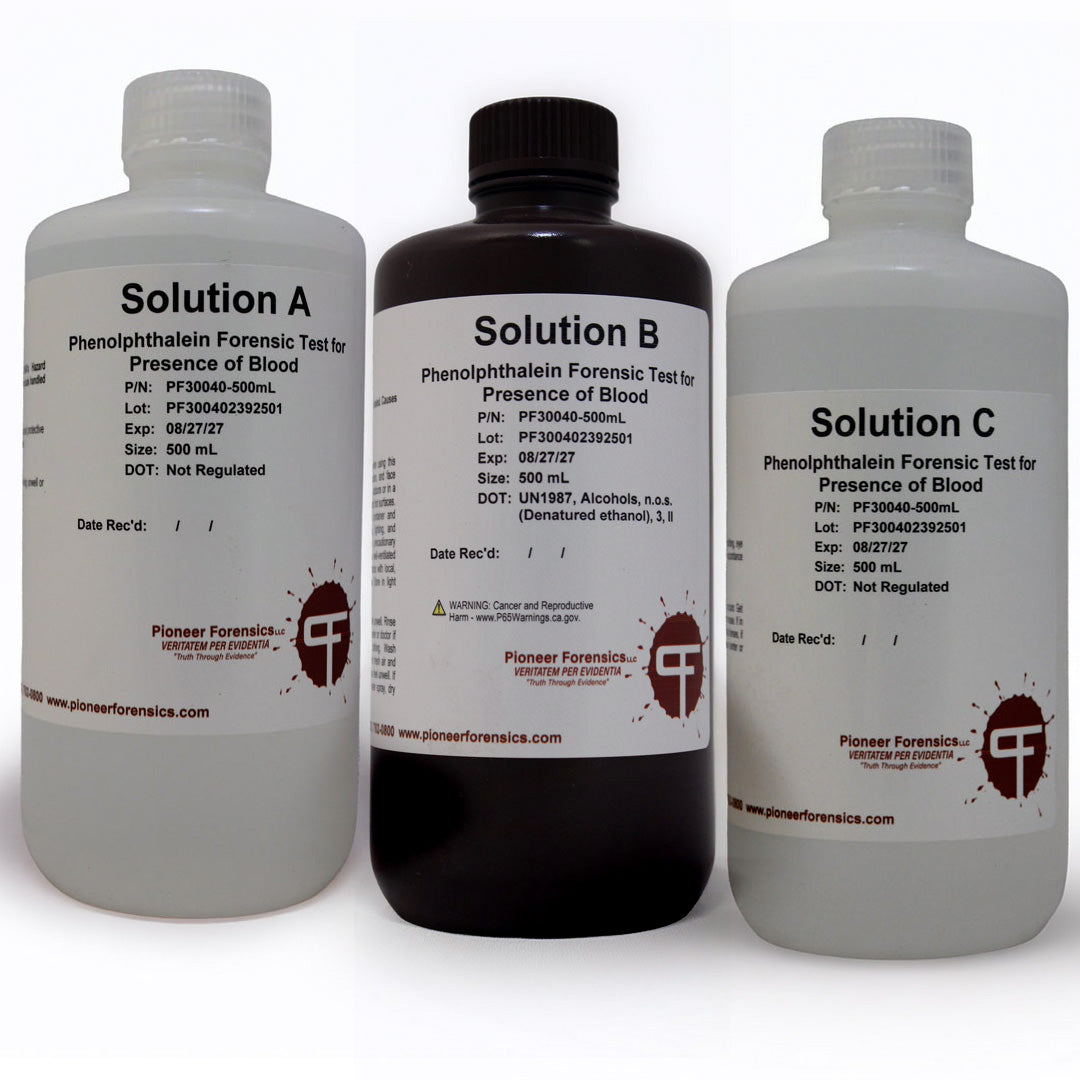
Phenolphthalein Forensic Set Features
Formulated for rapid crime scene analysis, the Phenolphthalein Forensic Set provides highly reliable presumptive blood detection. Used extensively as the Kastle-Meyer test, this multi-part chemical kit reacts catalytically with the heme molecule found in hemoglobin. The resulting immediate pink coloration allows forensic professionals to quickly identify suspected biological evidence. Investigators rely on this targeted field set to distinguish potential bloodstains from other visually similar reddish substances.
Engineered for demanding field and laboratory workflows, the pre-measured set eliminates formulation guesswork to maximize testing efficiency. By integrating the required reagents into a complete system, examiners achieve court-admissible presumptive results in seconds. When incorporated into standard operating sequences, the chemical reaction offers high sensitivity with a low rate of false positives. This ready-to-use configuration significantly streamlines preliminary biological screening prior to DNA collection.
To prevent sample contamination, investigators must carefully perform the test on a secondary cotton swab rather than applying chemicals directly to the stain. Maintaining proper handling ensures the original evidence remains intact for subsequent genetic profiling. For optimal laboratory safety, preparation and storage of these reagents should occur in controlled environments away from excessive heat. Technicians must utilize appropriate personal protective equipment during chemical handling.
Available Sizes and Configurations
| SKU | Volume | Format |
|---|---|---|
| PF30040-15mL | 15 mL | Dropper Set |
| PF30040-3x500mL | 3 x 500 mL | Bulk Lab Set |
Technical Specifications
| Specification | Detail |
|---|---|
| Product Type | Presumptive Blood Test Kit (Kastle-Meyer) |
| Target Material | Hemoglobin in suspected bloodstains |
| Reaction Color | Rapid Pink |
| Application Phase | Preliminary crime scene screening |
| Preparation Requirement | Multi-part sequential application |
Laboratory Applications
For specialized forensic operations, integrating this presumptive test kit is critical when processing complex crime scenes. Crime scene investigators frequently encounter ambiguous stains on clothing, flooring, or weapons that require immediate preliminary identification. Because it selectively reacts with peroxidase-like activity in blood, the multi-step formula is highly valuable for rapid triage. Extracting usable intelligence requires a verified chemical approach to guide further laboratory analysis.
When executing the Kastle-Meyer process, the working solution involves a strict three-step sequential application on a swabbed sample. Technicians apply ethanol to expose the hemoglobin, followed by the phenolphthalein reagent, and finally a hydrogen peroxide oxidizer. Upon introducing the peroxide, a rapid pink color change indicates a positive presumptive result for blood. This critical triage step ensures crime labs only dedicate resources to actual biological evidence.
Forensic Reagent Comparison: Why Choose Rocky Mountain Reagents?
| Feature | Rocky Mountain Reagents Phenolphthalein Set | Typical Competitor |
|---|---|---|
| Format | Complete multi-part set | Individual components sold separately |
| Consistency | Standardized testing strength | Variable batch quality |
| Pricing | Below retail pricing | Full retail |
| Ships From | USA inventory | Varies |
Academic and Institutional Pricing
LabSupplies.com offers tiered quantity pricing for academic and research institutions. As an authorized dealer, we ship directly from USA inventory.
Product Documentation
Frequently Asked Questions
What is the Phenolphthalein Forensic Set used for?
This specialized forensic kit is used to perform the Kastle-Meyer test, a highly reliable presumptive test for the presence of blood at crime scenes. It helps investigators quickly determine if a suspicious reddish stain is likely biological in nature or simply a false positive like rust, paint, or food coloring.
How does the Kastle-Meyer test work?
The test involves a strict three-step chemical process applied to a swabbed sample of the stain. First, an alcohol solution is applied to expose the hemoglobin. Next, the phenolphthalein reagent is added. Finally, hydrogen peroxide is introduced. If blood is present, the hemoglobin catalytically breaks down the peroxide, rapidly turning the phenolphthalein a bright pink color.
Does this presumptive test destroy DNA evidence?
Not if performed correctly. Forensic protocols require investigators to gently rub a moistened cotton swab against the suspicious stain, and then apply the chemicals exclusively to that secondary swab. This method preserves the primary stain entirely intact for subsequent DNA extraction and genetic profiling at the laboratory.