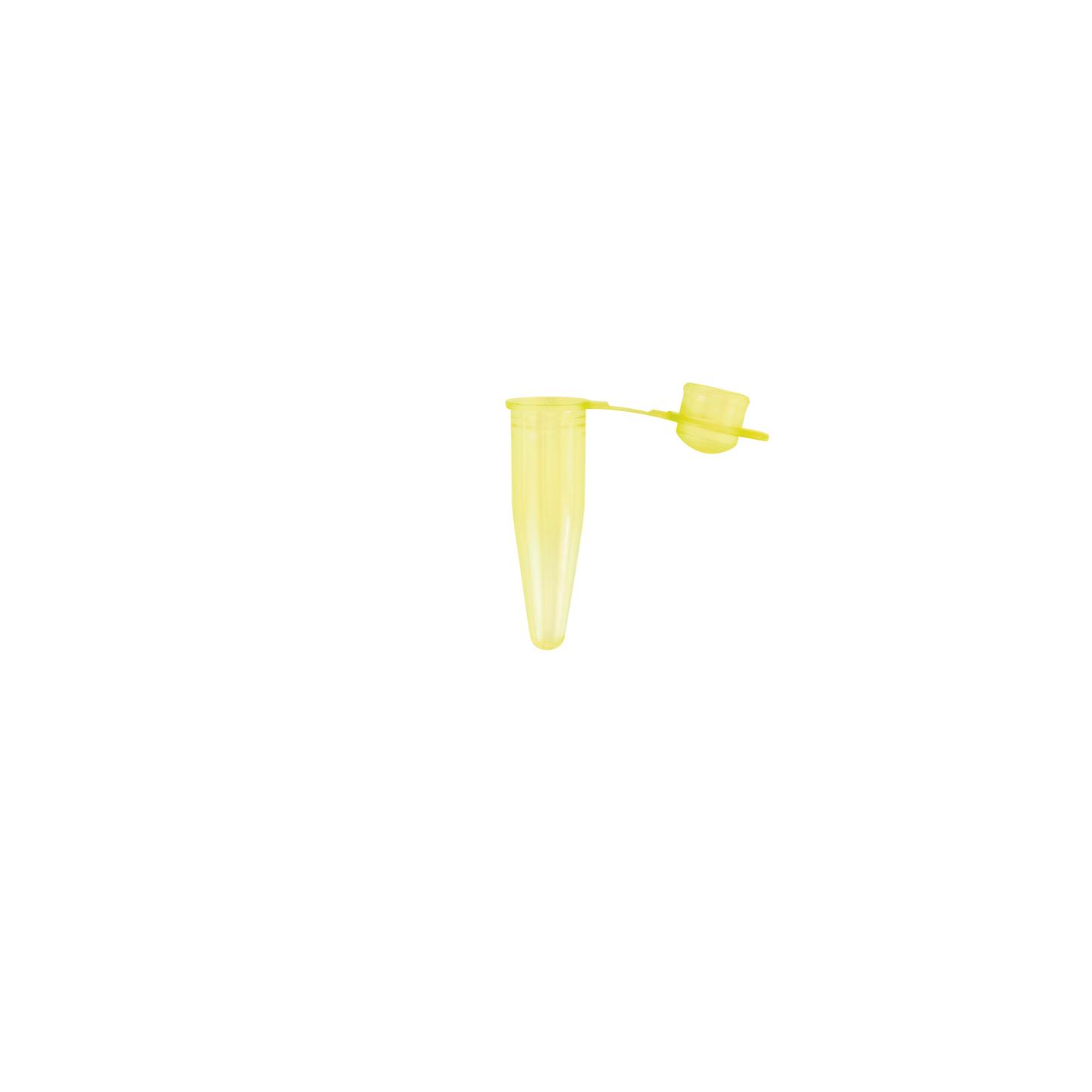

0.2 mL Thin-Wall PCR Tubes with Hinged Snap-Close Caps — PPC, Yellow, 1000/Bag (214-3468-Y80)
These 0.2 mL thin-wall PCR tubes feature an integrated hinged snap-close cap and are molded from yellow Polypropylene Copolymer (PPC) for reliable performance in standard 96-well thermocycler blocks. Supplied non-sterile in sealed 1000/Bag packaging, part number 214-3468-Y80 is well suited to high-throughput PCR, qPCR, and RT-PCR workflows where color-coded tube identification and secure, cap-free handling are priorities. Lot-to-lot dimensional consistency ensures a reliable fit in 0.2 mL block positions across common thermocycler platforms.
Technical Specifications
| Specification | Value |
|---|---|
| Part Number (MPN) | 214-3468-Y80 |
| Volume | 0.2 mL |
| Format | Individual PCR Tube |
| Cap Style | Hinged Snap-Close — Integrated |
| Wall Type | Thin-Wall |
| Material | Polypropylene Copolymer (PPC) |
| Color | Yellow |
| Sterility | Non-Sterile |
| Pack Size | 1000/Bag |
| Thermocycler Block Compatibility | Standard 96-Well, 0.2 mL |
| BPA / Phthalate Free | Yes |
| Country of Origin | USA |
Applications
- PCR and endpoint PCR amplification in standard 96-well thermocycler blocks
- Quantitative PCR (qPCR) requiring consistent thin-wall thermal equilibration
- Reverse transcription PCR (RT-PCR) for RNA-based workflows
- Molecular diagnostics requiring individual 0.2 mL tube format with secure cap closure
- Color-coded sample organization in multi-tube PCR rack and thermocycler block workflows
- High-throughput benchtop workflows where integrated hinged caps eliminate loose-cap handling and reduce sample loss risk
Chemical Resistance
| Reagent / Condition | Compatibility |
|---|---|
| Aqueous buffers / PCR mastermix | Excellent |
| Dilute acids | Excellent |
| Dilute bases | Excellent |
| Methanol | Compatible |
| Isopropanol | Compatible |
| Acetonitrile | Compatible |
| Aromatic solvents | Limited — not recommended for prolonged contact |
| Chlorinated solvents | Not recommended |
Quality & Procurement
Made in USA at Caplugs® Evergreen ISO-certified manufacturing facilities, these tubes are produced from virgin-grade, FDA-registered Polypropylene Copolymer (PPC) resin that is BPA-free and phthalate-free. PPC construction provides enhanced flexibility compared to standard PP homopolymer, supporting consistent hinged-cap snap integrity across repeated thermocycler temperature cycling. Sealed 1000/Bag packaging maintains product integrity from warehouse receipt through point of use, and lot-level quality controls ensure uniform wall thickness and tube geometry across every bag.
Frequently Asked Questions
Are these PCR tubes sterile?
No — they are supplied non-sterile. For most standard PCR and qPCR amplification workflows this is acceptable, since the thermocycler cycling conditions and the use of filtered or barrier tips provide adequate protection against contamination. If your protocol requires certified DNase/RNase-free or sterile tubes, verify that specification before ordering.
Will these tubes fit my thermocycler?
These tubes are dimensioned for standard 96-well, 0.2 mL thermocycler block positions. Most major thermocycler platforms accept standard 0.2 mL individual tubes; however, we recommend confirming your instrument manufacturer's tube-dimension requirements, particularly for heated-lid systems where tube height tolerance can be critical.
Why choose PPC over standard polypropylene for PCR tubes?
Polypropylene Copolymer (PPC) offers greater flexibility than standard PP homopolymer, which translates to a more reliable snap-close action on integrated hinged caps across repeated open-and-close cycles and across the temperature range seen in thermocycler runs. Thin-wall PPC construction also promotes rapid, uniform thermal equilibration between the block and the reaction volume.
What does the yellow color indicate?
Yellow is a color-coding option that allows labs to differentiate sample types, assay panels, or processing batches at a glance across PCR rack and thermocycler block workflows. It carries no standardized industry-wide meaning, so your lab can assign it to whatever category best suits your workflow and labeling conventions.