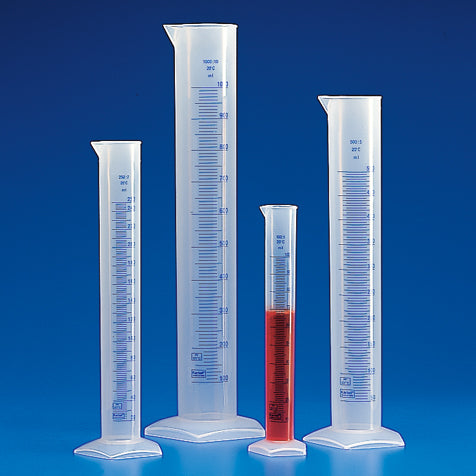

Polypropylene Graduated Cylinders with Printed Graduations | Globe Scientific
Polypropylene graduated cylinders with printed graduations from Globe Scientific feature high-contrast blue printed markings for easy readability during routine liquid measurement. Built from translucent PP, these cylinders resist breakage while providing reliable chemical compatibility with most laboratory reagents.
Blue printed graduation lines stand out clearly against the translucent cylinder body, reducing parallax errors during volume readings. The pentagonal base design keeps cylinders stable on lab benches, and the tapered pour spout minimizes dripping during transfers. Each cylinder is fully autoclavable at 121°C.
Available Sizes and Packaging
| Volume | Each SKU | Case SKU | Case Qty |
|---|---|---|---|
| 10mL | 602560-1 | 602560 | 10 |
| 25mL | 602561-1 | 602561 | 30 |
| 50mL | 602562-1 | 602562 | 30 |
| 100mL | 602563-1 | 602563 | 30 |
| 250mL | 602564-1 | 602564 | 12 |
| 500mL | 602565-1 | 602565 | 12 |
| 1000mL | 602566-1 | 602566 | 6 |
| 2000mL | 602567-1 | 602567 | 2 |
Technical Specifications
- Material: Polypropylene (PP), translucent
- Graduation Type: Blue printed (high-contrast)
- Graduation Units: Milliliters (mL)
- Accuracy Class: Class B per ISO 6706 / BS 5404
- Base Style: Wide pentagonal, roll-resistant
- Pour Spout: Tapered for controlled dispensing
- Autoclavable: Yes, 121°C for 20 minutes
- Chemical Resistance: Most acids, bases, and common solvents
Why Buy from LabSupplies.com
LabSupplies.com is an authorized Globe Scientific dealer for all graduated cylinders. We serve universities, government facilities, and healthcare institutions across the United States. Every order ships from the USA with fast processing times.
Frequently Asked Questions
Will printed graduations wash off during autoclaving?
Globe Scientific uses durable printing technology designed to withstand standard autoclave cycles at 121°C. While printed markings may eventually show wear after extensive repeated autoclaving, they maintain readability through normal laboratory use cycles.