

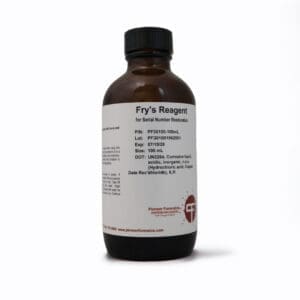
Fry's Reagent 2 Forensic Etchant Features
Formulated for rigorous metallurgical analysis, the Fry's Reagent 2 Forensic Etchant provides exceptional surface preparation for iron and steel. Used extensively for restoring obliterated serial numbers, this highly specific acidic solution attacks the stressed grain boundaries of ferrous metals. The resulting visual contrast allows forensic professionals to extract critical alphanumeric detail from heavily damaged firearms or vehicle chassis. Investigators rely on this targeted reagent to rescue intentionally obscured intelligence.
Engineered for demanding crime laboratory workflows, the pre-mixed liquid requires precise application to maximize visibility. By integrating specialized corrosive components, examiners achieve court-admissible visual enhancements even on deeply filed or ground steel surfaces. When incorporated into specific processing sequences, the chemical wash reveals the finest microstructural changes caused by the original mechanical stamping. The fast-acting matrix demands careful monitoring to prevent irreversible over-etching.
To prevent complete sample destruction, investigators must carefully control the reaction time and neutralize the evidence thoroughly once the desired contrast is achieved. Maintaining proper handling ensures the delicate metallurgical structures remain intact for photographic capture. For optimal laboratory safety, this advanced chemical formulation should always be applied within a certified fume hood. Technicians must utilize appropriate personal protective equipment to prevent severe chemical burns.
Available Sizes and Configurations
| SKU | Volume | Format |
|---|---|---|
| PF30100-100mL | 100 mL | Bottle |
Technical Specifications
| Specification | Detail |
|---|---|
| Product Type | Metallurgical Etchant |
| Target Material | Obliterated serial numbers on iron and steel |
| Application Surface | Firearms and industrial equipment |
| Application Phase | Surface restoration (destructive) |
| Preparation Requirement | Ready to use |
Laboratory Applications
For specialized forensic environments, integrating this unique etchant is critical when processing recovered steel firearms from crime scenes. Crime scene investigators frequently encounter evidence where standard non-destructive methods cannot penetrate the altered metal layers. Because it selectively attacks the stressed microstructures beneath the obliteration, the solution is highly effective at rescuing difficult characters. Extracting usable intelligence requires a chemical approach designed specifically for ferrous alloys.
When processing steel evidence, the working solution is typically applied using a delicate swab method rather than complete submersion. Technicians gently coat the surface and allow the chemical reaction to proceed before aggressively neutralizing the excess reagent with a basic solution. Upon achieving optimal alphanumeric definition, the evidence is immediately photographed under oblique lighting conditions. This critical documentation step ensures maximum resolution before the bare metal oxidizes.
Forensic Reagent Comparison: Why Choose Rocky Mountain Reagents?
| Feature | Rocky Mountain Reagents Fry's Reagent 2 | Typical Competitor |
|---|---|---|
| Format | Pre-mixed liquid | Requires manual acid mixing |
| Consistency | Standardized working strength | Variable batch quality |
| Pricing | Below retail pricing | Full retail |
| Ships From | USA inventory | Varies |
Academic and Institutional Pricing
LabSupplies.com offers tiered quantity pricing for academic and research institutions. As an authorized dealer, we ship directly from USA inventory.
Product Documentation
Frequently Asked Questions
What is Fry's Reagent 2 used for?
This highly specialized forensic chemical is a metallurgical etchant designed specifically to restore obliterated, filed, or ground-off serial numbers on iron and steel surfaces. It chemically attacks the stressed microstructures of the metal left behind by the original mechanical stamping process, revealing hidden characters.
Does this product need to be diluted before use?
No, this formulation is provided as a ready-to-use working solution. Forensic technicians can apply this reagent directly to the properly polished steel surface using a swab, avoiding the severe hazards associated with mixing raw, concentrated acids in the laboratory.
Do I need to neutralize the metal after applying this etchant?
Yes, absolutely. Because this is a highly corrosive acidic mixture, failing to neutralize the surface after the serial number is recovered will result in the continued destruction of the metal and the permanent loss of the evidence. Technicians typically use a basic solution like baking soda and water to halt the reaction.