

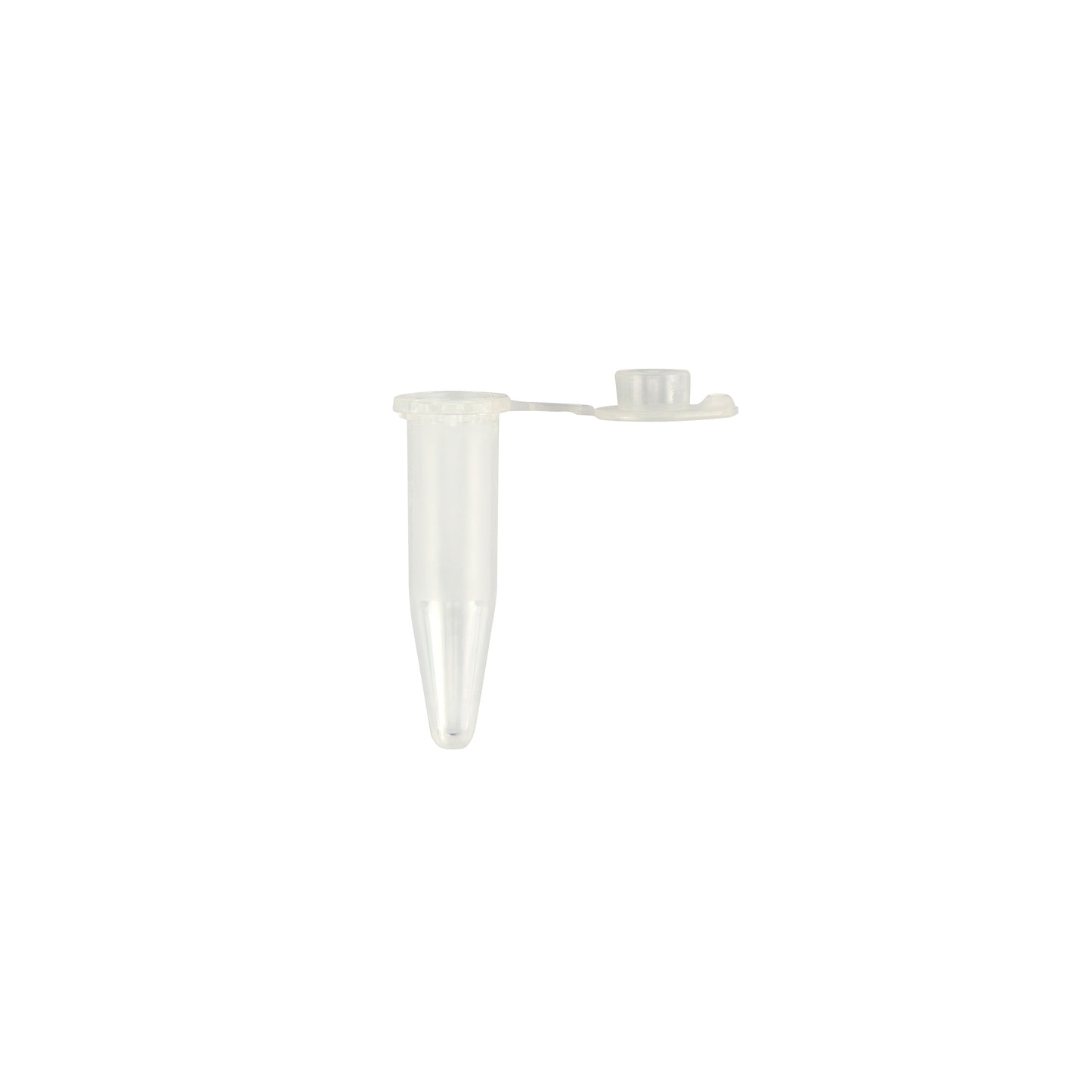
0.5 mL Conical Microcentrifuge Tubes with Tethered Cap — Natural PPC, Graduated, 1000/Bag
These 0.5 mL conical microcentrifuge tubes feature a permanently attached tethered cap and molded graduation markings, making them a reliable choice for PCR preparation, DNA/RNA extraction, enzyme reactions, and microvolume clinical sample processing. Constructed from polypropylene copolymer (PPC), the tubes offer enhanced flexibility and impact resistance compared to standard PP homopolymer, reducing the risk of cracking during high-speed centrifuge runs. Supplied non-sterile in sealed 1000/Bag packaging, part number 214-3425-080 delivers lot-to-lot dimensional consistency for reliable fit in standard 0.5 mL microcentrifuge rotor positions.
Technical Specifications
| Specification | Value |
|---|---|
| Part Number (MPN) | 214-3425-080 |
| Volume | 0.5 mL |
| Bottom Style | Conical |
| Cap Style | Tethered (permanently attached) |
| Graduation | Molded volume markings |
| Material | Polypropylene Copolymer (PPC) |
| Color | Natural |
| Sterility | Non-Sterile |
| BPA / Phthalate Free | Yes |
| Pack Size | 1000/Bag |
| Country of Origin | USA |
Applications
- PCR and qPCR reaction setup requiring precise microvolume handling
- DNA and RNA extraction with minimal dead-volume loss in a conical format
- Enzyme incubation and kinetics assays at the 0.5 mL scale
- Cell and protein pelleting in benchtop microcentrifuge workflows
- Clinical and CLIA laboratory microvolume sample processing where lot traceability is required
- High-throughput pipetting workflows where the tethered cap eliminates cap loss and reduces cross-contamination risk
Chemical Resistance
| Reagent / Condition | Compatibility |
|---|---|
| Aqueous buffers / saline | Excellent |
| Dilute acids | Excellent |
| Dilute bases | Excellent |
| Methanol / isopropanol / ethanol | Good — short-term contact |
| Acetonitrile | Good — short-term contact |
| Aromatic solvents (toluene, xylene) | Not recommended |
| Chlorinated solvents (chloroform, DCM) | Not recommended |
Quality & Procurement
Made in USA under ISO 9001 quality management, these Caplugs® Evergreen tubes are manufactured from BPA-free, phthalate-free polypropylene copolymer resin, ensuring compliance with modern laboratory safety standards. Each bag carries a lot number and manufacturing date to support full traceability in CAP-, CLIA-, and ISO 15189-accredited laboratories. LabSupplies.com is an authorized Caplugs® Evergreen dealer shipping from domestic inventory, providing consistent supply without offshore lead-time risk; tiered pricing is available for high-volume institutional and grant-funded accounts.
Frequently Asked Questions
Are these microcentrifuge tubes sterile?
No — these tubes are supplied non-sterile. They are intended for standard molecular biology, research, and clinical workflows that do not require a sterility guarantee. If your protocol requires sterile tubes, look for a DNase/RNase-free or sterile-designated product.
What is the advantage of a tethered cap over a separate snap cap?
The tethered cap is permanently attached via a flexible hinge, so it cannot be misplaced or mixed up between tubes during high-throughput pipetting. Single-handed opening and closing also reduces workflow interruption and lowers the risk of cross-contamination in repetitive microvolume processing.
Why use polypropylene copolymer (PPC) instead of standard polypropylene?
PPC offers greater flexibility and impact resistance than standard PP homopolymer, which reduces cracking during high-speed microcentrifuge runs — a meaningful advantage when working with precious or limited samples.
Are the volume graduations permanent and reagent-resistant?
Yes — the graduation markings are molded directly into the PPC tube wall rather than printed on, so they will not wash off or fade when exposed to aqueous buffers, dilute acids or bases, or standard molecular biology reagents.