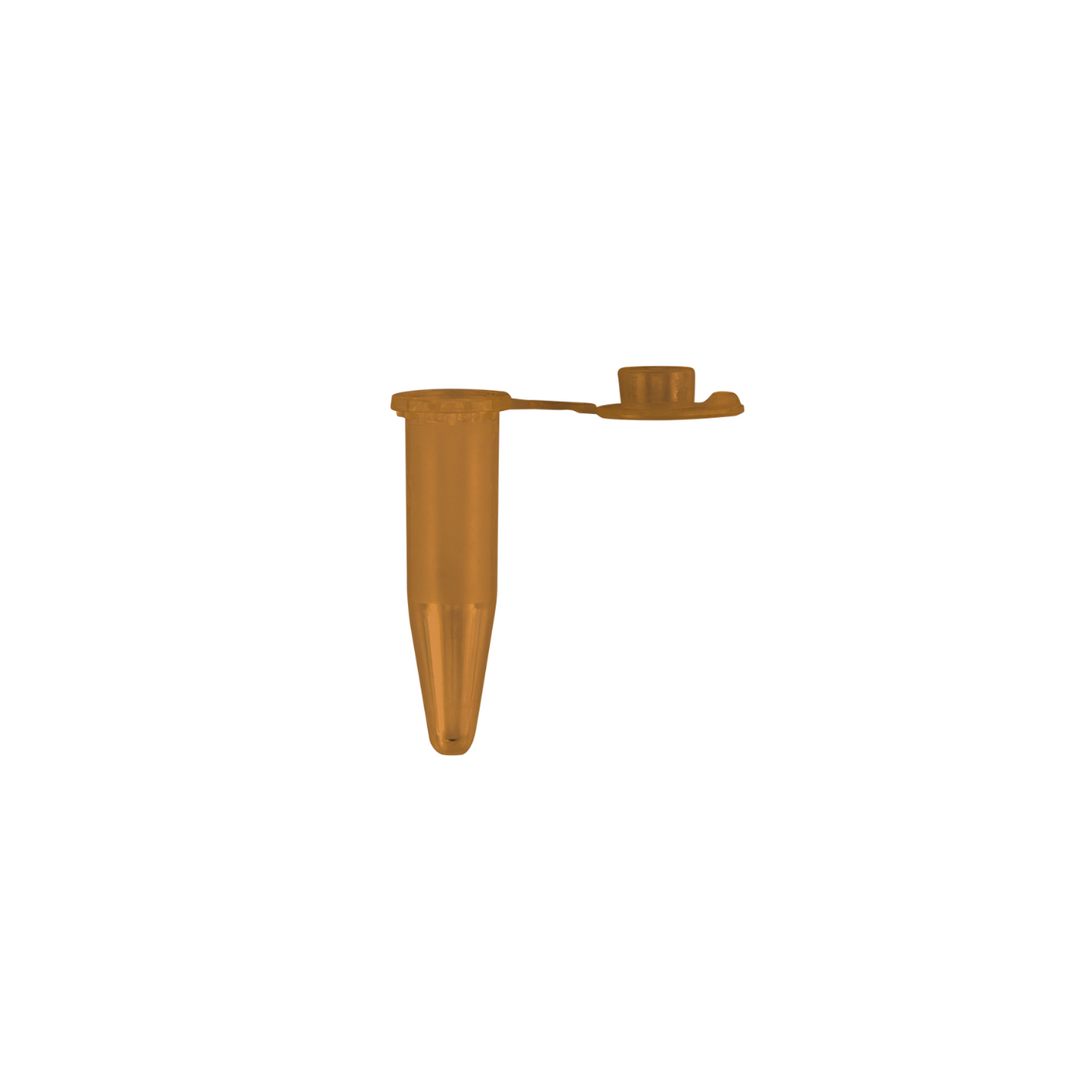

0.5 mL Amber Microcentrifuge Tubes with Tethered Cap — Conical, PPC, Graduated, 1000/Bag
These 0.5 mL conical microcentrifuge tubes feature a permanently attached tethered cap and are molded from amber Polypropylene Copolymer (PPC) — a material that offers enhanced flexibility and impact resistance compared with standard PP homopolymer, reducing cracking risk during high-speed centrifuge runs. Graduated volume markings are molded directly into the tube wall for solvent-resistant, permanent volume estimation at a glance. Supplied non-sterile in sealed 1000/Bag packaging, part number 214-3425-N80 is designed for demanding molecular biology, clinical, and research microvolume workflows where cap security and light protection matter.
Technical Specifications
| Specification | Value |
|---|---|
| Part Number (MPN) | 214-3425-N80 |
| Volume | 0.5 mL |
| Bottom Style | Conical |
| Cap Style | Tethered (permanently attached) |
| Graduation | Molded volume markings |
| Material | Polypropylene Copolymer (PPC) |
| Color | Amber |
| Sterility | Non-Sterile |
| BPA / Phthalate Free | Yes |
| Pack Size | 1000/Bag |
| Country of Origin | USA |
Applications
- PCR and qPCR reaction setup requiring precise microvolume handling in the 0.5 mL range
- DNA and RNA extraction — conical geometry minimizes dead volume during low-elution workflows
- Enzyme reactions, restriction digests, and ligation setups
- Cell and nuclei pelleting in standard microcentrifuge rotors
- Light-sensitive sample storage where amber construction reduces photodegradation
- High-throughput pipetting workflows where the tethered cap prevents cap loss and cross-contamination
Chemical Resistance
| Reagent / Condition | Compatibility |
|---|---|
| Aqueous buffers / saline | Excellent |
| Dilute acids | Excellent |
| Dilute bases | Excellent |
| Methanol | Good |
| Isopropanol | Good |
| Acetonitrile | Good |
| Aromatic solvents (toluene, xylene) | Not recommended — limited resistance |
Quality & Procurement
Made in USA, these Caplugs® Evergreen microcentrifuge tubes are produced from BPA-free, phthalate-free Polypropylene Copolymer resin. Sealed 1000/Bag packaging preserves product integrity from warehouse receipt through point-of-use. LabSupplies.com is an authorized Caplugs® Evergreen dealer shipping from USA inventory.
Frequently Asked Questions
Are these microcentrifuge tubes sterile?
No — they are supplied non-sterile. For applications requiring sterile consumables, such as tissue culture or certain clinical assays, sterile-packaged alternatives should be selected. Non-sterile tubes are appropriate for the vast majority of molecular biology and routine research workflows.
Why is the cap tethered rather than separate?
The tethered cap is permanently attached via a flexible hinge, which eliminates the risk of cap loss and prevents mix-ups between caps and tubes during high-throughput pipetting sessions. Single-handed opening and closing also reduces repetitive motion interruptions on the bench.
What is the advantage of PPC over standard polypropylene?
Polypropylene Copolymer (PPC) offers greater flexibility and impact resistance than standard PP homopolymer. This reduces the likelihood of stress cracking during high-speed microcentrifuge runs and makes the tubes more durable in cold-storage and freeze-thaw cycling applications.
Why choose amber-colored tubes instead of natural or clear?
The amber pigmentation blocks a significant portion of visible and ultraviolet light, helping to protect light-sensitive samples — such as fluorescent dye conjugates, RNA, and photodegradable reagents — during bench processing and short-term storage. The color also provides an easy visual cue for differentiating sample types in multi-tube rack workflows.