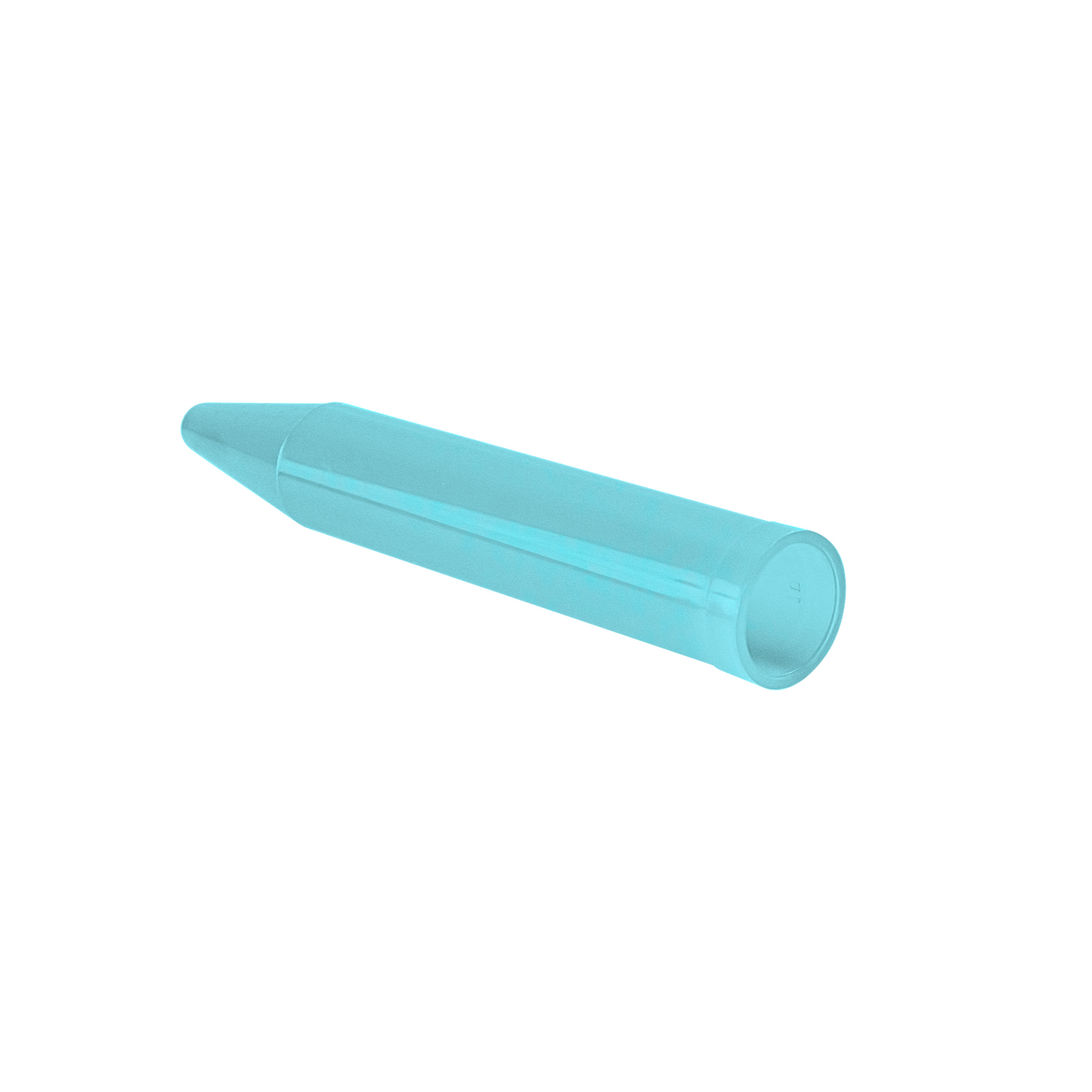

4.5 mL Conical Bottom Test Tubes, 12 × 75 mm — Polystyrene, Blue, 250/Bag
These 4.5 mL polypropylene conical bottom test tubes measure 12 × 75 mm and are manufactured from optically clear polystyrene (PS) in blue for color-coded rack identification across multi-tube clinical workflows. Supplied non-sterile in sealed 250/Bag packaging, part number 214-2023-B10 is designed for clinical hematology, urinalysis sediment analysis, toxicology sample preparation, centrifuge pelleting, and general laboratory use. The conical bottom geometry concentrates sample pellets at the tube tip after centrifugation, enabling complete aspirate recovery with minimal pellet disturbance.
Technical Specifications
| Specification | Value |
|---|---|
| Part Number (MPN) | 214-2023-B10 |
| Volume | 4.5 mL |
| Dimensions | 12 × 75 mm |
| Bottom Style | Conical |
| Material | Polystyrene (PS) |
| Color | Blue |
| Sterility | Non-Sterile |
| Pack Size | 250/Bag |
| BPA / Phthalate Free | Yes |
| Country of Origin | USA |
Applications
- Clinical hematology: differential cell counts and conical pellet concentration after centrifugation
- Urinalysis sediment analysis: conical geometry collects sediment at the tube tip for easy resuspension and microscopic examination
- Toxicology sample preparation: clean phase separation in aqueous and dilute-acid matrices
- Centrifuge pelleting of cells, precipitates, or particulates in standard 12 mm tube holders
- Color-coded rack organization in high-throughput clinical labs processing multiple sample pools simultaneously
- General clinical laboratory workflows requiring a standard 12 × 75 mm format
Compatibility
The 12 × 75 mm format seats securely in standard 12 mm clinical centrifuge tube holders and autoanalyzer sample racks designed for this footprint. Lot-to-lot dimensional consistency ensures reliable fit across automated analyzer rack systems throughout the procurement lifecycle. Verify tube dimensions against your specific centrifuge rotor or rack specification before substituting OEM supply.
Chemical Resistance
| Reagent / Condition | Compatibility |
|---|---|
| Water / aqueous buffers | Excellent |
| Dilute acids (HCl, H₂SO₄) | Good |
| Dilute bases (NaOH <1 M) | Good |
| Saline / physiological solutions | Excellent |
| Alcohols (MeOH, EtOH) | Fair — short-term contact only |
| Acetone / ketones | Poor — avoid |
| Strong oxidizers | Poor — avoid |
| Hydrocarbons / aromatic solvents | Poor — avoid |
Quality & Procurement
Made in USA at Caplugs® Evergreen ISO-certified manufacturing facilities using FDA-registered virgin-grade polystyrene resin. These tubes are BPA-free and phthalate-free, with lot-level quality controls ensuring consistent wall thickness, conical geometry, and length tolerance across all 250 tubes per bag. Sealed bag packaging maintains product integrity from warehouse receipt through point-of-use. LabSupplies.com is an authorized Caplugs® Evergreen dealer shipping from USA inventory.
Frequently Asked Questions
Are these tubes sterile?
No — they are supplied non-sterile, which is appropriate for the majority of clinical chemistry, hematology, urinalysis, and toxicology prep workflows where sterility is not required. If your protocol requires sterile tubes, please contact us to discuss options.
Will these tubes fit my centrifuge and autoanalyzer racks?
The 12 × 75 mm format is compatible with standard 12 mm clinical centrifuge tube holders and autoanalyzer sample racks built for this footprint. Always verify the tube dimensions against your specific rotor or rack specification before placing a large procurement order.
Why are the tubes blue, and how does that help in the lab?
The blue color provides immediate visual differentiation when multiple tube types or sample pools are processed simultaneously in high-throughput rack systems, reducing the risk of misidentification without requiring additional labeling steps.
Can polystyrene tubes be autoclaved or used with organic solvents?
No — polystyrene is not autoclavable and is not resistant to acetone, alcohols above short-term contact, aromatic solvents, or strong oxidizers. These tubes are intended for aqueous clinical matrices, dilute acids, and dilute bases. For protocols requiring autoclavability or broad solvent resistance, polypropylene tubes would be the appropriate choice.