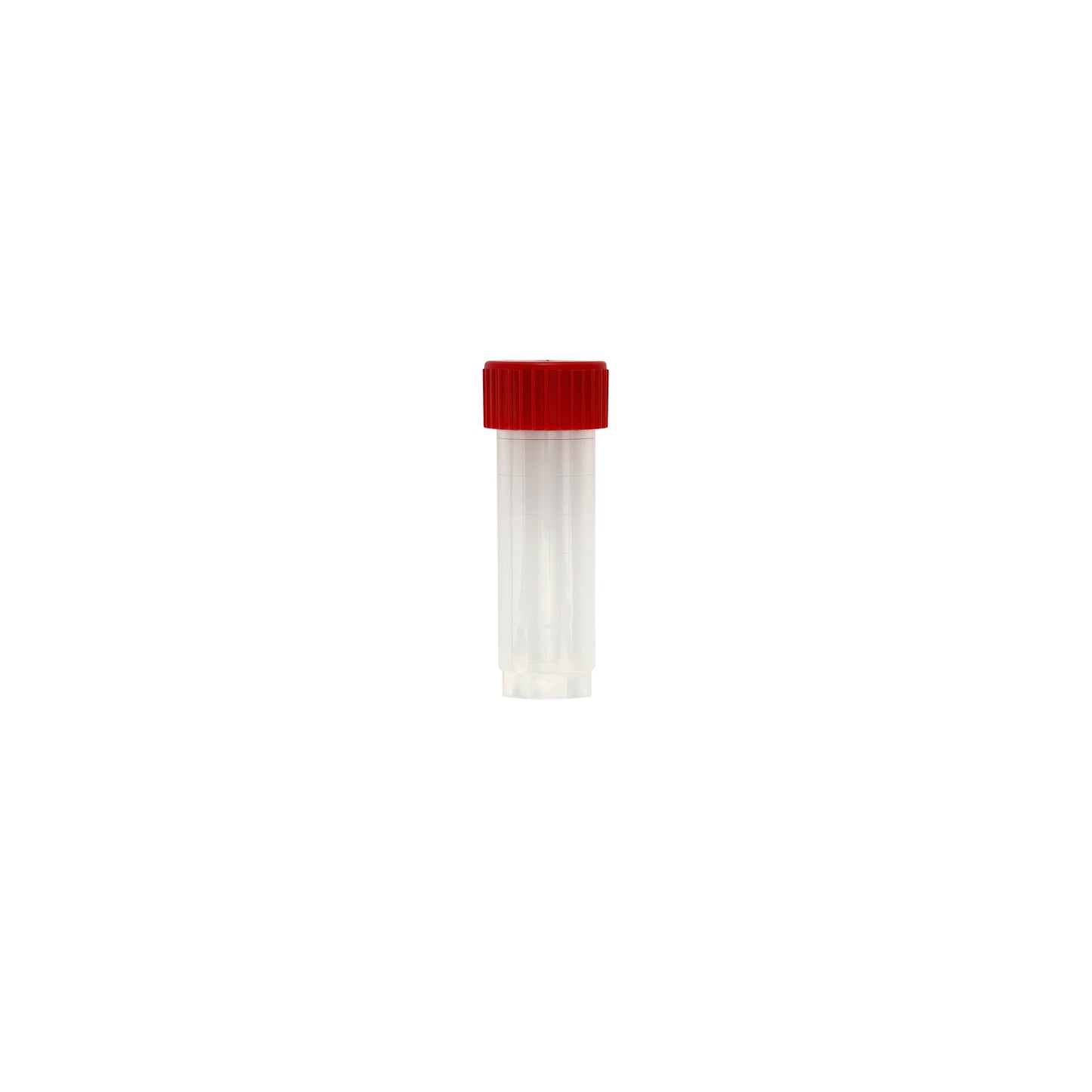

7.0 mL Screw-Cap Transport Vials, Red Cap — Polypropylene, Non-Sterile, 1,000/Bag (240-3007-R60)
These 7.0 mL polypropylene transport vials are precision-molded from virgin PP and paired with a red screw cap following the CLSI H3 color-coding convention for no-additive / clot-activator applications, making them the standard choice for serum specimen collection and clinical chemistry workflows. Supplied as 240-3007-R60, each bag contains 1,000 vials and 1,000 caps unassembled, giving laboratories full flexibility for pre-labeling, barcoding, or pre-printing before capping. The 7.0 mL volume provides sufficient capacity for initial analysis plus archive aliquots without excess sample dead-volume.
Technical Specifications
| Specification | Value |
|---|---|
| Part Number (MPN) | 240-3007-R60 |
| Volume | 7.0 mL |
| Tube Material | Polypropylene (PP) |
| Tube Color | Natural (semi-translucent) |
| Cap Material | Polypropylene (PP) |
| Cap Color | Red |
| Cap Type | Threaded Screw Cap |
| Cap Convention | No additive / clot activator (CLSI H3) |
| Assembly State | Unassembled — 1,000 vials + 1,000 caps per bag |
| Sterility | Non-Sterile |
| Pack Size | 1,000/Bag |
| Temperature Range | −20°C to +121°C |
| BPA / Phthalates | BPA-free; no phthalate plasticizers |
| Country of Origin | USA (California) |
Applications
- Clinical chemistry: Serum, plasma, and urine analyte transport; red cap signals no anticoagulant added, confirming specimen integrity for chemistry panels
- Serology & serum banking: Sufficient 7.0 mL volume accommodates primary analysis and multiple archive aliquots from a single draw
- Blood bank transport: EDTA/ACD whole blood and serum aliquots; cap color follows CLSI H3 color-coding convention for at-a-glance tube identification
- Molecular diagnostics: DNA/RNA transport with EDTA-stabilized samples; 7 mL capacity suits pre-PCR aliquoting and archive protocols
- Toxicology / drug screening: Urine chain-of-custody and serum drug-level specimens; threaded screw cap ensures leak-free transport
- Specimen management systems: Unassembled format supports centralized workflows where vials are pre-printed or barcoded before capping
Chemical Resistance
| Reagent / Condition | Compatibility |
|---|---|
| Aqueous buffers / saline | Excellent |
| Dilute acids and bases | Excellent |
| EDTA, citrate, ACD preservatives | Excellent |
| Ethanol (<70%) | Good — short-term contact |
| Isopropanol | Good — short-term contact |
| Acetone / chloroform / aromatic solvents | Not recommended |
| Autoclave (121°C) | Compatible |
| Freezer storage (−20°C) | Compatible |
Quality & Procurement
Made in USA at Caplugs® Evergreen's California manufacturing facility, these vials are produced from virgin polypropylene resin that is BPA-free and free of phthalate plasticizers, meeting the material standards expected for clinical and research specimen handling. PP's natural semi-translucent finish allows direct visual sample assessment, and the polymer's dimensional stability across a wide temperature range supports both frozen storage and autoclave sterilization workflows.
Frequently Asked Questions
Are these vials sterile?
No — the 240-3007-R60 vials are supplied non-sterile. They are intended for specimen transport and sample storage workflows where sterility is not a requirement; if your protocol requires sterile containers, please contact us for alternatives.
Why does the red cap matter for clinical use?
Red is the CLSI H3 color-coding convention for no-additive / clot-activator tubes, indicating that no anticoagulant is present and the specimen is intended as serum for chemistry panels, serology, or blood bank applications. The color allows staff to identify tube type at a glance without reading a label, reducing pre-analytical errors.
Why are the vials and caps shipped unassembled?
The unassembled format gives laboratories the flexibility to pre-print, barcode, or label vials before capping — the preferred workflow for centralized specimen management systems and high-volume collection programs. Vials and caps are simply pressed or threaded together at the point of use.
Can these vials be autoclaved or frozen?
Yes. Virgin polypropylene maintains dimensional stability from −20°C through +121°C, making these vials compatible with standard autoclave cycles and freezer storage. Avoid exposing them to chlorinated or aromatic solvents, which are not compatible with PP.