


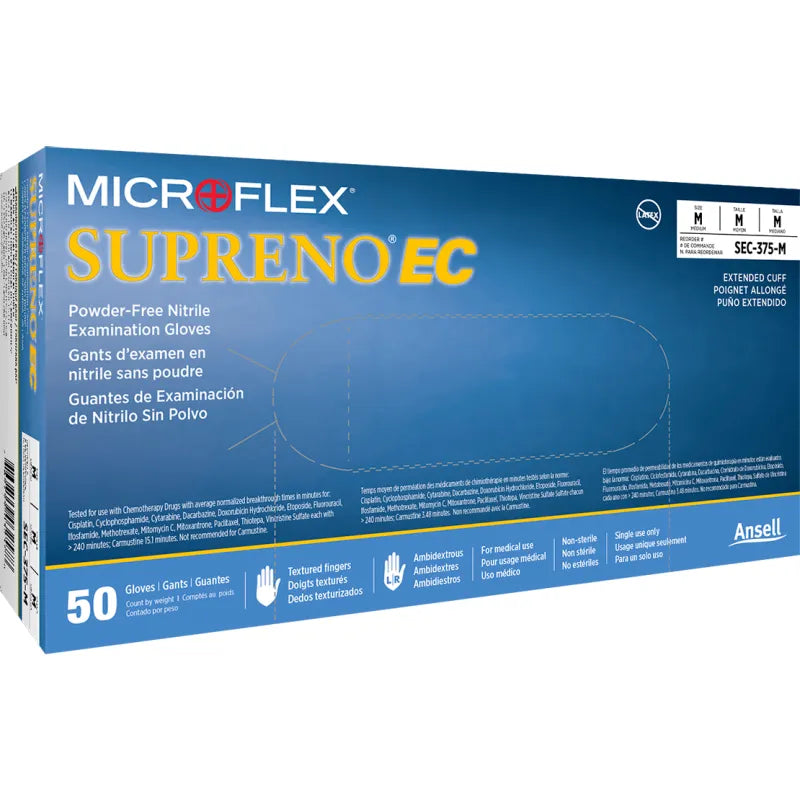
MICROFLEX® Supreno® EC SEC-375 Features
Engineered for chemotherapy drug handling, emergency medical response, and high-risk clinical environments where standard exam gloves are inadequate, the Ansell MICROFLEX Supreno EC SEC-375 is a high-barrier nitrile gloves with AQL 0.65, an 11.6-inch extended cuff, 8.7 mil finger thickness, and certifications covering chemotherapy drugs, fentanyl, gastric acid, and NFPA 1999 Emergency Medical Glove Requirements. At AQL 0.65, the SEC-375 is inspected to more than twice the barrier stringency of standard 1.5 AQL exam gloves. Fifty gloves per box in violet blue.
For first responders and EMS professionals at overdose incidents, SEC-375 testing against fentanyl and gastric acid documents barrier protection against specific overdose response materials. NFPA 1999 certification covers the emergency medical glove standard required by many agency PPE programs. Textured fingertips provide secure grip on instruments and IV lines. Polymer interior coating supports rapid donning when response time matters. Available in Small through 2X-Large at LabSupplies.com.
Technical Specifications
| Specification | Detail |
|---|---|
| Manufacturer | Ansell |
| Product Line | MICROFLEX® Supreno® EC |
| Part Number | SEC-375 |
| Material | Nitrile — latex-free |
| Color | Violet blue |
| Palm Thickness | 5.5 mil |
| Finger Thickness | 8.7 mil |
| Length | 11.6" / 295mm — extended cuff |
| Texture | Textured fingertips |
| Cuff | Extended — wrist and forearm coverage |
| Powder | Powder-free |
| Interior | Polymer coating for easy donning and doffing |
| Count | 50 gloves per box |
| AQL | 0.65 — more than twice the barrier stringency of standard 1.5 AQL |
| Chemotherapy | Tested per ASTM D6978 (see product packaging for drug list) |
| Overdose Response | Tested against fentanyl and gastric acid |
| NFPA Certification | NFPA 1999 — Emergency Medical Glove Requirements |
| Medical Grade | FDA exam grade |
| Latex | Latex-free nitrile construction |
Applications
To provide high-barrier extended-cuff protection in demanding clinical and emergency environments, the SEC-375 is used by oncology nurses during chemotherapy drug preparation and administration, pharmacy staff compounding hazardous drugs, EMTs and paramedics during trauma and overdose response, first responders encountering fentanyl at incident scenes, and clinical laboratory personnel handling bloodborne pathogens — and any facility whose PPE program mandates sub-1.0 AQL documentation.
SEC-375 vs. MICROFLEX® Cobalt N19
| Feature | Supreno EC SEC-375 | Cobalt N19 |
|---|---|---|
| AQL | 0.65 — high barrier stringency | 1.5 — standard |
| Cuff Length | 11.6" extended — wrist + forearm | 9.5" standard |
| Finger Thickness | 8.7 mil | Not separately spec'd |
| Palm Thickness | 5.5 mil | 3.9 mil |
| NFPA 1999 | Certified | Not listed |
| Chemo Tested | Yes — ASTM D6978 | Yes |
| Fentanyl Tested | Yes | Not listed |
| Texture | Fingertip textured | Fully textured |
| Count Per Box | 50 | 100 |
| Price | $14.99 / 50 pack | $12.00 / 100 pack |
Academic and Institutional Pricing
LabSupplies.com offers tiered quantity pricing for academic and research institutions. As an authorized dealer, we ship directly from USA inventory.
Frequently Asked Questions
What does AQL 0.65 mean and why does it matter for high-risk gloves?
AQL (Acceptable Quality Level) is the maximum allowable percentage of defective gloves in a batch under statistical sampling inspection. Standard nitrile exam gloves carry AQL 1.5 — up to 1.5% of gloves may have pinhole defects before the lot fails. SEC-375 carries AQL 0.65, with defect tolerance less than half the standard level. Handling chemotherapy drugs, fentanyl, and bloodborne pathogens where a pinhole represents a direct exposure pathway makes the lower AQL a documented assurance that each glove has met a significantly more rigorous threshold.
What is NFPA 1999 and why does it appear on the SEC-375 specification?
NFPA 1999 is the National Fire Protection Association Standard on Protective Clothing for Emergency Medical Operations, establishing minimum performance requirements for emergency medical gloves including bloodborne pathogen resistance, tear and puncture resistance, and barrier integrity under simulated emergency conditions. A glove meeting NFPA 1999 has been tested to the standards that EMTs, paramedics, and first responders require during patient contact in uncontrolled environments. Many agency PPE programs specify NFPA 1999 compliance, making the SEC-375 certification a procurement requirement match.
Why does the SEC-375 have an extended cuff compared to standard exam gloves?
Standard nitrile exam gloves measure approximately 9.5 inches from fingertip to cuff, placing the edge at the wrist on most adults. During IV line management, wound care, chemotherapy drug preparation, and emergency trauma response, chemical splash or pathogen exposure can reach the wrist and lower forearm between the glove and sleeve cuff. SEC-375's 11.6-inch extended cuff covers approximately 2 inches more of the wrist and forearm, closing the exposure gap during reaching, lifting, or direct patient contact.
What fentanyl and overdose response testing has the SEC-375 undergone?
Ansell tests the SEC-375 against fentanyl and gastric acid for overdose response suitability. First responders encounter fentanyl at overdose incident scenes, with documented responder exposure cases through inadequate glove barrier protection. Standard exam gloves are not tested against fentanyl permeation. SEC-375's overdose testing provides documented barrier evidence for agencies and protocols requiring fentanyl-tested PPE for overdose response assignments.
Ansell High-Barrier Exam Glove Family
Within the Ansell MICROFLEX catalog at LabSupplies.com, the SEC-375 is the high-barrier specification for chemotherapy, EMS, and high-risk clinical applications. Cobalt N19 (100/box, 3.9 mil, AQL 1.5) covers everyday clinical, lab, and food use at lower per-glove cost. MidKnight MK-296 (100/box, 4.7 mil, black, silicone-free) serves automotive and industrial roles.