


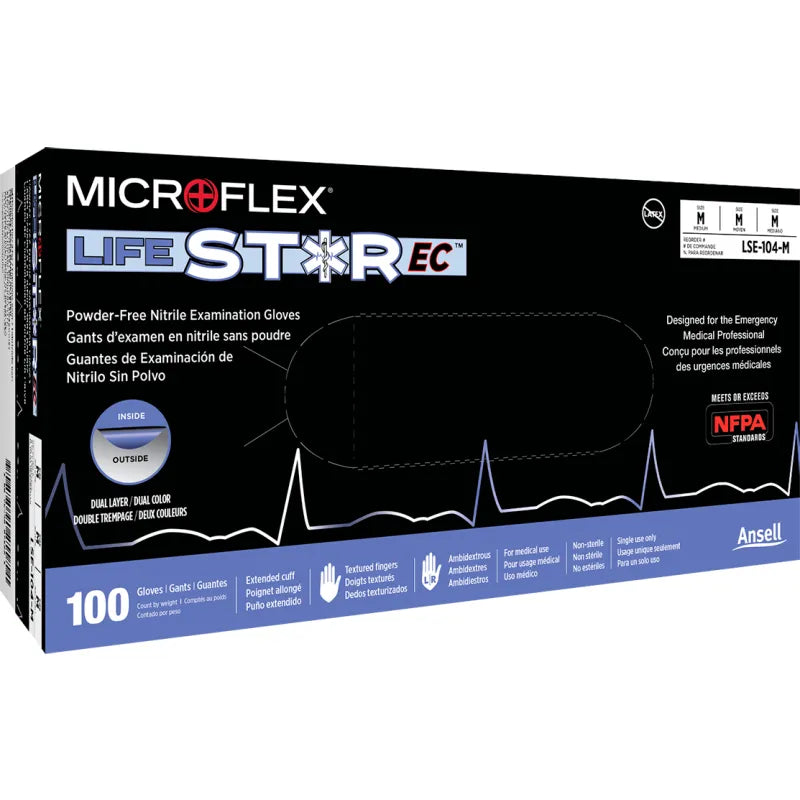
MICROFLEX® LifeStar EC™ LSE-104 Features
Engineered for EMS, first responder, and high-risk clinical applications requiring dual-layer protection with real-time breach detection, the Ansell MICROFLEX LifeStar EC LSE-104 is a dual-layer, dual-color nitrile gloves. White exterior over blue interior means a torn or punctured outer layer becomes immediately visible, alerting the wearer without removing the glove. AQL 0.65, NFPA 1999, fentanyl resistance greater than 240 minutes, and accelerator-free construction separate it from every single-layer alternative in this catalog. One hundred gloves per box.
Accelerator-free nitrile eliminates the residual compounds responsible for Type IV contact allergy in healthcare workers. Combined with latex-free construction, the LSE-104 addresses both Type I latex and Type IV accelerator allergy risks. Textured, non-stick, non-foaming fingertips maintain secure grip on instruments, IV lines, bandages, and medical tape in wet conditions. Available in Small through XX-Large at LabSupplies.com.
Technical Specifications
| Specification | Detail |
|---|---|
| Manufacturer | Ansell |
| Product Line | MICROFLEX® LifeStar EC™ |
| Part Number | LSE-104 |
| Material | Nitrile — latex-free, accelerator-free |
| Construction | Dual-layer |
| Color | White exterior / Blue interior (breach detection) |
| Palm Thickness | 5.5 mil (combined dual layers) |
| Finger Thickness | 8.7 mil |
| Cuff | Extended |
| Texture | Textured fingertips — non-stick, non-foaming |
| Powder | Powder-free |
| Count | 100 gloves per box |
| AQL | 0.65 |
| NFPA Certification | NFPA 1999 — Emergency Medical Glove Requirements |
| Chemotherapy | Tested per ASTM D6978 |
| Fentanyl | Tested >240 minutes (DEA-compliant laboratory) |
| Gastric Acid | Tested (overdose response) |
| Allergy Prevention | Accelerator-free — reduces Type IV chemical allergy risk |
| Medical Grade | FDA exam grade |
| Latex | Latex-free nitrile |
Applications
To provide dual-barrier, breach-detectable hand protection in highest-risk environments, the LSE-104 is deployed by EMS personnel and paramedics at trauma and overdose calls, emergency department nurses during high-exposure procedures, oncology and pharmacy staff compounding hazardous drugs, law enforcement officers at fentanyl exposure scenes, and healthcare workers with documented Type IV accelerator allergy for whom standard nitrile causes contact dermatitis.
LifeStar EC LSE-104 vs. Supreno EC SEC-375
| Feature | LifeStar EC LSE-104 | Supreno EC SEC-375 |
|---|---|---|
| Construction | Dual-layer white + blue | Single-layer violet blue |
| Breach Detection | Blue interior visible when outer layer fails | None |
| Allergy Prevention | Accelerator-free — Type IV protection | Not listed as accelerator-free |
| Fentanyl Testing | >240 minutes (DEA lab) | Yes (duration not published) |
| Count Per Box | 100 | 50 |
| Palm Thickness | 5.5 mil (dual layer) | 5.5 mil |
| Finger Thickness | 8.7 mil | 8.7 mil |
| AQL | 0.65 | 0.65 |
| NFPA 1999 | Certified | Certified |
| Price | $39 / 100 pack | $14.99 / 50 pack |
Academic and Institutional Pricing
LabSupplies.com offers tiered quantity pricing for academic and research institutions. As an authorized dealer, we ship directly from USA inventory.
Frequently Asked Questions
What does the dual-layer, dual-color design on the LifeStar EC provide that single-layer gloves cannot?
Dual layers provide double barrier protection against penetration by bloodborne pathogens, chemicals, and hazardous drugs. The critical advantage of the dual-color design — white exterior, blue interior — is breach detection: when the outer white layer is torn or punctured, the blue inner layer becomes visible at the damage site, alerting the wearer in real time. Single-layer gloves can be damaged without any visible indication, leaving the wearer unaware of a compromised barrier.
Why does accelerator-free construction matter for EMS and clinical glove selection?
Most nitrile gloves use chemical accelerators — thiurams, carbamates, mercaptobenzothiazoles — during manufacturing. Residual accelerators in the finished glove cause Type IV contact allergy reactions: delayed-onset dermatitis developing 24 to 72 hours after contact. Accelerator-free construction eliminates these compounds, providing allergy risk reduction beyond the latex-free protection all nitrile gloves share. Healthcare facilities with high glove usage increasingly specify accelerator-free gloves for clinical staff.
What does the fentanyl testing for more than 240 minutes on the LSE-104 mean?
Ansell commissioned a DEA-compliant laboratory to test LifeStar EC against fentanyl and gastric acid under simulated overdose response conditions. Greater than 240 minutes of resistance means the dual-layer barrier maintained protection against fentanyl permeation for at least four hours — covering the duration of a typical emergency response call. NIOSH has identified emergency responders as at-risk for fentanyl exposure, and the specific duration from DEA-compliant testing provides evidence for agencies requiring fentanyl protection documentation.
When should the LifeStar EC LSE-104 be chosen over the Supreno EC SEC-375?
Choose LifeStar EC when dual-layer breach detection is required, when staff have Type IV accelerator allergy risk, when fentanyl protection with specific duration documentation is needed, or when 100/box count at AQL 0.65 is preferred over the 50/box Supreno EC SEC-375. Choose the SEC-375 when single-layer extended cuff protection satisfies the protocol, violet blue color is preferred, or the lower per-box price is the priority. Both carry AQL 0.65, NFPA 1999, and extended cuff design.
Ansell High-Risk EMS Glove Family
Within the Ansell MICROFLEX high-risk catalog at LabSupplies.com, the LifeStar EC LSE-104 is the dual-layer breach-detection specification. Single-layer coverage at AQL 0.65 and NFPA 1999 is available through the Supreno EC SEC-375 (violet blue, 50/box) at lower per-box cost. Multipurpose clinical and laboratory use is covered by the Cobalt N19 (blue, 3.9 mil, 100/box, FDA 510(k)) at standard AQL 1.5.