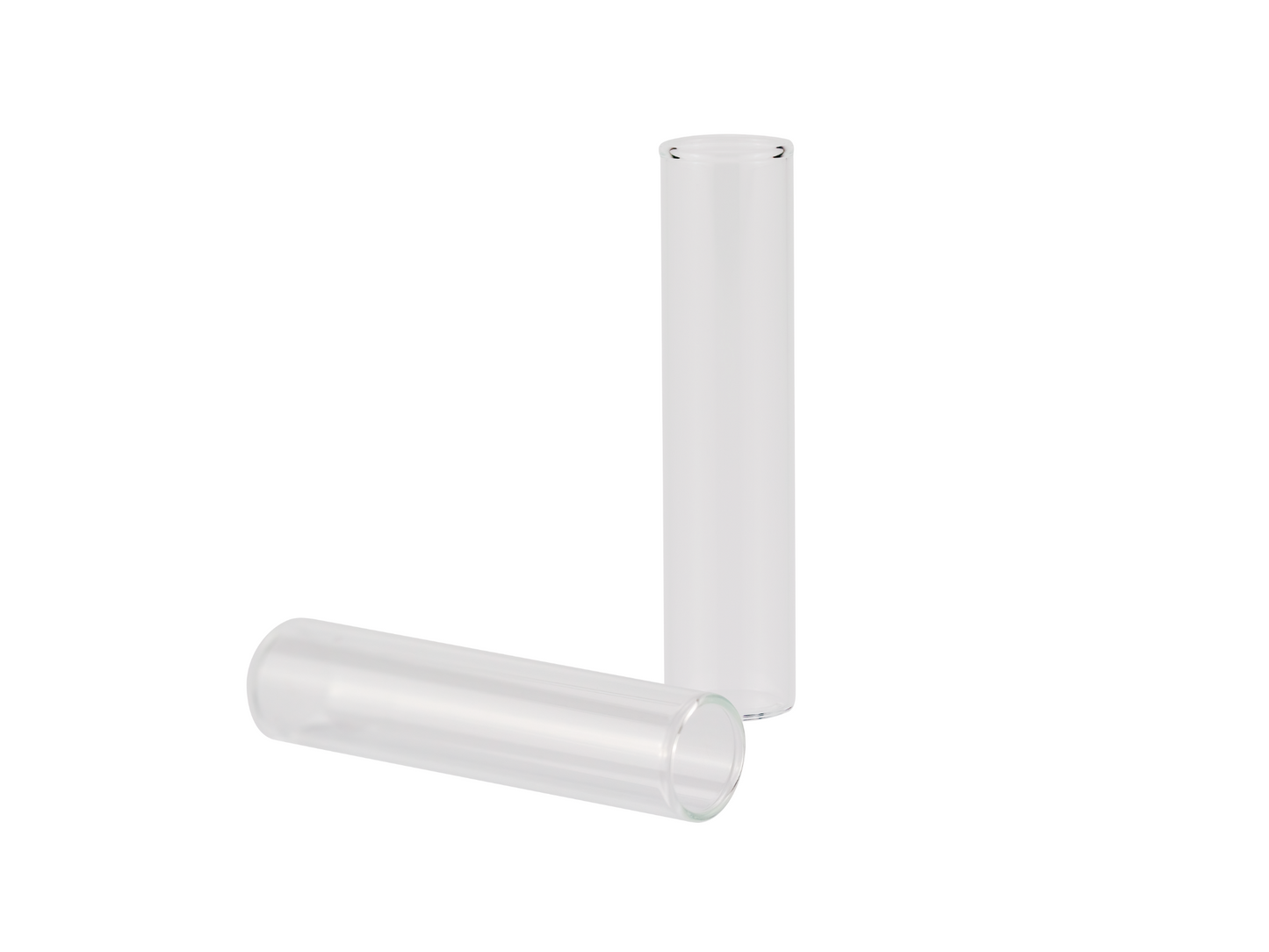

3.4 mL Round Borosilicate Glass Cuvettes — Abbott® TDx & TDxFLx Compatible, 200/Box
These 3.4 mL round borosilicate glass cuvettes are precision-dimensioned for the Abbott® TDx fluorescence polarization immunoassay (FPIA) analyzer and its TDxFLx successor, supplied non-sterile in a 200/Box format that matches standard TDx rack-loading. Manufactured in a U.S. facility to tight outer-diameter and wall-thickness tolerances, each lot is coded. As OEM TDx consumable supply becomes increasingly constrained, part number 201-3179-000 offers a dimensionally consistent, borosilicate-correct replacement for labs that cannot afford assay drift.
Technical Specifications
| Specification | Value |
|---|---|
| Part Number (MPN) | 201-3179-000 |
| Capacity | 3.4 mL |
| Geometry | Round (TDx optical-path format) |
| Material | Borosilicate Glass |
| Color | Natural |
| Sterility | Non-Sterile |
| Pack Size | 200/Box |
| Country of Origin | USA |
Applications
- Therapeutic drug monitoring (TDM) on the Abbott® TDx and TDxFLx platforms — cyclosporine, tacrolimus, aminoglycosides, vancomycin, anticonvulsants, and digoxin assays
- Fluorescence polarization immunoassay (FPIA) measurements where negligible autofluorescence and a precisely defined optical path are required
- Clinical immunoassay laboratories maintaining active TDx or TDxFLx instruments as primary or backup analyzers
- Research applications using homogeneous FPIA systems where borosilicate optical clarity is specified — verify optical path dimensions prior to use
Compatibility
These cuvettes are dimensioned as a direct OEM-replacement format for the Abbott® TDx analyzer across all generations, and the TDxFLx platform shares the same cuvette geometry, making them a confirmed fit for both instruments. The round-profile borosilicate body presents the correct optical path to the polarized excitation beam and emission detector required for FPIA measurements; substituting plastic or incorrectly dimensioned cuvettes introduces fluorescent background and path-length error that elevates assay CVs and can compromise reportable results. Laboratories operating either TDx or TDxFLx platforms should confirm rack compatibility with their specific instrument configuration when transitioning from OEM supply.
Chemical Resistance
| Reagent / Sample Type | Compatibility |
|---|---|
| Saline and aqueous buffers | Excellent |
| TDx aqueous/alcohol-based reagent matrix | Excellent |
| Dilute acids and bases (clinical concentrations) | Excellent |
| Serum and plasma | Excellent |
| Concentrated hydrofluoric acid | Not recommended — attacks borosilicate glass |
| Strong concentrated alkalis | Limited — minimize prolonged contact |
Quality & Procurement
Made in USA, these Caplugs® Evergreen cuvettes are produced to tight dimensional tolerances under rigorous quality controls. Borosilicate glass construction eliminates the leachable and extractable risk associated with plastic alternatives — even trace resin additives can produce fluorescent background that compromises FPIA assay performance. The material contains no BPA or phthalates. Given tightening OEM supply for Abbott TDx consumables, clinical laboratories actively running TDM panels are encouraged to maintain a minimum six-month inventory buffer.
Frequently Asked Questions
Why must these cuvettes be borosilicate glass rather than plastic?
The Abbott® TDx measures fluorescence polarization, which requires negligible background fluorescence from the cuvette itself. Even trace concentrations of plastic resin additives (stabilizers, processing aids) produce autofluorescence that elevates assay CVs and can shift results outside acceptable ranges. Borosilicate glass is optically transparent at TDx excitation and emission wavelengths and is chemically inert to the aqueous/alcohol TDx reagent matrix, making it the only suitable cuvette material for this platform.
Are these cuvettes compatible with the TDxFLx as well as the original TDx?
Yes — the TDxFLx shares the same cuvette geometry as the original TDx, so these cuvettes are a confirmed fit for both instrument generations. If your laboratory operates other FPIA research systems, verify optical path dimensions against your instrument's specifications before use.
Are these cuvettes sterile, and do they require any pre-treatment before loading?
These cuvettes are supplied non-sterile, consistent with standard practice for clinical chemistry cuvettes used in closed-system analyzers. No additional pre-treatment is required for routine TDx or TDxFLx operation; follow your laboratory's standard instrument preparation and quality control procedures.
How should we manage inventory given constrained OEM TDx consumable supply?
Because Abbott® TDx OEM consumable availability has become increasingly limited, laboratories actively running therapeutic drug monitoring panels are advised to maintain at least a six-month buffer stock.